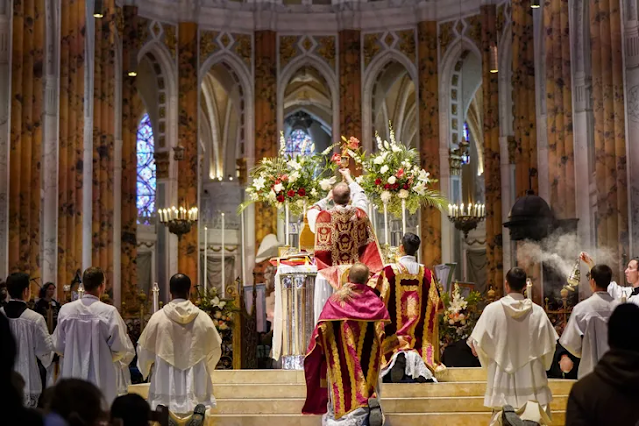
In the Diocesan Parish Church of All Souls, in Sanford (Orlando Diocese, Florida), by Bp. Tissier de Mallerais. The local diocese gave permission to the use of the parish church.
Update - Full video below:
In the Diocesan Parish Church of All Souls, in Sanford (Orlando Diocese, Florida), by Bp. Tissier de Mallerais. The local diocese gave permission to the use of the parish church.
Update - Full video below:

Chopin’s conversion
October 13th 1849
The Feast of St. Edward the
Confessor

Portrait of Frydeyrk Chopin
by
Eugène Delacroix.
They did it again: gorgeous images printed on neigh quality paper, and all the basic information a Traditional Catholic may need for each day of the year.

This year, the Angelus Press 2024 Calendar (starting in October 2023) is illustrated with gorgeous Stations of the Cross painted by Martin Feuerstein for the Church of Saint Ann, in Munich. A devout Catholic, Feuerstein was one of the greatest representatives of the Nazarene Movement, and his work at Saint Ann's is also filled with some of the brightest aspects of the then-burgeoning Beuronese style.
The Calendar has all the dates a Traditional Catholic may need, and, as usual, Angelus Press took great care with the printing itself, which is gorgeous. Available here.
***
Many of us still use and need daily a physical reminder for our activities -- online-based calendars can be both not very trustworthy, and not appropriate to be used at all times.
We highly recommend these two additionalAngelus Press's 2024 seasonal items:
Next week I'll be visiting the lovely state of Virginia for two events that are free and open to the public:


Recently a priest in New Zealand offered a NOM where he completely ad-libbed the Eucharistic Prayer at the funeral Mass for a religious Sister of Mercy. This happened in the Palmerston North diocese, which, in a moment of supreme irony, recently had its only diocesan TLM (apart from the SSPX) suppressed by the modernist Cardinal John Dew and retired bishop Peter Cullinane. The Roman Rite was canceled, and in its place, the "unique..." something or other is allowed to express itself.

By Paix Liturgique
October 4, 2023
Although we haven't published a review of traditional liturgy in France and around the world since 2019... we felt it necessary to return to the question of the number of Catholic faithful who wish to live their faith to the rhythm of traditional liturgy. We asked Christian Marquant, who has been interested in this subject for many years, to return to this theme which, as we shall see, remains a burning issue.
***
Louis Renaudin - Dear Christian, why is it important to ask the question of the size and therefore the number of the Catholic faithful who are attached to the traditional Roman liturgy?
Christian Marquant - In theory, it doesn't matter... no one, apart from learned researchers, is going to be interested in the number of Syro-Malabar or Syro-Malankar faithful... nor in the number of priests and faithful who still participate in the Ambrosian (reformed) rite in Milan, or the Mozarabic (cobbled-together) rite in Toledo and Salamanca, because in all these cases there is no controversy or underlying problem. However, when we consider the number, and therefore implicitly the importance, of those who wish to remain attached to the usus antiquior, i.e., to the Mass that has been the Mass of all Latin Christendom for over 1,000 years, we immediately find ourselves in a polemical field whose stakes are quite considerable for a large number of pastors and for members of the "modern" lobby. We are touching on the great division that has afflicted the Church since Vatican II, and to which the Holy Father indirectly alluded at the last consistory in his appeal for unity. A pathetic appeal to an almost empty St. Peter's Square...
Louis Renaudin - What division are you referring to?
The following letter was sent by His Eminence Cardinal Zen, Emeritus of Hong Kong, to Cardinals and Bishops all over the world. A recipient was kind enough to share this historic document with us.
(Click on each image of the six pages for larger view.)


On Oct. 4, the solemnity of St. Francis of Assisi, the 16th Ordinary Assembly of the Synod of Bishops on "synodality" opened. Many opposing statements and controversies have preceded and are accompanying the event. On October 2, in the face of "various statements by some senior prelates (... ) blatantly contrary to the constant doctrine and discipline of the Church, and which have generated and continue to generate among the faithful and other people of good will great confusion and the fall into error," five cardinals made it known that they had expressed their "deepest concern to the Roman Pontiff." submitting to Pope Francis five dubia on certain issues concerning the interpretation of Divine Revelation, the blessing of same-sex unions, synodality as a constitutive dimension of the Church, the priestly ordination of women and repentance as a necessary condition for sacramental absolution.

For all flesh is as grass, and all the glory of man as the flower of grass. The grass withereth, and the flower thereof falleth away: but the word of the Lord endureth for ever. And this is the word which by the gospel is preached unto you.
Saint Peter
1 Peter 1:24-25
***
Let us flee earthly desires, and let none of the things of this world be able to seduce us, who have a Father in heaven. Let us consider that the one who has risen to the all-peaceful sky will be terrible when he returns, and that all that he commanded us with gentleness, he will then exact with rigor. Let us, therefore, take great care of the time allotted to us to do penance; take care of our souls as long as it is possible. For our Redeemer will come back to judge us all the more severely because he will have been more patient before the judgment. So be careful of these things, my brethren, and reproach them with all sincerity. Although your soul is still tossed by the swirl of business, yet cast anchor of your hope in the eternal homeland.
St. Gregory the Great
In light of the recent dubia of five Cardinals to Pope Francis and the latter's unwillingness to provide clear responses in accord with the Catholic Faith, the organizers of the Missae Pro Missa campaign issue the following statement calling upon all Catholic faithful throughout the world to respond to the dubia as a testament to the Church's constant and unchangeable teaching.
Whereas, five Cardinals of the Catholic Church submitted dubia to Pope Francis asking for clarification of Catholic doctrine on matters of critical importance for the salvation of souls, especially in light of confusion surrounding the "Synod on Synodality."
Whereas, Pope Francis' initial response did not resolve the doubts raised but "if anything, deepened them," hence requiring the Cardinals to issue reformulated dubia requesting simple, yes/no answers "to elicit a clear response based on the perennial doctrine and discipline of the Church" (Aug. 21, 2023 letter of the Cardinals to Pope Francis).
Whereas, Pope Francis has not, to date, responded to the Cardinals' reformulated dubia, thus enabling confusion and error to spread, to the harm of souls.
We, simple Catholic faithful, wishing to testify to the truth of the Catholic Faith regardless of the Supreme Pontiff's willingness to do so, hereby provide the correct responses to the dubia in light of the Church's constant and unchangeable teaching.
We furthermore pledge our prayers and sacrifices, in the form of a spiritual bouquet, for the good of the Church and triumph of the Catholic Faith over the darkness of the present age, praying especially for the day when Peter will cease to be a scandal unto Christ because he "savourest not the things that are of God, but the things that are of men" (Matt. 16:23) but rather fulfill the divine command: "being once converted, confirm thy brethren" (Luke 22:32).
To respond to the dubia, please visit: https://www.missaepromissa.com/dubia

The month of October, besides being the month of the Rosary is traditionally dedicated to the Angels. Today we hear a lot about angels, but from a perspective that is not that of the Church.
There is a false devotion to the Angels, which consists in imagining them as mythological creatures attributing to them almost magical potentialities to fulfill our desires, appease our feelings, regardless of the observance of God's universal law, that is, respect for the objective order of creation.
Notification to Christ’s Faithful (can. 212 § 3)
Regarding Dubia Submitted to
Pope Francis
Brothers and Sisters in Christ,
We, members of the Sacred College of Cardinals, in accord with the duty of all the faithful “to manifest to the sacred pastors their opinion on matters which pertain to the good of the Church” (can. 212 § 3) and, above all, in accord with the responsibility of Cardinals “to assist the Roman Pontiff … individually … especially in the daily care of the universal Church” (can. 349), in view of various declarations of highly-placed Prelates, pertaining to the celebration of the next Synod of Bishops, that are openly contrary to the constant doctrine and discipline of the Church, and that have generated and continue to generate great confusion and the falling into error among the faithful and other persons of good will, have manifested our deepest concern to the Roman Pontiff. By our letter of July 10, 2023, employing the proven practice of the submission of dubia [questions] to a superior to provide the superior the occasion to make clear, by his responsa [responses], the doctrine and discipline of the Church, we have submitted five dubia to Pope Francis, a copy of which is attached. By his letter of July 11, 2023, Pope Francis responded to our letter.
Having studied his letter which did not follow the practice of responsa ad dubia [responses to questions], we reformulated the dubia to elicit a clear response based on the perennial doctrine and discipline of the Church. By our letter of August 21, 2023, we submitted the reformulated dubia, a copy of which is attached, to the Roman Pontiff. Up to the present, we have not received a response to the reformulated dubia.
Given the gravity of the matter of the dubia, especially in view of the imminent session of the Synod of Bishops, we judge it our duty to inform you, the faithful (can. 212 § 3), so that you may not be subject to confusion, error, and discouragement but rather may pray for the universal Church and, in particular, the Roman Pontiff, that the Gospel may be taught ever more clearly and followed ever more faithfully.
Yours in Christ,
Walter Cardinal Brandmüller
Raymond Leo Cardinal Burke
Juan Cardinal Sandoval Íñiguez
Robert Cardinal Sarah
Joseph Cardinal Zen Ze-kiun
Rome, 2 October 2023


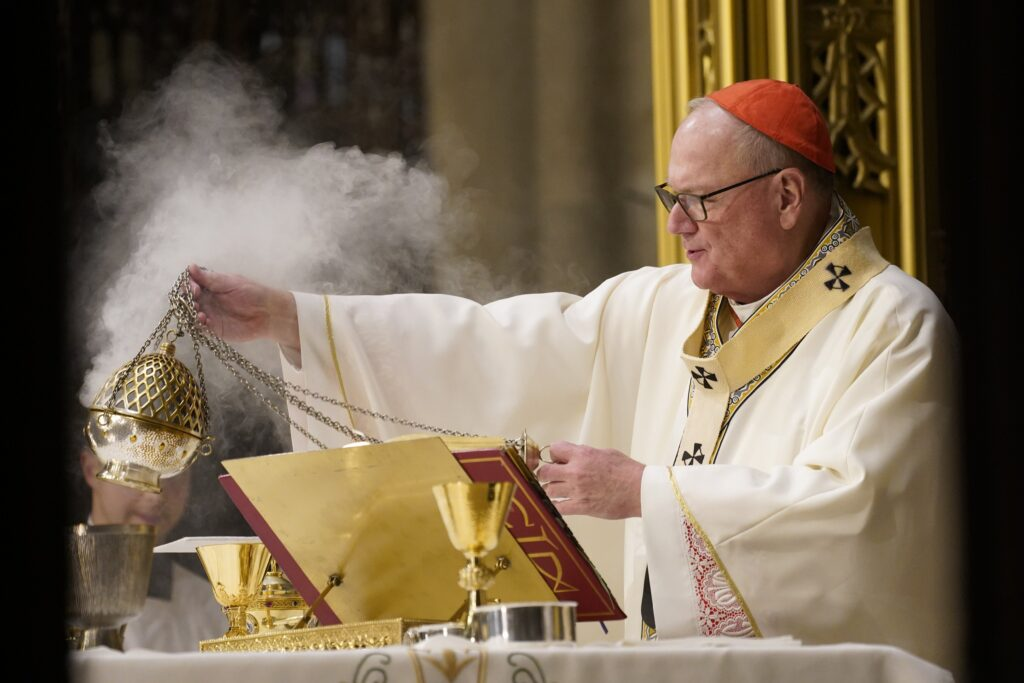
Cardinal Timothy Dolan of New York recently published an article about why Catholics are not coming to Sunday Mass any more. The top reason: Mass is too long. He also notes that the "Liturgy of the Word"— readings from scripture— now overshadows the "Liturgy of the Eucharist," leading the Eucharist to become an "afterthought."
 |
| LMS Annual Requiem 2018, celebrated by the retired Bishop Patrick Campbell, in Westminster Cathedral. |
28th September 2023
The Latin Mass Society has been informed that the Annual Requiem (sung, 1962 Missal) scheduled to take place at Westminster Cathedral on Saturday 4th November at 2:30pm will not take place.
Pope Francis, Giorgio Napolitano, and Matteo Messina Denaro

The great Juan Donoso Cortés (1809-1853) said that behind every political problem there is a theological and metaphysical problem. Sometimes, however, behind a theological problem there is a political problem that explains it. This is what must be kept in mind in order to predict what will happen in the next Synod: a religious assembly, desired and organized by a pope for whom politics prevails over theological and moral doctrine. Some episodes that have happened in recent days help us understand this.
On September 22, 2023, Giorgio Napolitano, a leading figure in Italian political life for many decades, died at the age of 98. In his long life Napolitano combined an iron Communist militancy, which in 1956 led him to approve of the Soviet invasion of Hungary, with an equally iron loyalty to the Masonic fraternity to which he belonged, following in the footsteps of his father Giovanni (1883-1895), a leading figure in the Grand Lodge of Italy. On May 10, 2006, after Napolitano's election to the presidency of the Republic, lawyer Gustavo Raffi, Grand Master of the Grand Lodge, pointed to this choice as "one of the highest moments in the democratic life of the country," and on the day of the ex-president's death the Grand Lodge displayed flags at half-mast at its national headquarters on the Janiculum Hill as a sign of condolence.
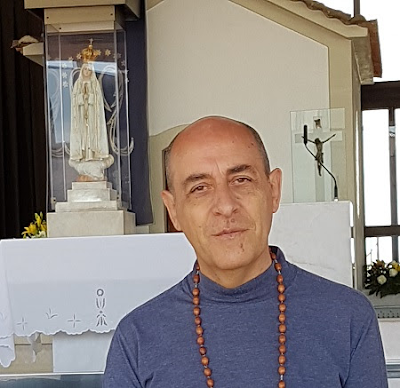

"The Pope, immigration and the Catholic Church before the Nations"
 |
| Pierre Manent's latest publication |

The two major disasters that have struck North Africa in recent days-first the earthquake in Morocco and then, the hurricane with the collapse of two dams in Libya-have caused thousands of casualties, mourning and devastation of all kinds. On Western TV and Internet channels, scenes of grief alternated with the voices of experts: meteorologists, geologists, climatologists. Never, however, was the name of God heard. God has been the great absentee from this dramatic horizon, as if to mention him, to juxtapose his name with these misfortunes, were blasphemy. God, for the dominant culture in the West does not exist, or if, he exists he is disinterested in the world. Yet, if God is the creator of the universe, the root cause of all that exists, nothing can escape his rule. God is not disinterested in his creatures. This interest of God in creation, this government of creatures that gives order to the universe is what we properly call Divine Providence. God, lovingly and powerfully provides for every sphere of creation, down to the smallest details. The Gospel says so when it states that all the hairs of our heads are numbered (Lk. 12:1-7).
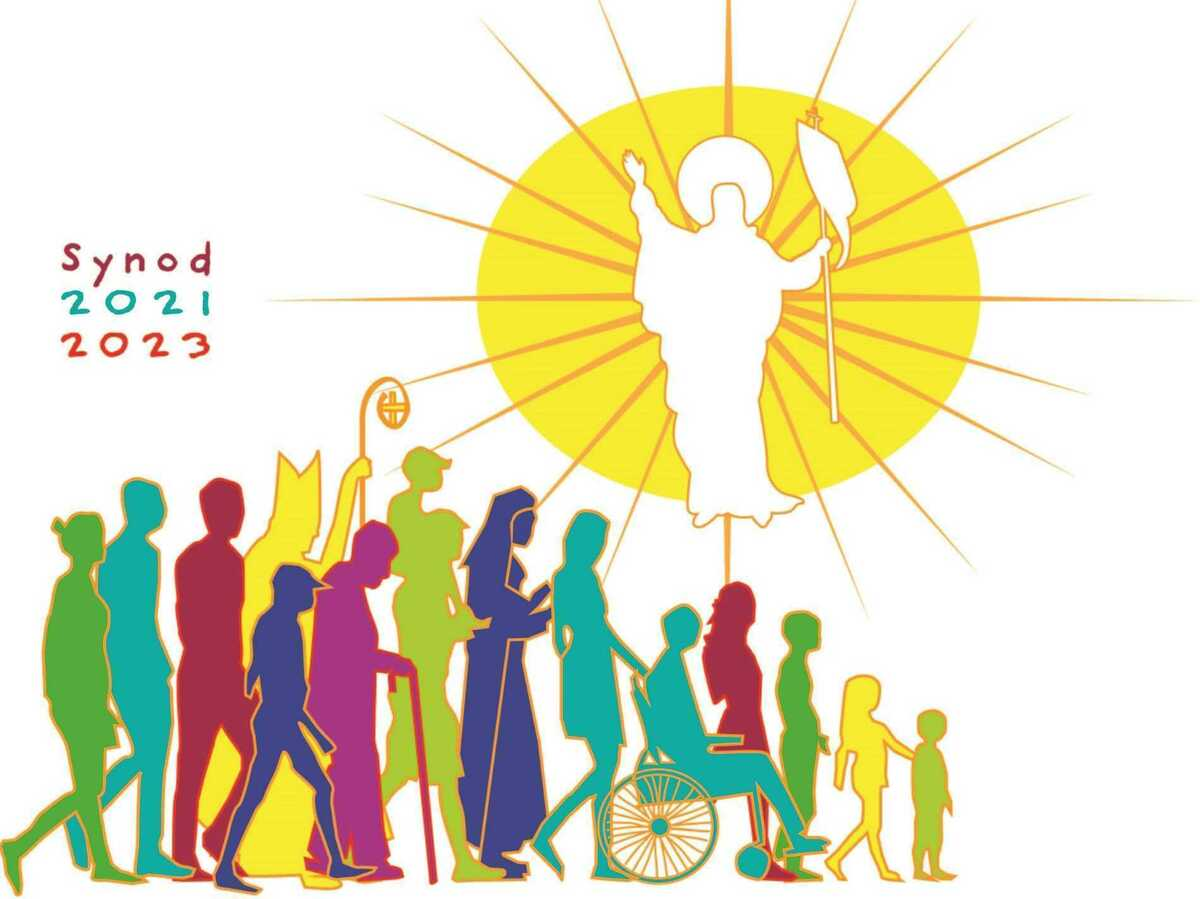
Synod is the exact translation of the Greek noun synodos. It is interesting to collect the elements from which the word is formed: syn, as an adverb means "whole, all together, at the same time", and as a preposition it can be translated "with, by means of". The noun synodos, indicates gathering, assembly, and also fellow traveler. The syn is composed with hodos, "way, route, guide" (it is feminine in Greek); from there it is also formed méthodos, method. Historically, in Christian antiquity the synod was called the convocation, and the meeting of the bishops, according to the ecclesiastical provinces, each presided over by the Metropolitan; which meet in assembly to deal with matters of utmost importance, define doctrines, and condemn and refute heresies, warning of the heterogeneity of those errors, in contradiction with respect to the didache, whose foundation is found in the apostolic beginnings. Two main features to keep in mind: the protagonists are always bishops, successors of the Apostles of Jesus, and the duration is determined in time, it does not extend excessively.
The name synod has remained to signify only those designated meetings, that is, an exclusively theological, ecclesiastical use. The history of the Church offers numerous testimonies of the interchange between synod and council, a name that comes from Latin, as we shall see below.

When he was elevated to Pope a decade ago, there was a widespread hope that Pope Francis would take effective steps to remedy the sexual abuse crisis in the Church. It is now clear that Francis has utterly failed in this regard. His Pontifical Academy for the Protection of Minors has fallen apart and lost all credibility amid the resignation of Fr. Hans Zollner earlier this year. At the time, Zollner criticized the Commission's shortcomings "in the areas of responsibility, compliance, accountability and transparency," particularly criticizing the lack of any clarity about the Commission's relationship to the Dicastery for the Doctrine of Faith (DDF), which oversees sex abuse investigations. At the time, The Pillar noted that "close and expert observers have complained for years about the wheels falling off the Vatican’s reform efforts — or complained that there were no wheels there to begin with."
First, his neighboring Uruguay. Then, his native Argentina. Then, Colombia. Now, the second-greatest prize, Mexico. Soon, Brazil, whose Supreme Court has just started debating the liberalization, and others.
Francis says NOTHING. We know, from John Paul II, that a Church that is clear in her pronouncements on abortion can truly change the debate. The Wojtyla pontificate was a beacon of hope for life, from Latin America to Eastern Europe — and even in UN conferences. Yet Francis says nothing. He does nothing. On the contrary, his allies are the same globalists promoting human sacrifice in Latin America. Maybe they think it’s good for the climate and net zero carbon goals…
The Francis Pontificate has truly become the Abortion Pontificate for "Catholic" Latin America.


We can't add much more right now, but talk is growing.
The SSPX leadership will obviously request Rome's approval, as Abp. Lefebvre himself requested in 1987/1988 (with unclear, then clear, results...), but what exactly will unfold is unclear at the moment.
We'll have more to add soon.
In Saint Eugène-Sainte Cécile this Saturday, accompanied by the sublime Schola Sainte-Cécile, in commemoration of the admirable work of 10 years of SOS Chrétiens d’Orient in favor of the persecuted Christian minorities of the Middle East/North Africa/Caucasus.
Video below:
Laudetur Iesus Christus!
 |
| "One missal to rule them all..." |
This beautiful 30-minute was produced by EWTN's Norwegian branch, EWTN Norge, and is narrated by Dr Clemens Cavellin, a traditional Catholic academic.

Traditonis Custodes states that "[i[t belongs to the diocesan bishop, as moderator, promoter, and guardian of the whole liturgical life of the particular Church entrusted to him, to regulate the liturgical celebrations of his diocese. Therefore, it is his exclusive competence to authorize the use of the 1962 Roman Missal in his diocese, according to the guidelines of the Apostolic See."
 |
| Henry Donneaud O.P. (b. 1960): Premiere French anti-traditionalist |
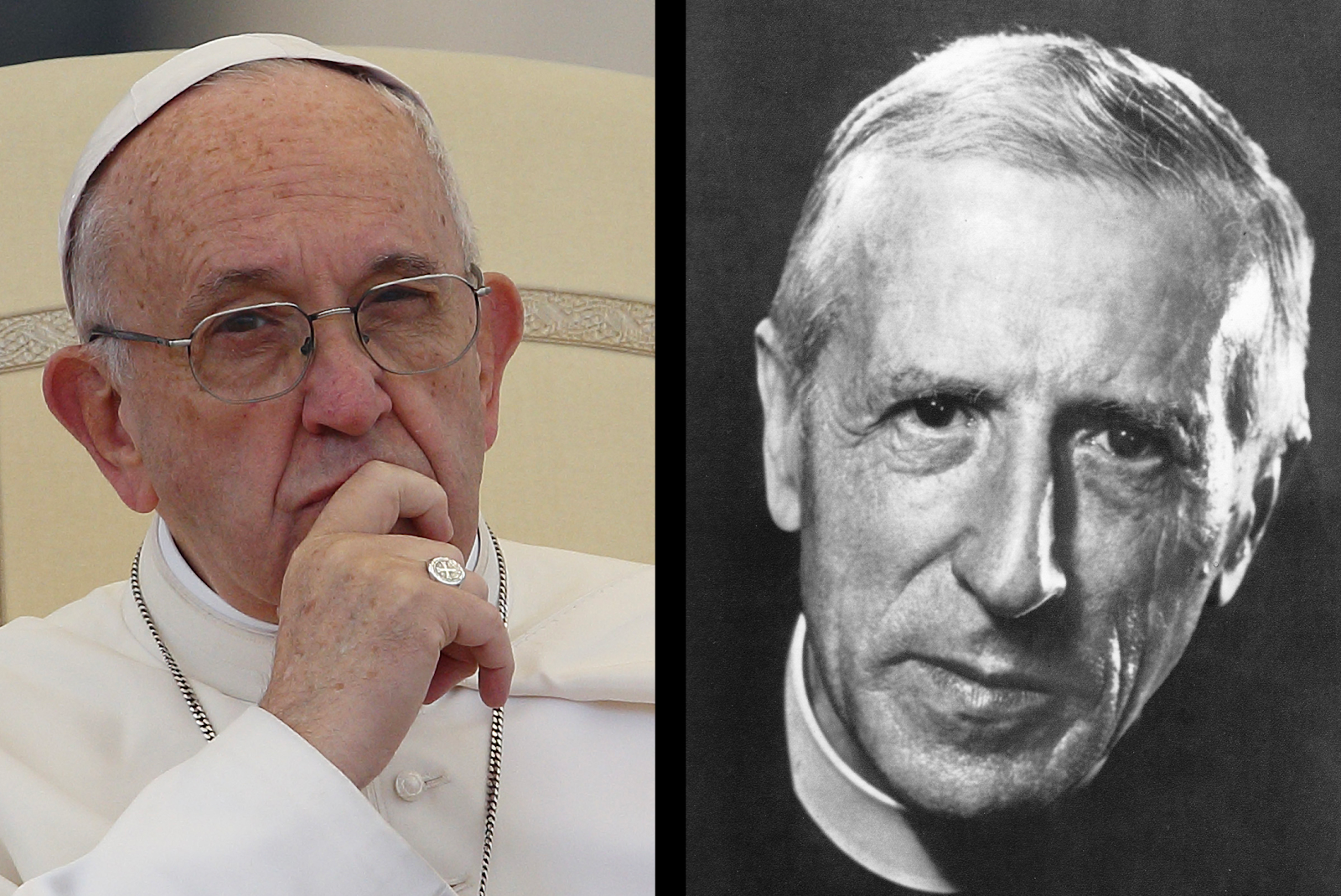
St. Paul's discourse in the Areopagus of Athens (Acts 17:22-31) is a model that can be analogically applied today to the relationship of Catholic Truth with the religiosity of "the nations". The Apostle did not prepare an inter-religious salad, like the one served in Mongolia. Incidentally, we can ask ourselves what a pastoral attitude consists of, in a Christian sense.

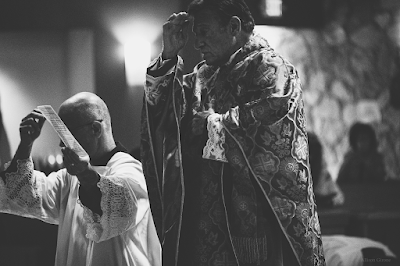
By James Baresel