Rorate Caeli

A new altar for the Cathedra of Saint Peter?

A new altar, with a traditional format, has been photographed in the place of the anvil-like iron structure which had been used as an altar under the Cathedra of Saint Peter, in Saint Peter's Basilica, since the time of the destruction of the Traditional altar (cf. our post "Liturgical Renewal at Saint Peter's: How does an altar disappear?").

The new altar is still a freestanding structure, but it is an improvement. However, when will the Traditional altar be put back in its place? Its destruction remains one of the most symbolic acts of the entire "liturgical renewal" and is a stain in the record of the Wojtyla pontificate.


SSPX: pilgrimage and a new Crusade of the Rosary


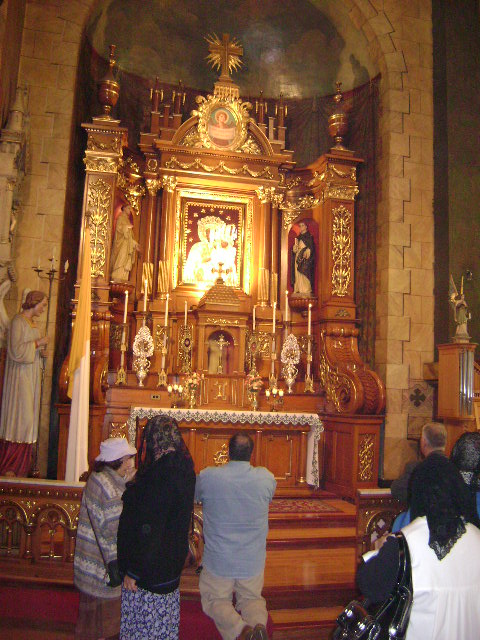
Pictures of the Solemn Mass, of the public recitation of the Holy Rosary, and of the Adoration of the Most Holy Sacrament, as the Sanctuary of Lourdes once again opens its doors and buildings to the Priestly Fraternity of Saint Pius X (FSSPX / SSPX) during the weekend of Christ the King. The four bishops of the SSPX, who were consecrated by Archbishop Marcel Lefebvre in 1988, were present in the pilgrimage.

Regarding developments in the ongoing conversation between the leadership of the Fraternity and Cardinal Castrillón Hoyos, President of the Pontifical Commission "Ecclesia Dei", the SSPX will start this Saturday a "Crusade of the Rosary" to "obtain from Our Lady the removal of the Decree of Excommunication", a "crusade" which will last from November 1 to Christmas Day.

This is a most auspicious development, considering that the last time a Crusade of the Rosary was proposed by the SSPX (in July 2006), its main intention was to "obtain from Heaven for Pope Benedict XVI the strength required to completely free up the Mass of all time, called the Tridentine Mass". All eyes to Heaven, and to Rome, in the next few months.

My kingdom is not of this world


Dixit Pilatus ad Iesum: "Tu es rex Iudæorum?" Respondit Iesus: "A temetipso hoc dicis, an alii dixerunt tibi de me?" Respondit Pilatus: "Numquid ego Iudæus sum? Gens tua et pontifices tradiderunt te mihi: quid fecisti?" Respondit Iesus: "Regnum meum non est de hoc mundo. Si ex hoc mundo esset regnum meum, ministri mei utique decertarent ut non traderer Iudæis: nunc autem regnum meum non est hinc."
(From the Gospel for the Feast of Our Lord Jesus Christ the King, John xviii, 33-36: " Pilate said to Jesus: Art Thou the King of the Jews? Jesus answered: Sayest thou this thing of thyself, or have others told it thee of Me? Pilate answered: Am I a Jew? Thine own nation and the chief priests have delivered Thee up to me: what hast Thou done? Jesus answered: My kingdom is not of this world. If My kingdom were of this world, my servants would certainly strive that I should not be delivered to the Jews: by now my Kingdom is not from hence.")

_____________________________________________________
Hear then, ye Jews and Gentiles! Hear, O circumcision! Hear, O uncircumcision! Hear, all ye kingdoms of the earth: I interfere not with your government in this world, "My kingdom is not of this world."

Cherish ye not the utterly vain terror that threw Herod the Elder into consternation when the birth of Christ was announced, and led him to the murder of so many infants in the hope of including Christ in the fatal number, made more cruel by his fear than by his anger: "My kingdom," He said, "is not of this world."

What would you more? Come to the kingdom that is not of this world! Come, believing, and fall not into the madness of anger through fear!

He says, indeed, prophetically, of God the Father, "Yet have I been appointed king by Him upon His holy hill of Zion;" but that hill of Zion is not of this world. For what is His kingdom, save those who believe in Him, to whom He says, "Ye are not of the world, even as I am not of the world"? And yet He wished them to be in the world: on that very account saying of them to the Father, "I pray not that Thou shouldest take them out of the world, but that Thou shouldest keep them from the evil." Hence also He says not here, "My kingdom is not" in this world; but, "is not of this world." And when He proved this by saying, "If my kingdom were of this world, then would my servants fight, that I should not be delivered to the Jews," He saith not, "But now is my kingdom not" here, but, "is not from hence."

For His kingdom is here until the end of the world [hic est enim regnum eius usque in finem sæculi...], having tares intermingled therewith until the harvest; for the harvest is the end of the world, when the reapers, that is to say, the angels, shall come and gather out of His kingdom everything that offendeth; which certainly would not be done, were it not that His kingdom is here! [...quod utique non fieret, si regnum eius non esset hic.]

But still it is not from hence; for it only sojourns as a stranger in the world: because He says to His kingdom, "Ye are not of the world, but I have chosen you out of the world." They were therefore of the world, so long as they were not His kingdom, but belonged to the prince of this world.

Of the world therefore are all mankind, created indeed by the true God, but generated from Adam as a vitiated and condemned stock; and there are made into a kingdom no longer of the world, all from thence that have been regenerated in Christ. For so did God rescue us from the power of darkness, and translate us into the kingdom of the Son of His love: and of this kingdom it is that He saith, "My kingdom is not of this world;" or, "My kingdom is not from hence."
Saint Augustine
In Evangelium Ioannis - Tractatus CXV


____________________________
  • Recess continues for a few days.
  • News: Proposition 17 of the Synod of Bishops: "It is wished that the ministry of the lectorate be opened also to women, so that their role of announcers of the Word may also be recognized in the Christian Community." (Original text in Italian.)
  • Other relevant news may be posted at any moment.

New age for episcopal resignation?

Our friends at Spanish-language blog La Buhardilla de Jerónimo notice the increasing buzz in the Italian press (including La Repubblica - external reference) regarding an imminent measure by Pope Benedict XVI, which could be released before the end of the year, and which would alter the pertinent canons and extend by three years (to 78) the age in which bishops would be required to present their resignations to the Pope. The measure would apparently not apply to prelates in Vatican dicasteries.

War is Peace - Freedom is Slavery - Ignorance is Strength


The great Vatican controversy in the last few days of the Synod of Bishops on Holy Scripture is linked to a text written months ago for an introduction to a new edition of the Pope's book "Jesus of Nazareth". The matter is linked, though, to the deepest discussions in the Synod.

Italian daily "Il Resto del Carlino" explains:

A banal "adjective" is agitating the secret Vatican offices. It is an adjective used by the lord of the manor (the Pope) and by his, let us say thus, "minister for Culture", Gianfranco Ravasi. The little word of contention is: "reale" [real].

You might ask: but is it possible that five little words (r-e-a-l-e) are capable of putting the Church in turmoil? Yes, in the sense that ths adjective was used with opposite meanings by Benedict XVI and by the president of the Pontifical Council for Culture. And if it is taken into consideration that this "real" is linked to a certain gentleman called Jesus Christ, you will understand well how the controversy may grow in tone.

The reason for the contention is the [new] illustrated edition of the book of Benedict XVI on Jesus of Nazareth, released in the past few days. The Pope wrote: "I have made the effort to present the Jesus of the Gospels and a real Jesus, as the historical Jesus in the true and proper sense." And also: "I consider that this Jesus, the one of the Gospels, is a historically sensible and convincing figure."

Ravasi signed the introduction to this volume, and, in a certain point, mentioned Benedict's words. This way: "It is to be noted that this adjective 'real' is not automatically synonymous with historical, because we know well that so many events are not recorded, or historically documentable and verifiable, yet nevertheless are deeply real."

In short: to the Pope, "real" is synonymous with "historical", for his minister for culture, it is not.

Naturally, all proper justifications will be made, in an effort to deny the obvious contradiction and to please the reigning Pontiff. But this is not surprising coming from Ravasi.

___________________
Transcript and tip: Papa Ratzinger Blog.
Recess for a few days.

The Crucified Christ


For the Apostle, the Resurrection is not an event which stands by itself, separated from death: the Risen one is always the one who was, first, crucified. Even Risen, he bears his wounds: the Passion is present in Him, and it may be said with Pascal that He is suffering even unto the end of the world, even though he is the Risen one, and lives with us, and for us.

Paul had understood this identity of the Risen one with the Crucified Christ in the encounter on the Road to Damascus: in that moment, it was clearly revealed to him that the Crucified is the Risen one, and that the Risen one is the Crucified, who asks Paul, “Why do you persecute me?” (Acts ix, 4). Paul is persecuting Christ in the Church, and now understands that the Cross is a “curse from God” (Deuteronomy xxi, 23), but a sacrifice for our Redemption.
Benedict XVI
General Audience
October 22, 2008

To Honor the King of Kings

The Faithful venerate relics of St. John Cantius and Blessed Karl of Austria

For the closing of their annual Forty Hours Devotion, the people of St. John Cantius parish in Chicago were graced with the presence of Her Imperial and Royal Highness, Maria Anna, Princess of Galitzine, granddaughter of Blessed Karl of Austria, and her husband Prince Piotr D. Galitzine along with members of the Royal Family. The Royal Family was in assistance at the 12:30 Solemn High Mass which was celebrated by parish pastor Rev. C. Frank Phillips C.R. The Mass was that of the feast of St. John Cantius (October 20). Franz Schubert’s Mass in G was sung by the Resurrection Choir and Orchestra and propers were chanted by the Schola Cantorum of St. Gregory the Great. Relics of St. John Cantius and of Blessed Karl were exposed for public veneration on the church’s Lady Altar. Vespers at 4:00 were the First Vespers of the Solemnity of St. John Cantius, Confessor and included a procession. Mozart's Vesperae de Confessore was sung by the Sine Nomine Choir and Orchestra. The great care with which the traditional liturgy and sacred music were treated is a hallmark of the priests and people St. John Cantius and was a befitting tribute to their Royal visitors who came to pay homage to their beatified predecessor whose feast day is October 21.

See more photos at the SJC website

Alternatives to "Ite, missa est" approved by Rome

From Zenit:

Mass Could End With More Than "Go in Peace"
Holy See Approves 3 Alternative Closing Messages

VATICAN CITY, OCT. 14, 2008 (Zenit.org).- The Holy See has approved three alternatives to "Ite, missa est," the final words said by the priest at Mass.Cardinal Francis Arinze, prefect of the Congregation for Divine Worship and the Sacraments, today notified the participants in the synod of bishops on the word of God about the new alternatives. The final message is currently rendered in English: "The Mass is ended, go in peace."

Benedict XVI has approved the alternatives, which were requested at the 2005 synod on the Eucharist to express the missionary spirit that should follow from the celebration of Mass.

According to Cardinal Arinze, the Pope had asked for suggestions to be presented. The congregation received 72, from which they prepared nine proposals. The Holy Father has chosen three.

The alternatives are in the revised third "editio typica" of the Roman Missal, which was printed last week, the cardinal said.

The alternatives are:

--"Ite ad Evangelium Domini nuntiandum"
--"Ite in pace, glorificando vita vestra Dominum"
--"Ite in pace" with "alleluia, alleluia" added during Easter season.
In English, these could be rendered along the lines of "go to announce the Gospel of the Lord"; "go in peace, glorifying the Lord with your lives"; and simply, "go in peace (alleluia, alleluia)."

The original Latin final message, "Ite, missa est," has not been modified.

Eucharistic compendium

Cardinal Arinze also announced that a Eucharistic compendium, also suggested by the '05 synod on the Eucharist, is nearly finished.

The book will define Eucharistic doctrine, benediction, Eucharistic holy hours, adoration, and prayers before and after Mass, he explained.

The cardinal further said that the Holy See, at the request of the Pope and the 2005 synod, is studying the most adequate moment during the Mass for the sign of peace.

The Holy Father indicated that episcopal conferences should consider two options: either before the "Agnus Dei" or after the Prayers of the Faithful. Each bishops' conference is to respond by the end of October, though there is a three-week grace period for late responses. The proposals will then be presented to the Holy Father, who will make a decision on the matter.

Finally, Cardinal Arinze announced that his congregation is preparing a volume with thematic materials for homily, with the aim of assisting and supporting priests throughout the world with their preaching.

Summorum Pontificum clarification document

We acknowledge the ongoing rumor about a possible publication of the clarification document of the motu proprio Summorum Pontificum in January 2009. Gregor Kollmorgen, of The New Liturgical Movement, offers a translation of the text published in the Italian religious news website Pontifex (Bruno Volpe):

The Instruction on the Motu Proprio Summorum Pontificum of 7 July 2007 which liberalized Holy Mass according to the ancient Roman rite, has been ready for some time already and is now being examined by Pope Benedict XVI. This Pontifex has learned from authoritative sources. The text, signed by Cardinal Darío Castrillón Hoyos, President of the Pontifical Commission Ecclesia Dei, will be signed most likely by the Pope in late December and published in the first days of January 2009. In its most important parts the document, which had become indispensable after the many problems in the application of the Motu Proprio and forms of outright recalcitrance on the part of not a few bishops (incidentally appropriately denounced in September by the Vice President of the Commission Ecclesia Dei, Monsignor Camille Perl), addresses two crucial topics: the interpretation of the term "stable group of faithful" within an ordinary parish and the problem of personal parishes. It was even considered to list and to indicate a minimum number of faithful, but this solution has been discarded.

According to the document, the traditionalist faithful present in a parish will have the full protection of the law to ask for the old Mass, and if the bishop refuses (here is the news), saying that there are no priests capable of celebrating according to the ancient rite in that place, the Commission Ecclesia Dei will authoritatively ("di imperio") send a priest able to do so to that diocese. In short, the bishops will no longer be able to refuse a priori to have the old Mass celebrated, because in such cases, the Commission Ecclesia Dei will send a delegated priest of its own.

The document then analyzes the case of personal parishes in which the traditionalists want to celebrate the Christmas Mass or the Easter Triduum according to the ancient rite, also in cases of an absence of priests, or a prohibition by the bishop. The possibility of a shortage of priests could be envisaged, and also in this case, Ecclesia Dei will take care. The Holy See, therefore, wants to establish definitive clarity regarding the application of the Motu Proprio, and for this reason also the powers and prerogatives of the Pontifical Commission Ecclesia Dei will be better defined and strengthened.

We also recall that several rumors indicated that this instruction should have been published in January 2008(!) - so take all rumors with a grain of salt. The only certainties are that the document exists, and that it awaits the final signature of the Holy Father.

[Tip: La Buhardilla]

A new book on the Benedictine Reform

Two great names come together to present to a wider audience the Benedictine liturgical reform. Father Nicola Bux is the author of La Riforma di Benedetto XVI - La Liturgia tra Innovazione e Tradizione (The Reform of Benedict XVI - Liturgy between Innovation and Tradition) - the book is published by Piemme, and the preface is written by the most famous religious journalist in the world, Vittorio Messori.

The reform of Benedict XVI
(by Nicola Bux)

[Presentation of the publisher:]

When, in July 2007, the motu proprio of Benedict XVI restored the celebration of the Latin Mass, loud voices of protest rose from several places.

The widespread fear was - and is - that Pope Ratzinger had at last thrown away his mask, revealing that reactionary defender of Tradition that many accused him of being since the days in which he was Prefect of the Congregation for the Doctrine of the Faith, that is, the former Holy Office. Benedict XVI replied by showing how the recovery of the Latin Rite was not a "step backwards", a return to days prior to the Second Vatican Council, but rather forward-looking, retaining from past Tradition all that it may offer of what is most beautiful and significant to the current life of the Church.

What Pope Ratzinger wishes to do in his patient work of reform is to renew the life of the Christian faithful - the gestures, the words, the time of everyday- restoring to the liturgy a wise balance between innovation and Tradition. Thus arises the image of Church always on her path, capable of reflecting upon itself and to value the riches of which its millennial treasury is full.


Update (October 12): With a review of Father Bux's book, Vaticanist Andrea Tornielli also reports on the probable indication of Cardinal Cañizares, of Toledo, as new Prefect of Divine Worship, before Christmas or early next January - and a possible indication, several months afterwards, of Archbishop Ranjith (current secretary of Divine Worship) as the new Archbishop of Colombo, Sri Lanka. [We reported on this matter last April.]

Announcements

Readers send us the following notes.

1. From England (Oxfordshire):
Masses for the quarter are now confirmed ... .

Please note the celebration of All Saints on Sat 1st November and All Souls (Sung) on Mon 3rd, both at 12.15 in the Oxford Oratory.

I'd particularly draw attention to the three special events:

Sat 25th October, the LMS Pilgrimage to Oxford: Solemn High Mass at 11 in Blackfriars, Procession at 2pm with the unveiling of a plaque, and Benediction at 3.30 back in Blackfriars. All in honour of the four beatified martyrs of 1589. Bishop Kenny, an auxiliary of the Archdiocese, will preach at the Mass and unveil the plaque. Please support this important event.

Mon 17th Nov: Sung Requiem for 450th Anniversary of Cardinal Pole, 7pm in Magdalen College chapel, followed by a drinks reception.

Fri 5th December: Solemn High Mass in St Birinus, Dorchester, for the patronal feast of this church, at 7pm.

As always we are eager to increase the pool of singers and servers so please get in touch with me if you are interested.
At the invitation of Bishop Moriarty and in response to Pope Benedict's Apostolic Letter Summorum Pontificum, priests from the Priestly Fraternity of St. Peter will celebrate a Latin Mass for the faithful of the Diocese attached to the older ("extraordinary") form of the Roman Rite (liturgical books of 1962). This Mass will be celebrated on the 2nd Sunday of every month in Cill Mhuire Church, Newbridge, Co. Kildare, beginning on Sunday, 12th October, at 1.00 p.m.

From St. Conleth's Parish Newsletter for Sunday, 5th October, 2008.

We acknowledge the ongoing rumor regarding a possible appointment of Archbishop M. Ranjith, the current Secretary of the Congregation for Divine Worship and the Discipline of the Sacraments, to a major diocese in his native Sri Lanka. Nonetheless, we also notice that it is an ancient and recurring rumor - we first reported it last April ("Motu Proprio wars in the Roman Curia: Ranjith off to Sri Lanka?").

Christ, the one true certainty


"He who heareth my word, and believeth ...hath life everlasting." (John, 5, 24) This affirmation by Jesus, which we heard in the Gospel, makes us think of the hardest moments of the pontificate of Pius XII, when, perceiving the collapse of every human certainty, he strongly felt the need, even through a constant ascetic effort, to adhere to Christ, the only certainty that never passes.

The Word of God became thus a light in his path, a path on which Pope Pacelli consoled the downtrodden and the persecuted, on which he dad to wipe away the tears of pain and weep for the countless victims of the war. Only Christ is the true hope of man; only trusting in Him is the human heart able to open itself to the love which conquers hate.

I have fought a good fight,
I have finished my course,
I have kept the Faith.

We, as a newly ordained priest, then just empowered to recite "Introibo ad altare Dei" (Psalm xiii. 4), hailed the Encyclical Annum Sacrum [on the consecration of the world to the Sacred Heart] with genuine approval, enthusiasm and delight as a message from heaven. ... It is only natural, then, that We should today feel profoundly grateful to Providence for having designed that the first year of Our Pontificate should be associated with a memory so precious and so dear of Our first year of priesthood, and that We should take the opportunity of paying homage to the King of kings and Lord of lords (I Timothy vi. 15; Apocalypse xix. 6) as a kind of Introit prayer to Our Pontificate, in the spirit of Our renowned predecessor and in the faithful accomplishment of his designs, and that, in fine, We should make of it the alpha and omega of Our aims, of Our hopes, of Our teaching, of Our activity, of Our patience and of Our sufferings, by consecrating them all to the spread of the Kingdom of Christ. ...
As Vicar of Him Who in a decisive hour pronounced before the highest earthly authority of that day, the great words: "For this was I born, and for this came I into the world; that I should give testimony to the truth. Every one that is of the truth, hearest My voice" (Saint John xviii. 37), We feel We owe no greater debt to Our office and to Our time than to testify to the truth with Apostolic firmness: "to give testimony to the truth." This duty necessarily entails the exposition and confutation of errors and human faults; for these must be made known before it is possible to tend and to heal them. "You shall know the truth and the truth shall make you free" (Saint John viii. 32).

In the fulfillment of this, Our duty, we shall not let Ourselves be influenced by earthly considerations nor be held back by mistrust or opposition, by rebuffs or lack of appreciation of Our words, nor yet by fear of misconceptions and misinterpretations. We shall fulfill Our duty, animated ever with that paternal charity which, while it suffers from the evils which afflict Our children, at the same time points out to them the remedy; We shall strive to imitate the Divine Model of shepherds, Jesus, the Good Shepherd, Who is light as well as love: "Doing the truth in charity" (Ephesians iv. 15).

Pius XII
Summi Pontificatus (1939)
______________________

Pius XII kept his promise, doing the Truth in Charity.

The Word of God and Unbelief of Jews

“But the testimony which I have is greater than that of John, for the works which the Father has granted me to accomplish, these very works which I am doing, bear me witness that the Father has sent me. . . . . You search the scriptures, because you think that in them you have eternal life, and it is they that bear witness to me; yet you refuse to come to me that you may have life. . . . . If you believed Moses, you would believe me, for he wrote of me.” Gospel of John, Chapter 5.

“And he expounded the matter to them from morning till evening, testifying to the kingdom of God and trying to convince them about Jesus both from the law of Moses and from the prophets. And some were convinced by what he said, while others disbelieved. So, as they disagreed among themselves, they departed, after Paul had made one statement: ‘The Holy Spirit was right in saying to your fathers through Isaiah the prophet: “Go to this people, and say, You shall indeed hear but never understand, and you shall indeed see but never perceive. For this people’s heart has grown dull, and their ears are heavy of hearing, and their eyes have closed . . .”’ Acts of the Apostles, Chapter 28.

“It [the Passion] is a grave and sad page which evokes the clash between Jesus and the Jewish people. This people predestined for receiving the Messiah, which was awaiting him for thousands of years and was entirely absorbed by this hope and certitude; at the crucial moment, that is when Christ comes, speaks and manifests himself, not only does not recognize him, but combats him, slanders him and finally will kill him.” Pope Paul VI, Homily, Passion Sunday, April 4, 1965, in Osservatore Romano, April 7, 1965, and in Documentation catholique 1448, May 16, 1965, columns 887-888.

“Let us pray for the unfaithful Jews, that our God and Lord will remove the veil from their hearts, that they themselves may acknowledge Jesus Christ, our Lord. Almighty and everlasting God, who does not reject even the unfaithfulness of the Jews from your mercy, hear our prayers which we bring on account of the blindness of that people, so that, having acknowledged the light of your truth which is Christ, they may be rescued from their darkness.” Translated from the Roman Missal for the liturgy of Good Friday as approved by Pope Pius XII and the immemorial custom of the Church.

Notes


"As you know, the absolute innovation of this Synod [of Bishops] is the presence of a rabbi, who yesterday afternoon spoke in congregation: it is the Chief Rabbi of Haifa, Shear-Yashuv Cohen. The latter, in an intervention dedicated to the interpretation of Scripture according to the Jewish faith, attacked Iranian president Ahmadinejad. And, in the evening, interviewed by Phil Pullella, a Vaticanist for Reuters, said that the Church should not beatify Pius XII and that, had he known that Benedict XVI was about to celebrate the fiftieth anniversary of the death of Pope Pacelli (with the Mass he will celebrate tomorrow at Saint Peter's), he would not even have come to the Synod. Apart from the fact that the date of the death of Pius XII is not exactly a Mossad secret, being found in every encyclopedia, apart from the fact that the fiftieth [anniversary] represents an important date, I find completely out of place that a Jewish exponent, invited to speak to the Catholic bishops, makes use of it to embarrass the Pope, most of all based on black legends."


2. The Institute of Christ the King Sovereign Priest (ICRSS) is no longer a mere diocesan institute, but has been recognized by Pope Benedict XVI as a Society of Apostolic Life of Pontifical Right.

With deepest gratitude to the Blessed Trinity, to Christ Our King, and His Immaculate Mother, to St. Joseph, to St. Michael the Archangel, to our patron saints, to the entire court of heaven, and with filial thankfulness to our Holy Father Pope Benedict XVI and his faithful collaborators, we have the joy to announce a very important event:

His Holiness Pope Benedict XVI

On the feast day of Our Lady, Queen of the Holy Rosary, the Vice-President of the Commission Ecclesia Dei, Very Reverend Monsignor Camille Perl, has read in our Seminary chapel the official decree by which, in the name of the Holy Father, the Institute of Christ the King Sovereign Priest was erected to the status of a Society of Apostolic Life of Pontifical Right. Also our Sisters Adorers of the Royal Heart of Jesus received the status of Pontifical Right. The Decree was signed by His Eminence Dario Cardinal Castrillon Hoyos. A Solemn Te Deum followed the reading of the Decree.

Born out of a profound union with the Holy Father in Rome and the Institute's founder and members having always lived in a continuous and unwavering spirit of faithful Romanitas, the Institute was granted the Pontifical Right after the formal time of experience and interrogation which is a traditional custom for the Holy See. Various positive Apostolic Visitations conducted by the Roman Curia and a very favorable consultation of all the Most Reverend Bishops in whose Dioceses we are invited to serve have finalized this canonical process.

After this affirmative evaluation of our spirituality and our international presence and work, the Pontifical Right is an expression of the appreciation of the service of the Institute of Christ the King by the Roman Pontiff and his collaborators to whom we are deeply obliged. The Pontifical Right will make it even easier for the Institute to conduct its service for the Church according to its constitutions and gives to Monsignor the Prior General rights and duties that are in unison with our canonical lifestyle.

BENEDICTO XVI SUMMO PONTIFICI PAX, VITA ET SALUS PERPETUA!
_________________
Tip: Saint Louis Catholic

The Word of God, the foundation that remains forever


The word of God is the foundation of everything, it is true reality. And in order to be realists, we must count on this reality. We must change our ideas that the material, solid things, that which can be touched, is the more solid and more secure reality.

At the end of the Sermon on the Mount, the Lord speaks to us of two possibilities for building the house of one's life: on the sand, or on the rock. Those who build on the sand to build upon the visible and tangible things, on success, on career, on money. Apparently, these are the true realities. But all of this will pass away one day. We see this today in the collapse of the major banks: this money is disappearing, it is nothing.

And like all of these things, which seem to be the true reality on which to rely, our realities of a second order. Those who build their lives on these realities, on the material, on success, on all that which is visible, build on the sand. Only the word of God is the foundation of all reality, enduring like the sky, and even more than the sky, is reality. We must therefore change our concept of realism.

The realist is the one who recognizes in the Word of God, in this apparently feeble reality, the foundation of everything. The realist is the one who builds his life on this foundation that remains forever.

Pope Benedict at Saint Paul's Without-the-Walls

On Sunday morning, 5th October Pope Benedict celebrated the opening Mass for the XIIth General Ordinary Assembly of the Synod of Bishops. The Mass was offered in the Basilica of Saint Paul's Without-the-Walls.

This post is a continuation of two previous posts on Rorate Caeli about the form of the 16th century chasuble. Please re-read these posts here and here.

On the occasion of the Opening Mass, Pope Benedict wore a green chasuble almost identical in shape and dimensions with the famous statue of Saint Philip Neri by the sculptor Algardi. A digitally-enhanced photograph of that statue is adjacent.


This green Papal chasuble conforms very closely with the dimensions set down by Saint Charles Borromeo at the end of the 16th century governing the size of the chasuble. Note that this chasuble differs significantly in its length and shape from another style of chasuble from the 16th century, which is sometimes referred to as the "Philip Neri" style. A purple and a red chasuble in this "Philip Neri" style were made for the use of Pope Benedict earlier this year (see adjacent photographs).


Photographs of the green chasuble at the beginning of this post from the Papa Ratzinger Forum: with thanks. Click on each of the images below for an enlarged view.

Defending the readings in the Traditional Mass


As the Synod on Holy Scripture is opened by Pope Benedict XVI in the Basilica of Saint Paul Outside the Walls, a good article on the forms of the Roman Rite and the Scripture readings.

WORDS OF DOCTRINE
Two theories born of Biblicism
Fr. Nicola Bux and Fr. Salvatore Vitiello

Some say that the post-Conciliar Mass is richer in Readings and Eucharistic Prayers, while the Missal said of Pius V would be poorer and less accurate. The theory is anachronistic since it fails to consider four centuries of distance; it is as if we were to say the same about "Sacramentaries" some centuries earlier than that of Pius V. What is more, it is forgotten that the pericopes of the Pius V Missal were formed on the basis of old capitularies with epistles, such as St Jerome's Liber comitis– dated 471 - or with Gospel pericopes ; a tradition in common with the Church of the East, as the Byzantine liturgy still shows today.

Secondly, the brief readings help memorize the essential and express the sobriety of the Roman Rite. Some even go as far as to say that the Extraordinary Form of the only Latin Rite gives too little emphasis to the presence of Christ in the Word, when the latter is proclaimed in the assembly; in this cas,e the liturgy loses its very essence, the 'two tables' - in Dei Verbum, n. 21, there would appear to be only “one” - forming one act of worship!

It is said that the Missal of the Council of Trent moves in a vision far from the tradition of the Church Fathers; that the Missal was planned for the priest only, not for the participation of the assembly because the congregation is merely irrelevant. In fact, it is said that the priest celebrates on his own and so does the congregation; they say the Mass of Paul VI is quite different because it is not the priest who celebrates but the Church, sacramentally present in the assembly, of which the priest, by reason of order, is the natural president.

This position is considerably problematic because it reduces everything to Word and Assembly. However “Jesus is not just the teacher, but also the redeemer of the whole person. The Jesus who teaches is, at the same time, the One who saves ” (J.Ratzinger-Benedict XVI, Gesù di Nazaret, p. 65) and this comes about effectively only through the Eucharistic Sacrament.

Another theory, widespread due to the customary phenomenon of substitution and exchanging one thing with another, is to equal the presence of Jesus Christ in the Blessed Sacrament with the presence of the Word in the Book of the Scriptures: the latter presence takes place only “when the Holy Scriptures are read in the Church” (Sacrosanctum Concilium n. 7). It is necessary to reaffirm that Christ's presence in the Word exists on two conditions: when it is read out “in the Church assembly ”, not privately, and when Sacred Scripture is 'read'. Therefore the holy book placed on the lectern or the altar is not sufficient for this presence.

To conclude, it is more than ever urgent for preaching and catechesis to return to making the proper distinction between Revelation, Word of God and Sacred Scripture which, although closely connected, are not equivalent. At times in fact, not without surprise, we see in this regard considerable confusion and not only among the lay faithful. Some even think that the Bible is to be interpreted with the Bible and not, as the Catholic Church has always held, with Tradition and by faithful listening to the Magisterium.

_________________________
FIDES translation, adapted according to the Italian original.

Note: Back from recess, we acknowledge the e-mail messages referring us to the new website of the Pontifical Commission "Ecclesia Dei", first acknowledged by the Spanish Traditional Catholic blog "Hoc Signo". Unfortunately, the website is still very much incomplete, but it may hopefully be a work in progress.

LMS announcement

Announcement of the Latin Mass Society of England and Wales:


Last Chance to Register for Confirmations:

Now is your last chance to register for Confirmations in the Traditional Latin Rite at St James’ Church, Spanish Place, London W1 on Saturday 15th November at 11.30 am with Bishop George Stack.

Confirmations will be followed by Benediction of the Blessed Sacrament.

If you are thinking of Confirmation for your child/ren this year, you need to register their details urgently with the Latin Mass Society. Please telephone or email to request a registration form and return it no later than 31 Oct 2008 to the LMS office.

Tel: 020 7404
7284.
Email:
thelatinmasssociety@snmail.co.uk

Recess continues for three days.

Ecce ego mittam Angelum meum qui præcedat te


"Angelis suis Deus mandavit de te, ut custodiant te in omnibus viis tuis." (From the Gradual for the Feast of the Holy Guardian Angels, Psalm xc, 11: "God hath given His angels charge over thee, to keep thee in all thy ways.")

Saint Bernard says there are three ways by which we ought to honor our guardian angels: "by reverence, by devotion, and by confidence."

By reverence, because these holy spirits and princes of heaven are always present with us, and assist us in all our actions. And on this account, out of regard to our guardian angels, we ought carefully to refrain from every action which can displease them. Saint Frances of Rome, widow, saw that the angel who attended her in a human form, every time that he observed any improper action or word in any one in conversation, covered his face with his hands.

[Prayer:] O my holy guardian angel, how many times have I by my sins obliged you to cover your face! I ask your forgiveness, and I beseech you to implore forgiveness for me from God, for I am resolved to offend neither God nor you any more by my negligences.

In the second place, we ought to honor our good angels by devotion to them, on account of the respect which they deserve, and the love which they have for us.

No love of father, brother or friend, can equal the love which our good angels have for each one of us. Our worldly friends often love us from motives of interest, and on this account very easily forget us when we are in adversity, and much more when we offend them. Our angel guardians love us solely from motives of charity, and hence when we are in difficulties they assist us more particularly, and cease not to help us after we have rebelled against God. Then will they endeavor to enlighten us, in order that we may soon return to God by repentance.

[Prayer:] O, how much do I thank you, my holy guardian, for the lights which you have communicated to me. Oh that I had always obeyed you! Continue to enlighten me, rebuke me when I fail, and do not forsake me unto the last moment of my life.

In the third place, we ought to have great confidence in the assistance of our good angels.

God's love for us was not satisfied with giving us his Son Jesus for our Redeemer, and Mary for our Advocate; he has been pleased to give us also his angels to be our guardians, and has commanded them to assist us during the course of our lives: "He hath given his angels charge over thee: to keep thee in all thy ways" [Psalm xc, 11].

[Prayer:] O God of infinite mercy, what more canst thou do for me that I may be saved? I thank thee, O my Lord; and I thank you also, O prince of paradise, my good angel, who for so many years have assisted and protected me. I have been unmindful of you, but you have not forgotten me. Who knows how much farther I may have to go before I enter eternity? O my good angel, guide me in the way to heaven, and cease not to assist me, until you behold me become your eternal companion in the kingdom of heaven!
Saint Alphonsus Liguori
Via della salute

_______________________
Recess for four days.
Relevant news may be posted at any time.
Angele Dei, qui custos es mei, me, tibi commissum pietate superna, illumina, custodi, rege et guberna. Amen.

Graduale on the web

Congratulations to the Church Music Association of America for another mighty addition to its list of online liturgical works: the Graduale Romanum (1908), one of the greatest liturgical accomplishments of the pontificate of Saint Pius X.

_________________________
Tip: The New Liturgical Movement.

Crisis? What crisis?
The beast was slain forever

"I saw that the beast was slain, and the body thereof was destroyed, and given to the fire to be burnt." (From the First Lesson of Matins, Michaelmas - Daniel vii, 11)
"Minds of all, it is true, are affected almost solely by temporal upheavals, disasters, and calamities. But if we examine things critically with Christian eyes, as we should, what are all these compared with the loss of souls?" (Pius XI, Quadragesimo Anno)

New reprints


The Rituale Romanum of 1952 (the edition in force in 1962), published earlier in September by the publishing house of the Holy See, the Libreria Editrice Vaticana, has recently been made available for purchase (more information here).

The Rituale is the second volume of the Monumenta Liturgica Piana, at the care of Italian liturgical scholars Manlio Sodi (who did not like Summorum Pontificum, but has profited from it...) and Alessandro Toniolo. The Missale was published in 2007, but the Breviarium and the Pontificale have not yet been published.

A high quality reprint of the Breviarium Romanum (1962), in two volumes, is being sold by the main seminary of the Priestly Fraternity of Saint Pius X (FSSPX / SSPX), Ecône (more information here).

Philippine Bishops’ Newspaper : There are no Just Wars

The CBCP Monitor is the fortnightly newspaper that is issued by the Catholic Bishops’ Conference of the Philippines, and that acts as its official organ. Its September 1-14 issue contains what may be a first in the world of Catholic Episcopal conferences: an editorial condemning – without qualifications – the very idea of “just war.” The language is unusually harsh in condemning a “theory” that has been held by virtually all Catholic doctors and theologians and which is taught by the Magisterium.

[UPDATE: The original version of the editorial was apparently written by Oscar Cruz, Archbishop of Lingayen-Dagupan and the recognized dean of Philippine canon lawyers. He is one of the Philippine hierarchy's harshest critics of the current president of the Philippines, whose overthrow he has repeatedly advocated. The original contains the following phrase, which has been modified in the published editorial: "It is definite and defined that any and all wars are unjust. In other words, there is no such animal as a just war..."]

The editorial refers to a “War in Mindanao.” This refers in particular to a still-ongoing military campaign against Islamic extremists in the southern Philippines, who had recently targeted and burned several Christian settlements after the collapse of peace talks between the main Islamic group and the Philippine government. Mindanao has been the scene of a continuous series of Islamic revolts and terrorist actions since the 1970’s.

The editorial appears in the first page of the “Opinion” section (p. A-4) of the CBCP Monitor, September 1-14, 2008 issue (Vol 12. No. 18). I will upload a scan of the editorial soon.

The text of the editorial is as follows. Emphasis mine.
Just war
ON the chilling occasion of the deadly and dreadful war now taking place in Mindanao – on otherwise naturally rich and potentially prosperous region in the country” a persistent question that comes to mind is one and the same. Is the war in Mindanao just?

If so, what makes it a just war? Who sees to it that the war is just? In the event the war is just, why not have war all over the country in promotion of the sorely needed justice in the land?

The unconscionable truth is that war makes a great business. As people are killed in war, there are always those who make big money in war trafficking. Just for the record, let it be noted that as the resources of others are destroyed by war, those however who make war their trade, in effect, build up their wealth. But the question remains and begs for an answer: When is a war just?

The answer to this is curiously found also in questions: Was there ever a just war in human history? Was the 1st World War just?

Was the holocaust just? Was the systematic extermination of the Jews just? Was the 2nd World War just?


Was the atomic bomb explosion in Hiroshima just? Was the indiscriminate killing of many thousands of civilian men, women and children just? Is the Iraq War just?

In other words: is it just to have thousands of invading soldiers killed and more thousands of locals sent to their death as “collateral damage” – with more people still to be killed as the days go on and as the war continues?

Thus far, history has not yet given humanity a just war. Despite philosophical or theological rationalizations, there is no such animal as a just war. Only fools say otherwise. Only clowns wear smiles during war. And only those, whose business is war, rejoice when war is actually waged.

Everybody else – if still alive and well – think, feel and say that there are no winners in war. And those who want war let them go to the front lines and do their war dance until they stop a bullet at hitting somebody else in its way.

The war in Mindanao is grim and gross. And those who are the causal factor of the war, those who provided the occasion for it, are not only censurable but also squarely answerable for the debacle: to agree to what is basically not agreeable, to promise what cannot be really done, to give way to what is not theirs to dispose of, and to expose the lives of others while carefully saving their own hides.

This is certainly not the way of the honorable much less the actuation of rational individuals. These are the characters squarely accountable for the War in Mindanao.

At their feet should be laid the dead and mutilated bodies of the war victims. In due time, justice will surely catch up with these purveyors of injustice – as it is already haunting and hunting them right now.

The core of our faith

Excerpt of a very interesting interview granted by Monsignor Georg Ratzinger to Andrea Tornielli, published today in Il Giornale:

What has the liturgy meant for the Ratzinger brothers?

"The liturgy, the Mass, represents the core of our faith and of our action, it is the personal meeting with God. It naturally is at first place. We cannot imagine a day without the Mass, without the liturgy, it would be poor, lacking what is essential..."

Why has Benedict XVI wished to liberalize the ancient, pre-Conciliar, liturgy with the motu proprio "Summorum Pontificum"?

"At the time of the liturgical reform, the change happened quickly, and it was not easy for all to accept. From one day to the other, the ancient liturgy was replaced by the new one, of which we are now fond and with which we celebrate mass with an interior participation which is full of joy. There were some in the Church, however, that did not accept this 'leap' completely, because the loss of the ancient liturgy had deprived them of something and had disturbed their faith. In order not to leave these people alone, to reintegrate them fully in the ecclesial community, my brother decided to render the ancient pre-Conciliar liturgy free."

_______________________________
Transcript: Papa Ratzinger blog

...whither your hope goes before, let your life follow...


Super flumina Babylonis illic sedimus et flevimus: dum recordaremur tui, Sion. (Offertory for the Twentieth Sunday after Pentecost, cf. Psalm cxxxvi, 1: "Upon the rivers of Babylon there we sat and wept; when we remembered thee, O Sion.")

“The waters of Babylon” are all things which here are loved, and pass away. One man, for example, loves to practice husbandry, to grow rich thereby, to employ his mind therein, thence to gain pleasure: let him observe the issue, and see that what he has loved is not a foundation of Jerusalem, but a stream of Babylon. Another says, 'It is a grand thing to be a soldier: all husbandmen fear those who are soldiers.'

But then other citizens of the holy Jerusalem, understanding their captivity, mark how the natural wishes and the various lusts of men hurry and drag them hither and thither, and drive them into the sea; they see this, and they throw not themselves into the waters of Babylon, but “sit down and weep,” either for those who are being carried away by them, or themselves whose deserts have placed them in Babylon, but sitting, that is, humbling themselves.

O holy Sion, where all stands firm and nothing flows! Who has thrown us headlong into this? Why have we left your Founder and your society? Behold, placed where all things are flowing and gliding away, scarce one, if he can grasp the tree, shall be snatched from the stream and escape.

Humbling ourselves then in our captivity, let us “sit by the waters of Babylon,” let us not dare to plunge ourselves in those streams, nor to be proud and lifted up in the evil and sadness of our captivity, but let us sit, and so weep. Let us sit “by” the waters, not beneath the waters, of Babylon; such be our humility, that it will not overwhelm us. Sit “by” the waters, not “in” the waters, not “under” the waters; but yet sit, in humble fashion, talk not as one would in Jerusalem.

For many weep with the weeping of Babylon, because they rejoice also with the joy of Babylon. When men rejoice at gains and weep at losses, both are of Babylon. One ought to weep, but in the remembrance of Sion. If one weeps in the remembrance of Sion, one ought to weep even when it is well with oneself in Babylon. ...

Brethren, let not your instruments of music rest in your work: sing one to another songs of Sion. Readily have you heard; the more readily do what you have heard, if you wish not to be willows of Babylon fed by its streams, and bringing no fruit. But sigh for the everlasting Jerusalem: whither your hope goes before, let your life follow; there we shall be with Christ. [Sed suspirate in aeternam Ierusalem; quo praecedit spes vestra, sequatur vita vestra: ibi erimus cum Christo.]

Christ now is our Head; now He rules us from above; in that city He will fold us to Himself; we shall be equal to the Angels of God. We should not dare to imagine this of ourselves - did not the Truth promise it? This then desire, brethren, this day and night think on. ...

Let the Rock conquer. Be built upon the Rock, if ye desire not to be swept away either by the stream, or the winds, or the rain. If ye wish to be armed against temptations in this world, let longing for the everlasting Jerusalem grow and be strengthened in your hearts. Your captivity will pass away, your happiness will come; the last enemy shall be destroyed, and we shall triumph with our King, without death.
Saint Augustine
Enarratio in Psalmum CXXXVI
"The Holy Father appointed as consultors of the Office of Liturgical Celebrations of the Supreme Pontiff: Msgr. Nicola Bux, professor at the Theological Faculty of Puglia, Italy; Fr. Mauro Gagliardi, professor at the Pontifical Athenaeum "Regina Apostolorum", Rome; Fr. Juan Jose Silvestre Valor, professor at the Pontifical University of the Holy Cross, Rome; Fr. Uwe Michael Lang C.O., official of the Congregation for Divine Worship and the Discipline of the Sacraments, and Fr. Paul C. F. Gunter O.S.B., professor at the St. Anselm Pontifical Athenaeum, Rome."

An interview (in Italian) with Msgr. Bux, after his appointment today (interesting enough, but it contains no new information).

The FSSP in France

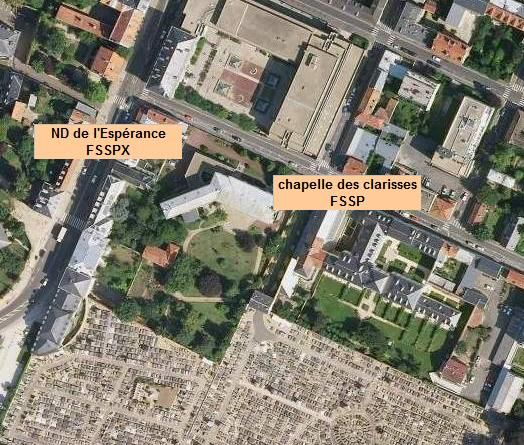
The Priestly Society of St. Peter has been entrusted with the Chapelle des Clarisses in Versailles under the authority of the rector of St. Louis Cathedral (Diocese of Versailles). The first Mass will be offered on October 12.

I will make no comment on the proximity of the FSSP’s new parish to the Society of St. Pius X’s Notre-Dame de l'Espérance chapel.


Tip: Le Forum Catholique

THE GLOW OF THE EMBER DAYS
By Michael P. Foley


A potential danger of traditionalism is the stubborn defense of something about which one knows little. I once asked a priest who had just finished beautifully celebrating an Ember Saturday Mass about the meaning of the Ember days. He replied (with an impish twinkle in his eye) that he hadn’t a clue, but he was furious they had been suppressed.


Traditionalists, however, are not entirely to blame for their unfamiliarity with this important part of their patrimony. Most only have the privilege of assisting at a Sunday Tridentine Mass, and hence the Ember days—which occur on a weekday or Saturday—slip by unnoticed. And long before the opening session of the Second Vatican Council, the popularity of these observances had atrophied.


So why care about them now? To answer this question, we must first determine what they are.


The Four Seasons


The Ember days, which fall on a Wednesday, Friday, and Saturday of the same week, occur in conjunction with the four natural seasons of the year. Autumn brings the September Embertide, also called the Michaelmas Embertide because of their proximity to the Feast of St. Michael on September 29.1 Winter, on the other hand, brings the December Embertide during the third week of Advent, and spring brings the Lenten Embertide after the first Sunday of Lent. Finally, summer heralds the Whitsun Embertide, which takes place within the Octave of Pentecost.


In the 1962 Missal the Ember days are ranked as ferias of the second class, weekdays of special importance that even supersede certain saints’ feasts. Each day has its own proper Mass, all of which are quite old. One proof of their antiquity is that they are one of the few days in the Gregorian rite (as the ’62 Missal is now being called) which has as many as five lessons from the Old Testament in addition to the Epistle reading, an ancient arrangement indeed.


Fasting and partial abstinence during the Ember days were also enjoined on the faithful from time immemorial until the 1960s. It is the association of fasting and penance with the Embertides that led some to think that their peculiar name has something to do with smoldering ash, or embers. But the English name is probably derived from their Latin title, the Quatuor Tempora or “Four Seasons.”2


Apostolic and Universal


The history of the Ember days brings us to the very origins of Christianity. The Old Testament prescribes a fourfold fast as part of its ongoing consecration of the year to God (Zech. 8:19). In addition to these seasonal observances, pious Jews in Palestine at the time of Jesus fasted every Monday and Thursday—hence the Pharisee’s boast about fasting twice weekly in the parable involving him and the publican (Lk. 18:12).


Early Christians amended both of these customs. The Didache, a work so old that it may actually predate some books of the New Testament, tells us that Palestinian Christians in the first century A.D. fasted every Wednesday and Friday: Wednesday because it is the day that Christ was betrayed and Friday because it is the day He was crucified.3 The Wednesday and Friday fast were so much a part of Christian life that in Gaelic one word for Thursday, Didaoirn, literally means “the day between the fasts.”


In the third century, Christians in Rome began to designate some of these days for seasonal prayer, partly in imitation of the Hebrew custom and partly in response to pagan festivals occurring around the same time.4 Thus, the Ember days were born. And after the weekly fast became less prevalent, it was the Ember days which remained as a conspicuous testimony to a custom stretching back to the Apostles themselves.5 Moreover, by modifying the two Jewish fasts, the Ember days embody Christ’s statement that He came not to abolish the Law but fulfill it (Mt. 5:17).6


Usefully Natural


This fulfillment of the Law is crucial because it teaches us something fundamental about God, His redemptive plan for us, and the nature of the universe. In the case of both the Hebrew seasonal fasts and the Christian Ember days, we are invited to consider the wonder of the natural seasons and their relation to their Creator. The four seasons, for example, can be said to intimate individually the bliss of Heaven, where there is “the beauty of spring, the brightness of summer, the plenty of autumn, the rest of winter.”7


This is significant, for the Ember days are the only time in the Church calendar where nature qua nature is singled out and acknowledged. Certainly the liturgical year as a whole presupposes nature’s annual rhythm (Easter coincides with the vernal equinox, Christmas with the winter solstice, etc.), yet here we celebrate not the natural phenomena per se but the supernatural mysteries which they evoke. The Rogation days commemorate nature, but mostly in light of its agricultural significance (that is, vis-à-vis its cultivation by man), not on its own terms, so to speak.8


The Ember days, then, stand out as the only days in the supernatural seasons of the Church that commemorate the natural seasons of the earth.
This is appropriate, for since the liturgical year annually renews our initiation into the mystery of redemption, it should have some special mention of the very thing which grace perfects.


Uniquely Roman


But what about Saturday? The Roman appropriation of the weekly fast involved adding Saturday as an extension of the Friday fast. And during Embertide, a special Mass and procession to St. Peter’s was held, with the congregation being invited to “keep vigil with Peter.” Saturday is an appropriate day not only for a vigil, but as a day of penance, when our Lord “lay in the sepulchre, and the Apostles were sore of heart and in great sorrow.”9 It is this Roman custom, incidentally, which gave rise to the proverb, “When in Rome, do as the Romans do.” According to the story, when Sts. Augustine and Monica asked St. Ambrose of Milan whether they should follow the weekly fasts of either Rome or of Milan (which did not include Saturdays), Ambrose replied: “When I am here, I do not fast on Saturday; when I am in Rome, I do.”10


Solidarity of Laity and Clergy


Another Roman custom, instituted by Pope Gelasius I in 494, is to use Ember Saturdays as the day to confer Holy Orders. Apostolic tradition prescribed that ordinations be preceded by fast and prayer (see Acts 13:3), and so it was quite reasonable to place ordinations at the end of this fast period. This allows the entire community to join the candidates in fasting and in praying for God’s blessing upon their vocation, and not just the community in this or that diocese, but all over the world.


Personally Prayerful


In addition to commemorating the seasons of nature, each of the four Embertides takes on the character of the liturgical season in which it is located. The Advent Ember days, for example, celebrate the Annunciation and the Visitation, the only times during Advent in the 1962 Missal when this is explicitly done. The Lenten Embertide allows us to link the season of spring, when the seed must die to produce new life, to the Lenten mortification of our flesh. The Whitsun Embertides, curiously, have us fasting within the octave of Pentecost, teaching us that there is such a thing as a “joyful fast.”11 The Fall Embertide is the only time that the Roman calendar echoes the Jewish Feast of the Tabernacles and the Day of Atonement, the two holidays that teach us so much about our earthly pilgrimage and about Christ’s high priesthood.12


The Ember days also afford the occasion for a quarterly check-up of the soul. Blessed Jacopo de Voragine (d. 1298) lists eight reasons why we should fast during the Ember days, most of them concerning our personal war against vice. Summer, for example, which is hot and dry, is analogous to “the burning and ardour of avarice,” while autumn is cold and dry, like pride. Jacopo also does a delightful job coordinating the Embertides with the four temperaments: springtime is sanguine, summer is choleric, autumn is melancholic, and winter is phlegmatic.13 It is little wonder that the Ember days became times of spiritual exercises (not unlike our modern retreats), and that folklore in Europe grew up around them affirming their special character.14


Even the Far East was affected by the Ember days. In the sixteenth century, when Spanish and Portuguese missionaries settled in Nagasaki, Japan, they sought ways of making tasty meatless meals for Embertide and started deep-frying shrimp. The idea caught on with the Japanese, who applied the process to a number of different sea foods and vegetables. They called this delicious food—have you guessed it yet?—“tempura,” again from Quatuor Tempora.


Dying Embers


While the Ember days remained fixed in the universal calendar as obligatory (along with the injunction to fast), their radiating influence on other areas of life eventually waned. By the twentieth century, ordinations were no longer exclusively scheduled on Ember Saturdays and their role as “spiritual checkups” was gradually forgotten. The writings of Vatican II could have done much to rejuvenate the Ember days. The Constitution on the Sacred Liturgy decrees that
liturgical elements “which have suffered injury through accidents of history are now to be restored to the vigor which they had in the days of the holy Fathers” (50).


But what came instead was the Sacred Congregation of Divine Worship’s 1969 General Norms for the Liturgical Year and the Calendar, where we read:


On rogation and ember days the practice of the Church is to offer prayers to the Lord for the needs of all people, especially for the productivity of the earth and for human labor, and to give him public thanks (45).

In order to adapt the rogation and ember days to various regions...the conferences of bishops should arrange the time and plan for their celebration (46).


Happily, the Ember days were not to be removed from the calendar but tweaked by national bishops’ conferences. There were, however, several shortcomings with this arrangement. First, the SCDW treats Rogation and Ember days as synonymous, which—as we saw in a previous article15—they are not. The Ember days do not, for example, pray for “the productivity of the earth and for human labor” in the dead of winter.


Second, by calling for an adaptation to various regions, the SCDW allowed the Ember days to take on an indeterminate number of meanings that have nothing to do with nature, such as “peace, the unity of the Church, the spread of the faith, etc.”16 Unlike the organic development of the Ember days, which preserved its basic meaning while taking on others, the 1969 directive has no safeguards to keep newly assigned meanings from displacing the Embertides’ more fundamental purpose.


Third, the national bishops’ conferences were supposed to fix the dates of the Ember days, but none, as far as I can tell, ever did.


Dead Embers & Lively Debates


In the wake of this ambiguity and indirection, the Ember days disappeared from the celebration of the Novus Ordo, and at one of the worst possible times. For just as the Church was letting its liturgical celebration of the natural slip into oblivion, the West was going berserk over nature.


Ever since the publication of Machiavelli’s Prince in the sixteenth century, modern society has been predicated on a technological war against nature in order to increase man’s dominion and power. Nature was no longer a lady to be wooed (as she had been for the Greeks, Romans, and medieval Christians); she was now to be raped, beaten into submission through evermore impressive technological advances17 that would render mankind, in Freud’s chilling words, “a prosthetic god.”


While there were some strong reactions against this new attitude, the modern hostility to the God-given only expanded as time went on, growing from a war on nature to a war on human nature. Our current preoccupations with genetic engineering, sex “changes,” and same-sex “marriage”—all of which are attempts to redefine or reconfigure the natural—are examples of this ongoing escalation.

The environmental movement that began in the 1960s has helped bring to light the wages of ruthlessly exploiting nature, and thus today we have a renewed appreciation for the virtues of responsible stewardship and for the marvels of God’s green but fragile earth. Yet this same movement, which has served in many ways as a healthy reawakening, is peppered with absurdities. Often the same activists who defend endangered tadpoles go on to champion the annihilation of unborn babies. Recently, after liberalizing their abortion laws, Spain’s socialist government introduced legislation to grant chimpanzees legal rights in order “to preserve the species from extinction”—this in a land with no native ape population.18


Contemporary environmentalism is also sometimes pantheistic in its assumptions, the result being that for many it has become a religion unto itself. This new religion comes complete with its own priests (climatologists), its own gospels (sacrosanct data about rising temperatures and shrinking glaciers), its own prophets (Al Gore, who unfortunately remains welcome in his own country), and, most of all, its own apocalypticism, with the four horsemen of deforestation, global warming, ozone depletion, and fossil fuels all leading us to an ecological Doomsday more terrifying to the secular mind than the Four Last Things.19


Conclusion


My point is not to deny the validity of these anxieties, but to lament the neo-pagan framework into which they are more often than not put. Modern man is such a mess that when he finally recovers a love of nature, he does so in a most unnatural manner. Both the early modern antipathy to nature and the late modern idolatry of it stand in dire need of correction, a correction that the Church is well poised to provide. As Chesterton quipped, Christians can truly love nature because they will not worship her. The Church proclaims nature’s goodness because it was created by a good and loving God and because it sacramentally reflects the grandeur of God’s goodness and love.


The Church does this liturgically with its observance of the “Four Seasons,” the Embertides. Celebrating the Ember days does not, of course, provide ready solutions to the world’s complicated ecological difficulties, but it is a good refresher course in basic first principles. The Ember days offer an intelligent alternative to pantheist environmentalism, and they do so without being contrived or pandering, as a new Catholic “Earth Day” or some such thing would undoubtedly be.


It is a shame that the Church unwittingly let the glow of Embertide die at the precise moment in history when their witness was needed the most, but it is a great boon that Summorum Pontificum makes their celebration universally accessible once again. What remains is for a new generation to take up their practice with a reinvigorated appreciation of what they mean. At least then we’ll know why we are so furious.

 
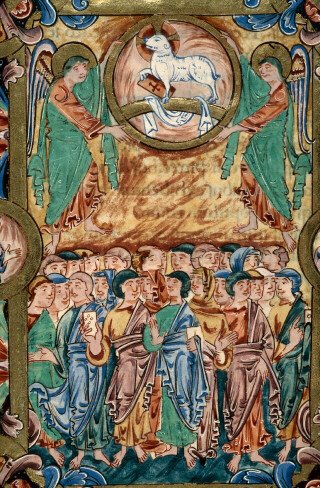
Michael P. Foley is an associate professor of patristics at Baylor University. He is the author of Wedding Rites: A Complete Guide to Traditional Music, Vows, Ceremonies, Blessings, and Interfaith Services (Eerdmans) and Why Do Catholics Eat Fish on Friday? The Catholic Origin to Just About Everything (Palgrave Macmillan). _______________________________ NOTES: This article appears in the Fall 2008 issue of The Latin Mass Magazine, vol. 17:4; web publication at RORATE CÆLI authorized by author and periodical. Images related to the First and Second Lessons and to the Gospel of Ember Saturday in September: in the first image, Aaron and Moses offer a holocaust to the Lord.

1.Officially, they fall on the first [full] week after the Feast of the Holy Cross (September 14). 2. Another theory is that “Ember” comes from the Old English, ymbren, meaning time or season. 3. The one reason stated by the Didache is more polemical: Christians fast on different days in order to be different from the “hypocrites,” i.e., the Pharisees (8.1). 4.Cf. Francis X. Weiser, Handbook of Christian Feasts and Customs (New York: Harcourt, 1958), 31-32. 5.Weiser does claim, however, that voluntarily fasting or abstaining on Wednesdays was still alive in some areas when he was writing (1958). Of course, the other remnant of the weekly fast is Friday abstinence from flesh meat. 6.Technically, neither Jewish fast was part of the Mosaic Law, though both were, I would argue, part of the Mosaic way of life. 7.From a prayer by St. Thomas Aquinas. 8.Cf. my article, “The Rogationtide,” TLM 17:2 (Spring 2008), pp. 36-39. 9.Jacopo de Voragine, “The Ember days,” in The Golden Legend. 10.Cf. Michael P. Foley, Why Do Catholics Eat Fish on Friday? The Catholic Origin to Just About Everything (New York: Palgrave Macmillan, 2005), 148-49. 11.The medievals called this the jejunium exultationis—the fast of exultation. 12.There are relevant readings from the Old Testament and from the Letter to the Hebrews that are used throughout the year in both the 1962 and 1970 lectionaries, but the September Embertide is the only time that these readings are used in order to coincide with the autumn festivals of Sukkot and Yom Kippur. Again we see the principle of fulfillment rather than abolition liturgically enacted. 13.Cf. The Golden Legend, Volume 1, “The Ember Days.” 14.In the Middle Ages, the Ember days were kept as holydays of obligation, with rest from work and special acts of charity for the poor, such as feeding and bathing them. There was also an old superstition that the souls in Purgatory were temporarily released from their plight in order to thank their relatives for their prayers and beg for more. 15.Cf. my article, “The Rogationtide,” TLM 17:2 (Spring 2008), pp. 36-39. 16.Response to the query “How should rogation days and ember days be celebrated?” (http://www.catholicculture.org/library/view.cfm?recnum=5932, retrieved 2/20/08). 17.Cf. The Prince, ch. 25. 18.“Spain to Recognize Rights of Apes?” Catholic World News, 6/27/08, http://www.cwnews.com/news/viewstory.cfm?recnum=59360. 19.This is not a parody. Cf. Peter Montague, “The Four Horsemen—Part 1,” Rachel’s Environment & Health Weekly, #471, 12/7/95 (http://www.ejnet.org/rachel/rehw471.htm).