Rorate Caeli

40 years of Missale Romanum and the new Roman Rite - IV
A liturgical tale in three acts

Dramatis Personae

Pope Saint Pius V
Pope Paul VI
Pope Benedict XVI
____________

Act I

Pope Saint Pius V: "Furthermore, by these presents [this law], in virtue of Our Apostolic authority, We grant and concede in perpetuity that, for the chanting or recitation of the Mass in any church whatsoever, this Missal is hereafter to be followed absolutely, without any scruple of conscience or fear of incurring any penalty, judgment, or censure, and may freely and lawfully be used. Nor are superiors, administrators, canons, chaplains, and other secular priests, or religious, of whatever title designated, obliged to celebrate the Mass otherwise than as enjoined by Us. " (Quo Primum Tempore - July 14, 1570)

____________

Act II

Pope Paul VI: "We wish that these Our decrees and prescriptions may be firm and effective now and in the future, notwithstanding, to the extent necessary, the apostolic constitutions and ordinances issued by Our predecessors, and other prescriptions, even those deserving particular mention and derogation." (Apostolic Constitution "Missale Romanum" - April 3, 1969)


"The Novus Ordo was promulgated in order to replace the old one, after studied deliberation, in the execution of the norms which emanated from the Second Vatican Council." (Speech to the Secret Consistory - on the matter of Archbishop Marcel Lefebvre - May 24, 1976)

____________

Act III

Pope Benedict XVI: "It is, therefore, permissible to celebrate the Sacrifice of the Mass following the typical edition of the Roman Missal promulgated by Bl. John XXIII in 1962 and never abrogated, as an extraordinary form of the Liturgy of the Church." (Summorum Pontificum - July 7, 2007)

"What earlier generations held as sacred, remains sacred and great for us too, and it cannot be all of a sudden entirely forbidden or even considered harmful." (Letter to the Bishops on the publication of Summorum Pontificum - July 7, 2007)

40 years of Missale Romanum and the new Roman Rite - III
Ratzinger: "A fabricated liturgy"


J.A.Jungmann, one of the truly great liturgists of our [20th] century, had defined liturgy in his time as a "liturgy fruit of a development", as it was understood in the West, represented mostly by historical research; probably also contrasting with the Eastern notion which does not view historical evolution and growth in the liturgy, but only the reflection of the eternal liturgy, whose light, throughout the sacred unfolding, enlightens our ever-changing time with its unchanging beauty and grandeur.

Both concepts are legitimate and are not irreconcilable.

What happened after the Council was altogether different: instead of a liturgy fruit of continuous development, a fabricated liturgy was put in its place. A living growing process was abandoned and the fabrication began. There was no further wish to continue the organic evolution and maturation of the living being throughout the centuries and they were replaced -- as if in a technical production -- by a fabrication, a banal product of the moment.

Gamber, with the vigilance of a true visionary and with the fearlessness of a true witness, opposed this falsification and tirelessly taught us the living fullness of a true liturgy, thanks to his incredibly rich knowledge of the sources. As a man who knew and who loved history, he showed us the multiple forms of the evolution and of the path of the liturgy; as a man who saw history from the inside, he saw in this development and in the fruit of this development the intangible reflection of the eternal liturgy, which is not the object of our action, but which may marvelously continue to blossom and to ripen, if we join its mystery intimately.
Joseph Cardinal Ratzinger
Preface to the French edition of K. Gamber's
Die Reform der römischen Liturgie: Vorgeschichte und Problematik

40 years of Missale Romanum and the new Roman Rite - II
The new Ordo created a new liturgical rite

Does the Pope have the authority to change a liturgical rite founded on apostolic tradition and developed over many centuries? ... [I]n the past, the Church hierarchy did not exercise a strong influence on the development of liturgical forms. It simply sanctioned the rite that grew out of local custom, and even the Church practice of officially sanctioning a rite emerged relatively late, only after printed liturgical books became popular.

In the West, this practice began after the Council of Trent; and it is defined in Article 22 of the Constitution on the Sacred Liturgy [Sacrosanctum Concilium]. Referring to Canon 1257 of the Codex Iuris Canonici [1917], it says, "The supervision of the sacred liturgy depends solely on the authority of the Church, which resides in the Apostolic See and, in accord with the law, with the diocesan bishop (...Therefore, no other person, not even a priest, may add, remove, or change anything in the liturgy on his own authority)."

The Council did not elaborate on what the term "supervision of the sacred liturgy" (Sacra Liturgiae moderatio) means. If we consider past practices and customs, however, the term cannot mean the type of sweeping revisions of the Mass ritual and the alteration of liturgical texts that we are now experiencing. Rather, we must understand the real meaning in a larger context: Above all, the Council Fathers were intent on preventing every priest from "devising" the liturgical rite "on his own authority"—which, of course, is exactly what is happening today.

Nor can the liturgical reformers derive their authority from Article 25 of the Liturgy Constitution, which says, "The liturgical books are to be revised (recognoscantur) as soon as possible." ... 

[T]he type of revision of the liturgy of the Mass envisioned by the Council was the Ordo Missae published in 1965. At the very beginning, the decree [of 1965] points out that the revision (nova recensio) of the Order of the Mass is being issued because of the mutationes made to the Council's Instructions on the Proper Implementation of the Constitution on the Sacred Liturgy [Inter oecumenici].

As recently as May 28,1966, in an official letter written on behalf of the Pope and addressed to the Abbot of Beuron, who had sent to the Pope a copy of the new (post-Council) edition of the Schott-Missal, then Cardinal Secretary of State Cicognani stated, "The singular characteristic and primary importance of this new edition is that it reflects completely the intent of the Council's Constitution on the Sacred Liturgy." The letter made no mention of the fact that a comprehensive revision of this very Missal was already under way.

Only four years had passed since the publication of the new Missal when Pope Paul VI surprised the Catholic world with a new Ordo Missae, dated April 6, 1969 [and promulgated by the Apostolic Constitution "Missale Romanum"]. The revision made in 1965 did not touch the traditional liturgical rite. In accordance with the mandate of Article 50 of the Constitution on the Sacred Liturgy, it had been primarily concerned with removing some later additions to the Order of the Mass. 

The publication of the Ordo Missae of 1969, however, created a new liturgical rite. In other words, the traditional liturgical rite had not simply been revised as the Council had intended. Rather, it had been completely abolished, and a couple of years later, the traditional liturgical rite was, in fact, forbidden.

All this leads to the question: Does such a radical reform follow the tradition of the Church? Given the evidence we have presented, one cannot invoke the Council's decisions to support such an argument. As we have already shown, the assertion, which continues to be made, that the inclusion of some parts of the traditional Missal into the new one means a continuation of the Roman rite, is baseless.

The argument could be made that the pope's authority to introduce a new liturgical rite, that is, to do so without a decision by a council, can be derived from the "full and highest power" (plena et suprema potestas) he has in the Church, as cited by the First Vatican Council, i.e., power over matters quae ad disciplinam et regimen ecclesiae per totum orbem diffusae pertinent ("that pertain to the discipline and rule of the Church spread out over all the world").

However, the term disciplina in no way applies to the liturgical rite of the Mass, particularly in light of the fact that the popes have repeatedly observed that the rite is founded on apostolic tradition. For this reason alone, the rite cannot fall into the category of "discipline and rule of the Church." To this we can add that there is not a single document, including the Codex Iuris Canonici, in which there is a specific statement that the pope, in his function as the supreme pastor of the Church, has the authority to abolish the traditional liturgical rite. In fact, nowhere is it mentioned that the pope has the authority to change even a single local liturgical tradition. The fact that there is no mention of such authority strengthens our case considerably.

There are clearly defined limits to the plena et suprema potestas (full and highest powers) of the pope. For example, there is no question that, even in matters of dogma, he still has to follow the tradition of the universal Church—that is, as Vincent of Lerins says, what has been believed (quod semper, quod ubique, quod ab omnibus). ... 

As we examine the issue of unlimited papal authority and how it relates to the authority to change the established liturgical rite, ... this argument just may be the already established fact that, until Pope Paul VI, there has not been a single pope who introduced the type of fundamental changes in liturgical forms which we are now witnessing. ...

Not only is the Ordo Missae of 1969 a change of the liturgical rite, but that change also involved a rearrangement of the liturgical year, including changes in the assignment of feast days for the saints. To add or drop one or the other of these feast days, as had been done before, certainly does not constitute a change of the rite, per se. But the countless innovations introduced as part of liturgical reform have left hardly any of the traditional liturgical forms intact.

Since there is no document that specifically assigns to the Apostolic See the authority to change, let alone to abolish the traditional liturgical rite; and since, furthermore, it can be shown that not a single predecessor of Pope Paul VI has ever introduced major changes to the Roman liturgy, the assertion that the Holy See has the authority to change the liturgical rite would appear to be debatable, to say the least.
Klaus Gamber
The Reform of the Roman Liturgy
(Die Reform der römischen Liturgie: Vorgeschichte und Problematik) 
(Regensburg, 1981)

"Got a revolution, got to revolution!"
40 years of Missale Romanum and the new Roman Rite - I

The Church in 1969 was in the middle of the most serious crisis in its modern history, as the debacle following the Council and, particularly, the publication of Humanae Vitae, unfolded. Time reported on the grave situation in the Church:

For Pope Paul VI, the solemn ceremonies of Holy Week were more sorrowful than usual. On two successive days, in his most anguished public statements to date on the crisis in the Roman Catholic world, the Pope issued extraordinarily direct attacks on defecting clergy and dissent within the church.

Speaking to pilgrims in St. Peter's Basilica on Wednesday of Holy Week, the Pope identified the present-day sufferings of the church with the agony of Christ. "The Lord tests us," he declared. "The church suffers from the abandonment by so many Catholics of the fidelity that centuries-old tradition merits." Even "favored sons" engage in destructive criticism, and by their defections, "certain ecclesiastics and religious crucify the church." At Holy Thursday services next day, he spoke of the "practically schismatic ferment that divides and subdivides the church. How can the living and true church be authentic," he asked, "if the company that forms it is so often and gravely corroded by contestation or forgetfulness of its hierarchical structure?"

From his point of view, the Pope had good reason for the outbursts. Although the Vatican has by now be come accustomed to the public defection of priests, it was shocked by the recent resignations of two young, promising bishops. In Chile, the Most Rev. Gabriel Larrain Valdivieso, 44, auxiliary to the Cardinal-Archbishop of Santiago, left the priesthood for secular humanitarian work. In Peru, Bishop Mario Cornejo Radavero, 41, auxiliary to the Cardinal-Archbishop of Lima, reportedly brought his cardinal to tears by resigning to marry. Priestly defections have even touched the Vatican itself, where an honored member of the papal house hold, Monsignor Giovanni Musante (TIME, Mar. 21), had also left to marry.

Paul has frequently denounced excesses of reform within the church, but last week marked the first time that he has publicly referred to schism—a word that has almost never been mentioned by pontiffs since Clement VII hurled the accusation at Henry VIII more than four centuries ago. To many Vatican observers, the Holy Week statements suggest that the Pope has taken as much as he can from the dissenters and is ready to deliver an ultimatum to those who persist in ecclesiastical rebellion.
Hilarious! Actually, Pope Montini gave a great gift to the rebellious wing of the Church: on Holy Thursday, 40 years ago, he imposed (or at least attempted to impose) upon the whole Latin Church a completely New Mass, a liturgy much to the liking of the rebels. His own Roman Mass, promulgated by the Apostolic Constitution "Missale Romanum" - the second major step, after Pontificalis Romani,  in the fabrication of a new Roman Rite.

On the 70th Anniversary of Victory Day in Spain

RADIOMESSAGE
«CON INMENSO GOZO»
OF HIS HOLINESS
PIUS XII
TO THE SPANISH FAITHFUL

(April 14, 1939)

With great joy We address you, most dear children of Catholic Spain, to express to you our fatherly congratulations for the gift of peace and of victory, with which God has deemed worthy to crown the Christian heroism of your faith and charity, tried in so many and so generous sufferings. Our Predecessor, of venerable memory, expected, with longing and trust, this Providential peace, which is undoubtedly the fruit of that copious blessing which he sent, in the very beginning of the struggle, "to all those who had devoted themselves to the difficult and dangerous task of defending and restoring the rights and the honor of God and Religion" [1]; and We do not doubt that this peace shall be the one that he himself foretold since then, "the sign of a future of tranquility in order, and of honor in prosperity" [2].

Visitation

1. The Apostolic Visitation within the Legion of Christ/Regnum Christi had been widely known since at least before the Papal visit to Africa. It is good to see that it has been made public by the Holy See and the Legionaries today.

For the developments which led to the current Visitation, read our previous posts on the suspension of Father Maciel, the Founder, the praise of Father Maciel after his death by the leadership of the Legion ("Church is Sanhedrin, Pope is Pilate, Maciel is Jesus"), the suspension of the "Secret vows", and the new revelations regarding Father Maciel.

2. In other news, the very religious government of the People's Republic of China has once again arrested a Bishop, while the Chinese situation is being discussed in the Vatican.

70 years ago

March 29, 1939. Valencia, the capital and last stronghold of the Spanish Communist and Socialist forces is conquered by the federation of forces under Francisco Franco, whose government had already been recognized by most Western powers in the preceding months. The most brutal persecution of Catholics ever recorded is over after more than 30 terrible months. The intercession of the martyrs had been stronger than the might of the Soviet Union.
(Image: Pontifical Mass of Thanksgiving for the end of the war - Valencia, May 14, 1939)

"I am for love"

Cardinal Barbarin

In yet another assault on the Pope before a French church, approximately sixty members of homosexual organizations rallied at the steps of the Fourviere Basilica in Lyon this morning to "denounce the irresponsibility of Pope Benedict XVI regarding AIDS."
While the faithful filed into the church for Sunday Mass offered by their archbishop, Philippe Cardinal Barbarin, protestors representing Lesbian and Gay Pride, the Gay and Lesbian Forum, and AIDS Rhône unfurled a banner reading “The condom is life - The Church prohibits it” while chanting, “No to the callote (zucchetto), long live the capote (condom)”.
Meanwhile, in front of the Basilica, about sixty Catholic parents and children, gathered in support of the Holy Father, wearing stickers that read “Hands off my Pope”.
"There is a painful lack of understanding" complained Cardinal Barbarin. "The issue of condoms is a taboo subject and we must create conditions for a dialogue in mutual respect.” He continued, "We must listen to all of the cries because they come from the heart, but that does not create the conditions for dialogue."
When asked whether he advocated "the capote" or "abstinence", the Cardinal replied: "I am for Love."
After the Mass, His Eminence invited a delegation of seven protestors to the archdiocese for a "respectful dialogue", "in a cordial and relaxed atmosphere" according to a source close to the archdiocese.
Details gleaned from La Croix

Pierced


As the first week in Passiontide begins, beautiful words by Spanish writer Eugenio D'Ors (Eugeni D'Ors i Rovira), the author of one of our favorite aphorisms, "Todo lo que no es tradición es plagio" ("All that is not tradition is plagiarism").
The voice of Simeon already rises up, it elevates itself in the midst of the House of God. He had been there for many years, and he did not wish to leave it. He did not leave, nor did he die, in expectation of this, so that his eyes could see it. 

... His hands take the Child, Whom you had already once removed from the menaces of the Herod of Death. The prophetic voice rises up in the Temple:

-Behold this One is set for the fall and disorientation of many, and will lead to contradiction.

And to you he says:

- Your own soul shall be pierced by a sword.

Now - now, it pierces you. Now that you know the first Sorrow, from which all Sorrows shall come forth, and to its wound the other sorrows will not add anything else. Now that, with the fate of the Son, your fate has been set for ever. Now that, in the dust of your path, the footmarks of all future suffering have already been set. Now, when you already feel the Son to be lost, lost among the doctors, then among the apostles, then among the soldiers, then between the thieves, and in death, and in the tomb. Now that you can already see how the blessed flower of your flesh belongs to contradiction, and not to rest; to war, and not to peace; to your mission, and not to yourself...
Eugenio D'Ors
(1926)

Traditional Ordinations in the Latium countryside


J.P.Sonnen, of Orbis Catholicus, was in Tarquinia as five members of the Franciscans of the Immaculate were ordained to the priesthood by Archbishop Burke in a Traditional ceremony in the beautiful ancient church of Saint Francis (sets of pictures: 1 - 2 -3 - 4 - 5 - 6 - 7 - 8 - 9).

Ave, Sancta Dei Genitrix


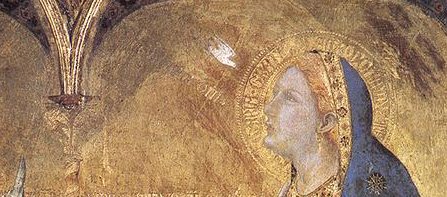
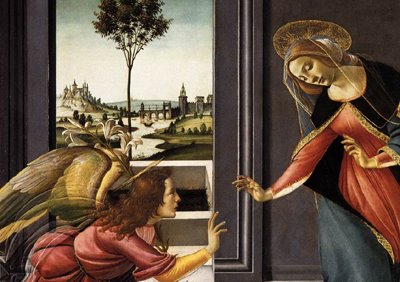
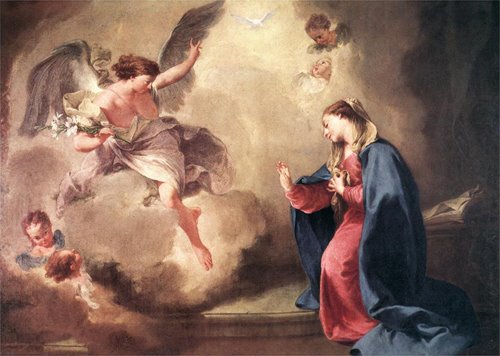
Deus, qui de beatæ Mariæ Virginis utero Verbum tuum, Angelo nuntiante, carnem suscipere voluisti: præsta supplicibus tuis; ut, qui vere eam Genitricem Dei credimus, ejus apud te intercessionibus adjuvemur. Per eumdem Dominum... (Collect of the Feast of the Annunciation of the Blessed Virgin Mary: "O God, who didst will that Thy Word should take flesh, at the message of an Angel, in the womb of the Blessed Virgin Mary, grant to Thy suppliant people, that we who believe her to be truly the Mother of God, may be helped by her intercession with Thee. Through the same Lord...")


He saw the reasonable race, the race of men that, like Himself, expressed the Father's Mind, wasting out of existence, and death reigning over all in corruption. He saw that corruption held us all the closer, because it was the penalty for the Transgression; He saw, too, how unthinkable it would be for the law to be repealed before it was fulfilled.


He saw how unseemly it was that the very things of which He Himself was the Artificer should be disappearing. He saw how the surpassing wickedness of men was mounting up against them; He saw also their universal liability to death. All this He saw and, pitying our race, moved with compassion for our limitation, unable to endure that death should have the mastery, rather than that His creatures should perish and the work of His Father for us men come to nought, He took to Himself a body, a human body even as our own.


Nor did He will merely to become embodied or merely to appear; had that been so, He could have revealed His divine majesty in some other and better way. No, He took our body, and not only so, but He took it directly from a spotless, stainless virgin, without the agency of human father—a pure body, untainted by intercourse with man. He, the Mighty One, the Artificer of all, Himself prepared this body in the virgin as a temple for Himself, and took it for His very own, as the instrument through which He was known and in which He dwelt.
Saint Athanasius
On the Incarnation

SSPX Ordinations canceled in Germany
Transferred to Écône


The rumors are apparently being confirmed: several German-language news agencies report today that the ordinations which had been planned for next Saturday at the Seminary of the Sacred Heart of Jesus,of the Priestly Fraternity of Saint Pius X (FSSPX / SSPX), in Zaitzkofen (near Regensburg, Bavaria, Germany) have been canceled.

UPDATE: The ordinations have not been canceled, but merely transferred, "at the request of the Holy See", to the Swiss seminary of the SSPX, the Seminary of Saint Pius X, in Écône, as confirmed by the Superior General of the Fraternity, Bishop Bernard Fellay (Source: DICI - permanent link).

Full text of the communiqué (our thanks to the Rev. Fr. Anthony, our reader, for the translation):

At the request of the Holy See, we decided to move the ordinations to the sub-diaconate that were supposed to take place at Zaitzkofen, in Germany, this Saturday March 28th. They will take place at the seminary of Ecône, in Switzerland, on the same date.

This decision is intended to be a peaceful gesture after the lifting of the unjust condemnations that weighed on the Bishops of the Society and the violent reactions that followed. In fact, we regret that some Episcopates have taken advantage of this to conduct an open rebellion against the Sovereign Pontiff. We are particularly disheartened by the attitude of the German Episcopate that has not ceased to show its hostility stripped of charity and its continuous judgements of intention, treating us “hatefully, without misgiving or restraint”, as the Holy Father justly said in his letter of last March 10th.

We know that our situation, before the law of the Church, is imperfect. This is not new, and is intimately linked with the crisis that is affecting the Church and the state of necessity that flows from it. Then, it is useless to invoke law to try to suffocate the life of our priestly society. The other ordinations will take place as planned. There has never been any question of cancelling them. Indeed, the kind act of the Holy See should not be interpreted as a determination to strangle the Society of Saint Pius X.

We are sticking to the schedule as indicated by the decree of last January 21st which provides for the “necessary talks” concerning the Council Vatican II and its novelties. To the Holy Father, we repeat our promise of our prayer so that the full light of the whole Truth may bloom from these doctrinal discussions.

Menzingen, March 24th 2009.

+ Bernard Fellay

43% of French Catholics wish to see Benedict XVI go

(Reuters, 21/03/2009)
PARIS - According to an Ifop poll for the Journal du Dimanche, 43% percent of French Catholics desire the departure of Pope Benedict XVI who has been widely criticized after his recent statements about condoms. If 54% want him to remain in the Vatican, 83% of the Catholics of France believe that the Church must change its discourse and its positions on abortion to reflect changes in society.
According to the survey which is to be published on Sunday, they also want the Church to change its discourse and its positions on homosexuality (69%), remarriage for the divorced (77%), and contraception (85%).
The survey was conducted from March 19 to 20 among a sample of 620 Catholics representative of the French population aged 18 and over, following the remarks of the pope.
From the plane which brought him to Africa last Tuesday, Benedict XVI asserted (estimé) that distribution of condoms was not a means to fight the AIDS pandemic, but on the contrary it aggravates the problem.
The first CSA poll for Le Parisien/Aujourd'hui published on Saturday showed that the image of the pope had deteriorated significantly in France, including among Catholics.
According to this study, 23% of the French say they have a good opinion of Benedict XVI while that figure was 53% in September. There are now 57% who have a poor opinion of him in contrast to 25% six months ago.
Among Catholics, 29% of those responding say they have a good image of the pope compared to 65% in September. 55% expressed a negative opinion compared to 19% six months ago.
The declining image of the pope is also confirmed by Catholics who practice regularly of which only 52% (compared to 86% in September) have a good opinion of him.
The CSA poll was conducted by telephone on March 18 and 19 from a sample of 1012 people representative of the French population.
France Wednesday expressed "its profound concern" ("sa très vive inquietude") in the wake the of the pope’s comments.
"These words are regressive and we are very concerned about these statements which call into question the spirit and the struggle of several decades" against AIDS, said Rama Yade, Secretary of State responsible for human rights.

Mission: it is our duty to offer everyone
the possibility of attaining eternal life

At this moment I would like to go back in thought five centuries, to the years following 1506, when, in these lands, then visited by the Portuguese, the first sub-Saharan Christian kingdom was established, thanks to the faith and determination of the king, Dom Alphonsus I Mbemba-a-Nzinga, who reigned from 1506 until his death in 1543. 

The kingdom remained officially Catholic from the sixteenth century until the eighteenth, with its own ambassador in Rome. You see how two quite different ethnic groups – the Bantu and the Portuguese – were able to find in the Christian religion common ground for understanding, and committed themselves to ensuring that this understanding would be long-lasting, and that differences – which undoubtedly existed, and great ones at that – would not divide the two kingdoms! For Baptism enables all believers to be one in Christ.

Today it is up to you, brothers and sisters, following in the footsteps of those heroic and holy heralds of God, to offer the Risen Christ to your fellow citizens. So many of them are living in fear of spirits, of malign and threatening powers. In their bewilderment they end up even condemning street children and the elderly as alleged sorcerers. 

Who can go to them to proclaim that Christ has triumphed over death and all those occult powers (cf. Eph 1:19-23; 6:10-12)? Someone may object: “Why not leave them in peace? They have their truth, and we have ours. Let us all try to live in peace, leaving everyone as they are, so they can best be themselves.” But if we are convinced and have come to experience that without Christ life lacks something, that something real – indeed, the most real thing of all – is missing, we must also be convinced that we do no injustice to anyone if we present Christ to them and thus grant them the opportunity of finding their truest and most authentic selves, the joy of finding life. Indeed, we must do this. It is our duty to offer everyone this possibility of attaining eternal life.
Benedict XVI
Mass with religious of Angola and São Tomé
Luanda, Angola
March 21, 2009

Tunicled Acolytes in Manila


The Hermandad de la Sagrada Pasion de Jesus held a procession last March 15 in Intramuros, the Walled City of Manila. Just like the Grand Marian Procession last December 7 in Intramuros, the procession featured the traditional Hispanic practice of vesting the acolytes, thurifers and crucifers in tunicles.
Intrmuros was the capital of Spanish Philippines from 1571 to 1898. Until their destruction during World War II, the monasteries and churches of the Walled City had lovingly preserved many medieval liturgical practices from Spain, such as the use of the cortina to hide the sanctuary during Lent, and tunicled acolytes. Since the 1980's, there have been modest attempts to revive the liturgical and devotional traditions associated with Intramuros. Pray that eventually, the life-giving heart of these traditions -- the Usus Antiquior -- will find its way back to Manila Cathedral (the massive church in the middle picture) .

Martyrological nature of the primacy of Peter

In October 1998, Joseph Cardinal Ratzinger issued a document on the Primacy of the Successor of Peter. This document is available here: http://www.ewtn.com/library/curia/cdfprima.htm

The Prefect of the Congregation for the Doctrine of the Faith wrote: "The Roman Pontiff - like all the faithful - is subject to the Word of God, to the Catholic faith, and is the guarantor of the Church's obedience; in this sense he is servus servorum Dei. He does not make arbitrary decisions, but is spokesman for the will of the Lord, who speaks to man in the Scriptures lived and interpreted by Tradition; in other words, the episkope of the primacy has limits set by divine law and by the Church's divine, inviolable constitution found in Revelation. The Successor of Peter is the rock which guarantees a rigorous fidelity to the Word of God against arbitrariness and conformism: hence the martyrological nature of his primacy."

It is given today to Pope Benedict XVI to live in his flesh this reality of his ministry. Let us pray to Saint Joseph, Protector of the Holy Church and Patron Saint of the Holy Father to assist, guide and strengthen Pope Benedict XVI in his difficult task. God bless the Holy Father!
Father Laurent Demets, FSSP

Saint Joseph: Complete submission to the will of God

I ... encourage you to look to Saint Joseph. When Mary received the visit of the angel at the Annunciation, she was already betrothed to Joseph. In addressing Mary personally, the Lord already closely associates Joseph to the mystery of the Incarnation. Joseph agreed to be part of the great events which God was beginning to bring about in the womb of his spouse. He took Mary into his home. He welcomed the mystery that was in Mary and the mystery that was Mary herself. He loved her with great respect, which is the mark of all authentic love. Joseph teaches us that it is possible to love without possessing. In contemplating Joseph, all men and women can, by God’s grace, come to experience healing from their emotional wounds, if only they embrace the plan that God has begun to bring about in those close to him, just as Joseph entered into the work of redemption through Mary and as a result of what God had already done in her.
...
Joseph was caught up at every moment by the mystery of the Incarnation. Not only physically, but in his heart as well, Joseph reveals to us the secret of a humanity which dwells in the presence of mystery and is open to that mystery at every moment of everyday life. In Joseph, faith is not separated from action. His faith had a decisive effect on his actions. Paradoxically, it was by acting, by carrying out his responsibilities, that he stepped aside and left God free to act, placing no obstacles in his way. Joseph is a “just man” (Mt 1:19) because his existence is “ad-justed” to the word of God.
...
The life of Saint Joseph, lived in obedience to God’s word, is an eloquent sign for all the disciples of Jesus who seek the unity of the Church. His example helps us to understand that it is only by complete submission to the will of God that we become effective workers in the service of his plan to gather together all mankind into one family, one assembly, one “ecclesia”. Dear friends from other Christian confessions, this quest for unity among the disciples of Christ represents a great challenge for us. It leads us first of all to be converted to the Person of Christ, to let ourselves be drawn more and more to him. In him, we are called to acknowledge one another as brothers and sisters, children of the same Father. During this year dedicated to the Apostle Paul, the great herald of Jesus Christ and the Apostle of the Nations, let us all turn towards him so as to hear and learn “the faith and truth” which are the deepest reasons for the unity of Christ’s disciples.
Benedict XVI
March 18, 2009

Ite ad Ioseph


____________________________

In Solemnitate Sancti Ioseph,
«Protector Sanctæ Ecclesiæ»,
Eum deprecemur pro Beatissimo Papa Nostro Benedicto XVI,
olim Cardinalis Iosephus Ratzinger

Ad te beate Ioseph,
in tribulatione nostra confugimus, atque, implorato Sponsæ tuæ sanctissimæ auxilio, patrocinium quoque tuum fidenter exposcimus. Per eam, quæsumus, quæ te cum immaculata Virgine Dei Genitrice coniunxit, caritatem, perque paternum, quo Puerum Iesum amplexus es, amorem, supplices deprecamur, ut ad hereditatem, quam Iesus Christus acquisivit Sanguine suo, benignus respicias, ac necessitatibus nostris tua virtute et ope succurras.

Tuere, o Custos providentissime divinæ Familiæ, Iesu Christi sobolem electam; prohibe a nobis, amantissime Pater, omnem errorum ac corruptelarum luem; propitius nobis, sospitator noster fortissime, in hoc cum potestate tenebrarum certamine e cælo adesto; et sicut olim Puerum Iesum e summo eripuisti vitæ discrimine, ita nunc Ecclesiam sanctam Dei ab hostilibus insidiis atque ab omni adversitate defende: nosque singulos perpetuo tege patrocinio, ut ad tui exemplar et ope tua suffulti, sancte vivere, pie emori, sempiternamque in cælis beatitudinem assequi possimus.
Amen.
A Leone XIII scripta

“This Pope is becoming a real problem”

Former Prime Minister of France speaks his mind to France Culture about Benedict XVI

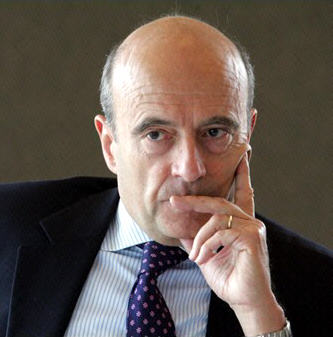
Former Prime Minister Alain Juppé (UMP), interviewed Wednesday by France Culture concerning the words of Benedict XVI denouncing condoms, said that "this pope is becoming a real problem" because he is living “in a situation of total autism."

The current mayor of Bordeaux who says he is Catholic "because I was born into it" and because "I am committed to Christian values" assured that, “This pope is becoming a real problem." He cited the reinstatement of Bishops "one of which is the apostle - dare I say – of negationism." Juppé also commented on the excommunication in Brazil and the question of condoms.

In Brazil, "that a nine year old girl who was raped, whose life is in danger, should be – if not herself, then at least her parents and the doctor who helped her abort – excommunicated; that is an extraordinary lack of Christian charity" continued the former head of government.

"To go say in Africa that condoms increase the danger of AIDS is, first of all an untruth and it is inacceptable for the African people and for everyone else," he continued. "There is a real problem, I feel a profound sense of uneasiness all around me" said Mr. Juppe, who has "the impression" that the pope "lives in a situation of total autism.”

Orange

A BRAVE STATEMENT


DECLARATION
Bold
Regarding the article entitled "Dalla parte della bambina brasiliana” [by Archbishop "Rino" Fisichella] and published in L'OSSERVATORE ROMANO on March 15, we the undersigned declare:

1. The fact [the rape of the little girl] did not happen in Recife, as the article states, but in the city of Alagoinha (Diocese of Pesqueira).

2. All of us - beginning with the parish priest of Alagoinha (undersigned) - treated the pregnant girl and her family with all charity and tenderness. The Parish priest, making use of his pastoral solicitude, when aware of the news in his residence, immediately went to the house of the family, in which he met the girl and lent her his support and presence, before the grave and difficult situation in which the girl found herself. And this attitude continued every day, from Alagoinha to Recife, where the sad event of the abortion of the two innocent [babies] took place. Therefore, it is quite evident and unequivocal that nobody thought in "excommunication" in the first place. We used all means at our disposal to avoid the abortion and thus save all THREE lives. The Parish priest personally joined the local Children's Council in all efforts which sought the welfare of the child and of her two children. In the hospital, in daily visits, he displayed attitudes of care and attention which made clear both to the child and to her mother that they were not alone, but that the Church, represented by the local Parish priest, assured them of the necessary assistance and of the certainty that all would be done for the welfare of the girl and to save her two children.

3. After the girl was transferred to a hospital of the city of Recife, we tried to use all legal means to avoid the abortion. The Church never displayed any omission in the hospital. The girl's parish priest made daily visits to the hospital, traveling from the city which is 230 km [140 mi] away from Recife, making every effort so that both the child and the mother felt the presence of Jesus the Good Shepherd, who seeks the sheep who need most attention. Therefore, the case was treated with all due care by the Church, and not 'sbrigativamente' [summarily], as the article says.

4. We do not agree [with Archbishop Fisichella] that the "decision is hard... for the moral law itself". Our Holy Church continues to proclaim that the moral law is exceedingly clear: it is never licit to eliminate the life of an innocent person to save another life. The objective facts are these: there are doctors who explicitly declare that they perform and will continue to perform abortions, while others declare with the same firmness that they will never perform abortions. Here is the declaration written and signed by a Brazilian Catholic physician: "...As an obstetrician for 50 years, graduated in the National Medical School of the University of Brazil, and former chief of Obstetrics in the Hospital of Andarai [Rio de Janeiro], in which I served for 35 years until I retired in order to dedicate myself to the Diaconate, and having delivered 4,524 babies, many from juvenile [mothers], I never had to resort to an abortion to 'save lives', as well as all my colleagues, sincere and honest in their profession and faithful to their Hippocratic oath. ..."

5. The affirmation [in the article] that the fact was made public in the newspapers only because the Archbishop of Olinda and Recife rushed to declare the excommunication is false. It suffices to notice that the case was made public in Alagoinha on Wednesday, February 25; the Archbishop made his pronouncement to the press on March 3; and the abortion was performed on March 4. It would be too much to imagine that the Brazilian press, before a fact of such gravity, would have silenced during the period of six days. Therefore, the news of the pregnant girl ("Carmen") was made public in the newspapers before the consummation of the abortion. Only after that, when asked by journalists, on March 3 (Tuesday), the Archbishop mentioned canon 1398. We are convinced that the disclosure of this therapeutic penalty (the excommunication) will do much good to many Catholics, making them avoid this grievous sin. The silence of the Church would be very prejudicial, especially considering that fifty million abortions are being performed every year around the world, and in Brazil alone one million innocent lives are ended. The silence may be interpreted as collusion or complicity. If any doctor has a "perplexed conscience" [as the article says] before performing an abortion (which seems extremely improbable to us), he should - if he is a Catholic and wishes to follow the law of God - seek a spiritual director.

6. The article is, in other words, a direct attack of the defense of the lives of the three children vehemently made by Archbishop José Cardoso Sobrinho and leaves evident how much the author does not have the necessary data or information to speak on the matter, due to his utter ignorance of the facts. The text may be interpreted as an apologia of abortion, violating the Magisterium of the Church. The abortionist doctors were not in the moral crossroads mentioned by the text; on the contrary, they performed the abortion with full knowledge and coherence with what they believe and teach. The hospital in which the abortion on the little girl was performed is one of those in which this procedure is always performed in our state, under the cover of "legality". The doctors who acted as executioners of the twins declared, and still declare in the national media, that they did what they are used to doing "with great pride". One of them declared even that: "Then, I have been excommunicated many times".

7. The author believed he could speak about [a situation] he did not know, and, what is worse, he did not even have the trouble of first speaking to his brother in the episcopate, and, for his imprudent attitude, he is causing great scandal among the Catholic faithful in Brazil who are believing that Archbishop José Cardoso Sobrinho was rash in his pronouncements. Instead of seeking his brother in the episcopate, he chose to believe in our openly Anti-clerical press.

Recife-PE, March 16, 2009

Fr. Cícero Ferreira de Paula
Chancellor - Archdiocese of Olinda and Recife

Mons. Edvaldo Bezerra da Silva
Vicar General - Archdiocese of Olinda and Recife

Fr Moisés Ferreira de Lima
Rector of the Archdiocesan Seminary

Dr. Márcio Miranda
Attorney for the Archdiocese of Olinda and Recife

Fr. Edson Rodrigues
Parish priest of Alagoinha-PE - Diocese of Pesqueira

Live Event

The Franciscan Friars of the Immaculate will broadcast live the Missa Cantata (yes, a Traditional Mass) for the Solemnity of St Joseph on Thursday, March 19, at 7pm EDT (11pm GMT) from the Our Lady of Guadalupe Chapel, in Connecticut

Live broadcast will begin below at the time of the event.

The Christian message always brings hope

I come among you as a pastor, I come to confirm my brothers and sisters in the faith. This was the role that Christ entrusted to Peter at the Last Supper, and it is the role of Peter’s successors. When Peter preached to the multitudes in Jerusalem at Pentecost, there were visitors from Africa present among them. And the witness of many great saints from this continent during the first centuries of Christianity – Saint Cyprian, Saint Monica, Saint Augustine, Saint Athanasius, to name but a few – guarantees a distinguished place for Africa in the annals of Church history. 

Right up to the present day, waves of missionaries and martyrs have continued to bear witness to Christ throughout Africa, and today the Church is blessed with almost a hundred and fifty million members. How fitting then, that Peter’s successor should come to Africa, to celebrate with you the life-giving faith in Christ that sustains and nourishes so many of the sons ad daughters of this great continent! 
...
Even amid the greatest suffering, the Christian message always brings hope. The life of Saint Josephine Bakhita offers a shining example of the transformation that an encounter with the living God can bring to a situation of great hardship and injustice. In the face of suffering or violence, poverty or hunger, corruption or abuse of power, a Christian can never remain silent. The saving message of the Gospel needs to be proclaimed loud and clear, so that the light of Christ can shine into the darkness of people’s lives.
Benedict XVI
Welcoming ceremony - Yaoundé, Cameroon
March 17, 2009

For continuing coverage of the Papal visit to Africa, visit the special websites of Radio Vaticana and of the Holy See.

Ongoing Vatican wars
Rino Fisichella, saboteur

On the matter of the Archbishop of Olinda and Recife, in Brazil, and his brave defense of Church doctrine and Canon law, as well as the pathetic and repulsively lukewarm article written by the president of the Pontifical Academy for Life, Archbishop "Rino" Fisichella, there is nothing else to add to the combative words of the great Spanish blogger Francisco José Fernández de la Cigoña.

The late intervention of Fisichella happened after Cardinal Re had already assured the Archbishop of Olinda and Recife of the support of the Holy See. But the careerists and showmen in the Vatican always have to appear when they are not being noticed.
Something is not working at the Vatican

The contradictions, the denials, saying something today when something else was said yesterday: it is all too much. With evident delight of all the enemies of the Church. Nothing of the sort has ever been seen. Some want the Church of certainties to become the Church of doubts. Where everything goes. Both black and white.

Morals a la carte, renouncement to principles, the [notion that] everything goes according to what is convenient is being imposed de facto. Or at least this is what some intend. The result is that the walls of the fortress are being breached. And some are delighted. The truth is not in the Church anymore. Some say one thing, and others say the opposite. If all kingdom divided shall fall, there are some who are already popping the champagne.

The news of the excommunication of those who participated in an abortion was not really [news], even though some wished to exploit the repugnant circumstances of the fact to attack the Church. Human life was sacred until the day before yesterday, from its conception to its end. Now, it seems it varies. It is [sacred] in some cases, and less so in others.

The Church chose the excommunication of the qualified authors of abortion confronted with the astounding crime multiplied by millions. She could not have done so, and it would still be a crime and a sin. But she did it. I suppose that by weighing the pros and the cons. The terrorist attacks in which hundreds are killed, the cases of abuse of children of very young age, ... multiple rapes, the bombing of defenseless populations... [sic] Their perpetrators, guilty of most grievous sin, are not excommunicated latae sententiae. But those who perform an abortion are. Or at least they were until yesterday. It is unknown today.

Because it seems that there are good abortions. Such as the one of Brazil. Quite a box has been opened! Let us now see how it will be closed.

... Whoever participated directly and effectively in the abortion of the Brazilian girl is excommunicated. With the declaration of the Archbishop of Olinda and Recife or without it. The Brazilian prelate might not have declared what already had taken place. And, considering what happened, perhaps that would have been more prudent. But he did not do other than expressing what the Church affirmed until yesterday. And I would like to suppose that she still affirms it.

I criticized the fact that a French bishop meddled in the Brazilian affair, and with words which almost justified that abortion. I believe that the Frenchmen are four at least by now. And they are now strengthened by an Italian who is none other than the president of the Pontifical Academy for Life. And the encomium mortis of the one who should in theory be the defender of life deserved the pages of L'Osservatore Romano. It is all absurd.

You will now see the attempts, difficult if not impossible, to put the toothpaste back in the tube. The general interpretation, and it is enough to read the world media, is that the Church legitimizes an abortion. That there are good abortions. That the Church has at last given in. And that she has recognized her error.

I am convinced that once again nothing will happen. ... I personally believe that Salvatore Fisichella, Rino to his friends, should resign today. Or be dismissed. And also the director of L'Osservatore.

Vianney, the model priest

[Pope Benedict XVI:] "In order to favor this tendency of priests towards spiritual perfection, upon which the effectiveness of their ministry principally depends, I have decided to call a special 'Year for Priests' which will run from 19 June 2009 to 19 June 2010". [This year marks] "the 150th anniversary of the death of the saintly 'Cure of Ars', Jean Marie Vianney, a true example of a pastor at the service of Christ's flock".

The Pope will inaugurate the Year on 19 June, presiding at Vespers in St. Peter's Basilica where the relics of the saintly 'Cure of Ars' will be brought for the occasion by Bishop Guy Bagnard of Belley-Ars, France. He will close the year on 19 June 2010, presiding at a "World Meeting of Priests" in St. Peter's Square.

During the course of the Year, Benedict XVI will proclaim St. Jean Marie Vianney as patron saint of all the priests of the world. A "Directory for Confessors and Spiritual Directors" will also be published, as will a collection of texts by the Supreme Pontiff on essential aspects of the life and mission of priests in our time.

The Congregation for the Clergy, together with diocesan ordinaries and superiors of religious institutes, will undertake to promote and co-ordinate the various spiritual and pastoral initiatives which are being organised to highlight the role and mission of the clergy in the Church and in modern society, and the need to intensify the permanent formation of priests, associating it with that of seminarians.
Holy See Press Office

Note: Currently,  Saint John Mary Vianney, is the Patron Saint of Parish Priests - declared so by the Pope who canonized him, Pius XI. More papal words on Saint John Mary Vianney: Sacerdotii Nostri Primordia  (John XXIII).

Words of Doctrine: 
Primacy at the service of Church unity
Fr. Nicola Bux and Fr. Salvatore Vitiello

Seventy years ago, Cardinal Eugenio Pacelli, a Roman, was elected Pope with the name Pius XII. In those days, no one could imagine that the college of cardinals or the college of bishops would ever fail to be “in agreement in what you profess – according to the words of the Apostle – so that you are perfectly united in your beliefs and judgements” (1 Cor 1,10). Also John XXIII, in his opening discourse to the Council, could speak of “renewed, serene and tranquil adhesion to all the teachings of the Church in its entirety and preciseness, as it still shines forth in the Acts of the Council of Trent and the First Vatican Council”. Could we ever imagine that the Church, the mystical Body of Christ, could speak not in unison? Could we ever conceive ecclesiology of communion, overlooking what the Council said about the primacy (cfr Lumen gentium 13, 22 e 23) ?

Therefore, the whole Church, bishops, priests and lay faithful, would do well to reflect on the meek and argued words of the Holy Father Benedict XVI at the Major Roman Seminary and at the Angelus on Sunday 22 February and put an end to “polemics that are born where faith degenerates into intellectualism and humility is substituted by the arrogance of being better than the other … a caricature of the Church that should be one in mind and heart ”. These words express a patient exercise of Primacy and should be accepted by all Catholics with humble docility.

The Holy Father knows that Primacy has its own 'martyrological structure' because “God's message cannot be chained up. ”(2 Tm 2,9) and this is true for every Pope. The Primacy of Peter exists and operates because ecclesial communion cannot be destructive, indeed the Creed calls it ‘Catholic’. On this matter it is better to turn to what he wrote as a theologian, in Introduction to Christianity: “one fundamental idea is documented, since the beginning, as determinant: the words refer to unity of place: the ‘Catholic church', is only a community united with the bishop, not partial groups, which, for some reason or another, have separated themselves from it. Secondly, what is referred to here is the unity of local Churches among themselves, since they are not to close in on themselves they are the Church only if they remain open to one another, forming the one Church […] the adjective ‘Catholic’ expresses the Church's episcopal structure and the necessity for unity of all the bishops among themselves […]” (It. edition, ed. Queriniana-Vaticana, 2005, p 335).

After observing that this idea does not constitute the primary element, he states: “Fundamental elements of the Church are rather forgiveness, conversion, penance, Eucharistic communion and then, on this basis, plurality and unity: plurality of the local Churches, which are Church only through insertion into the body of the one Church […]Episcopal constitution appears in the background as a means of this unity[…]. An ulterior stage, again in the order of means, will be constituted by the service of the Bishop of Rome. One thing is clear: the Church is not to be seen starting from her organisation, instead her organisation must be understood starting from the Church. However at the same time it is clear that, for the visible Church, visible unity is something more than simple ‘organisation’.[…] Only by being ‘Catholic’, that is visibly one but with multiplicity, can she respond to what is demanded by the Symbol. In a torn and divided world the Church must be a sign and a means of unity, she must cross barriers and unite nations, races, classes. To what point, also in this task, has she failed, we know all too well […]despite everything…instead of simply denigrating the past, we should above all demonstrate that we are ready to answer the call of the present, striving not simply to confess the Catholicity of the Creed, but to achieve it in the life of our torn world ” (It. edition, p 336-337). [FIDES]