Rorate Caeli
Showing posts with label Strange Altars. Show all posts

"Systemic risk" doesn't just apply to banks, but to the liturgy
The way we form our youth forms our future
Francis' monsignor moratorium not so bad an idea ...

Rorate has brought our readers a couple of examples of strange altars and extremely irreverent liturgical behavior, mainly coming from Calvert Hall College in Maryland, the Christian Brothers' high school (see here and here).

Some liberal or even conservative Catholics will say that the Faith formation of the boys at this school will not be altered in the negative in the long term due to poor liturgy. Well, pictured below is a byproduct of that twisted liturgical formation -- and the systemic ramifications are not insignificant, as you will read. 


The immodestly-dressed man in the picture above is Monsignor Richard Hilgartner (we have cropped out the half-dressed young lady on his arm), until very recently the Director of the U.S. Bishops' Secretariat for Divine Worship.  

He was educated at Calvert Hall College. And, according to the USCCB, he headed the implementation of the re-translated Novus Ordo missal.

If you'd like to weigh in on his choice of dress -- or lack thereof -- he has publicly posted this photo for all to see on his Facebook page (click here).  UPDATE: it appears Monsignor has taken the photo off Facebook. 

Makes us wonder if Pope Francis isn't onto something with his monsignor moratorium.

Speaking of strange altars, part 2

We recently wrote about some very strange altars (see here). Then, a former student of Calvert Hall College High School in Maryland, sent us the photo below of the school's "Thanksgiving Liturgy." We weren't sure at the time if this was the unbloody Sacrifice on Calvary or aisle 8 at Whole Foods. 

Then, after a barrage of criticism on the school's Facebook page, which in the thread had the priest in the photo defending this Mass with Vatican II arguments, the school took the photo and the thread down. 

But wait! There's more ...


Today, in a live stream of the school's "liturgy," it's clearly Advent! The report below is from a former student of the school:

Speaking of strange altars ...

We recently wrote about some very strange altars (see here). Now, a former student of Calvert Hall College High School in Maryland, sent us this photo via Facebook of the school's "Thanksgiving Liturgy." We're not sure if this is the unbloody Sacrifice on Calvary or aisle 8 at Whole Foods. 

Who says Catholic education is dead? Feel free to weigh in here


(The Crescat has also posted this.)

Basket case:
The craze for strange new altars and "youth churches"

In the past few days this photograph has circulated among some Catholic blogs (and at least one Orthodox blog):


It shows Cardinal Marx spreading chrism on what surely has to be one of the strangest altars ever consecrated for a Catholic church in the past 60 years.

This event, the consecration of this altar, actually took place in 2010 for Munich's Jugendkirche ("youth church"). More pictures of the event can be found here. The altar is not as light as it appears: it is made of galvanized bronze and weighs 160 kg (350 lb) all in all. 

Below we see the altar in use during a Youth Mass in 2011 led by Bishop Engelbert Siebler, at that time an Auxiliary Bishop for Munich and Freising (source):


Speaking of youth churches: all in all there are more than a hundred Catholic "youth churches" in Germany, Austria, Switzerland and Luxembourg. There is a website on the activities of the various Catholic and Protestant "youth churches" in German-speaking lands: Jugendkirchen. There are no words to describe many of the pictures. For example:


Coming back to Cardinal Marx and his attitude to strange altars: he consecrated or will be consecrating 2 of them this month. 

On the 10th of November, he consecrated a new altar for the Church of the Annunciation in Traunstein-Haslach, one of the oldest parishes in the Archdiocese of Munich and Freising, dating back to the 14th century. (More photos here.)


Then on the 24th of November (today) he is scheduled to consecrate the following altar, for the church of St. Michael in Attel. According to the linked article, the altar is made of glass, with a metal framework inside.


These are no "isolated instances" but part of a wider trend that has not stopped at all in these past few years. This is the continuing trend of permanently erecting deliberately "modern" (normally cube or irregularly-shaped) free-standing altars versus (or in place of) traditional and venerable altars, implanting dissonance, rupture and ugliness in the middle of so many old churches in Europe. This trend has continued and will continue, Benedict XVI or no Benedict XVI, Francis or no Francis, with or without the blogs documenting them, and despite the fantasies of some that insanity in liturgy and sacred art is over. In this article alone we show, or link to pictures of, 48 examples of these modernist altars. All but one have been set up in traditionally-designed churches constructed before Vatican II, and all were set up after the election of Benedict XVI, with 42 being installed in the period from 2010 to the present year (2013) -- we are talking here of a continuing trend, on top of thousands of churches already disfigured during the post-Conciliar era. In setting up these "dissonant" altars the intent to destroy harmony in very heart of the sanctuary, and therefore of the liturgy, is obvious.

To see more examples from Germany, the old version of Fides et Forma has a post with pictures of Archbishop Gerhard Müller consecrating five very "modern" altars as Bishop of Regensburg between 2006 and 2012 (three of them between 2010 and 2012), all in beautiful old Bavarian churches. In 2011 we reported about the horror in Hildesheim's seminary and the devastation of the Augustinian church in Würzburg. As for Austria, Eponymous Flower featured the consecration of a red "lego altar" in an 18th-century Baroque church in 2012.

This year, France saw the consecration of a decidedly modernist new sanctuary (and altar) in the Church of Our Lady of Accoules. France also has this blank-looking altar consecrated in May of this year for the 12th century Abbey of Leoncel, this round altar (with scarcely enough space for the sacred vessels) consecrated in December 2012 in St Etienne de Corbeil-Essonnes (see also this link), a tiny altar made in 2012 for an old church in Nerbis, and this disturbing altar (with seemingly headless bodies) consecrated in 2011 for the old church of St. Pierre du Mont:


New altar, St. Pierre du Mont, 2011.

Even in Paris the mania has taken its toll: witness the new altar of the church of Saint Medard (consecrated by Cardinal Vingt Trois in 2011; click here for more pictures) or the new altar of the church of Saint Thomas Aquinas in Paris, consecrated early this year (scroll down this page for the date, and pictures of the consecration):

Church of Saint Thomas Aquinas, Paris. New altar, 2013.

The creator of the above altar, Jacques Dieudonne, made a similar altar for one of Lyons' old churches, Saint Polycarp, where the new altar was set up in 2011. The year before (2010), the Cardinal-Archbishop of Lyons consecrated a new altar for the church of Saint Louis de Fontaines sur Saône in the Archdiocese of Lyons. Judge for yourselves (and note that the denuded old High Altar still has a neglected tabernacle):


 New altar (2010) of Saint Louis de Fontaines sur Saône in the Archdiocese of Lyons

In addition, France has such delights as the monument to dissonance consecrated in 2011 for the 18th-century Sainte-Madeleine de Besançon (see below), the Cathedral of Amiens' new altar dedicated in 2011, and this cramped little altar established last year in the historical Église Sainte-Marguerite de Soppe-le-Haut. There was also, in 2011, the infamous "restoration" of the historic church of Saint Hilaire, in Melle (Deux-Sèvres, Poitou-Charentes).


The new altar and ambo of Sainte-Madeleine de Besançon, 2011.

Want more? See this tree-trunk-like altar consecrated in 2011 for the medieval church of Notre-Dame de Pré-en-Pail in the Diocese of Laval. And then we have this nondescript table in Brassempouy (also blessed in 2011), this cube consecrated for the medieval Basilica of Paray-Le-Monial (2011), this altar "on fire" (the article doesn't say the year, but this was installed in the centuries-old Carmel of Angers in 2012), this new altar made for the church in Givry in 2012 (the new altar is shown past the 3:00 mark, see also below) and this (the new altar, along with the new ambo and throne of the Gothic-style Cathedral of Nantes, set up in May of this year).

Givry's new altar, 2012.


Deserving their own category for bad taste are the irregularly-shaped altar consecrated in Notre Dame d'Urville in 2011 (see this and this) and the plainly weird altar installed in the ancient church of Saint-Paul-lès-Dax in 2012. And how can we forget the "ikea" altar of the Cathedral of St. Vincent in Viviers, placed around 2011?

Examples just a bit older are the square altar consecrated in 2008 in Sayrac, the new altar consecrated in 2008 in St Martin de la Canourgue, and the new altar and sanctuary of Saint-Jean-Baptiste de Belleville in Paris (inaugurated in 2008). We are not sure when this green cube was stuck into the magnificent church of Saint Pierre in Besançon, but from its style and design it would seem to be of recent vintage.

In neighboring Belgium, Archbishop Leonard of Mechlin-Brussels blessed a glass altar in 2012 in the splendid neoclassical (18th c.) Église Saints-Jean-et-Étienne-aux-Minimes in Brussels. In that same year, the Cathedral of Liege was gifted with this green horror:


Tiny Luxembourg has not escaped the trends: see this example from 2011.

For examples from Italy, we have this cube altar consecrated only last month for a neoclassical church, this new asymmetrically designed altar consecrated in August this year for an 18th century church in Trent (!), yet another cube altar of rough stone consecrated in December last year for the 16th-century parochial church of Montorfano, this "work of art" installed in a large Renaissance church in Bergamo in late 2010, the Cathedral of Reggio Emilia's controversial new altar (and sanctuary area) consecrated in 2011, and the infamous red cube of the Camaldolese monastery in Montegiove (that we reported in 2010).

The Gesù in Rome was not spared. This monument to banality was installed only a couple of years ago, when Benedict XVI was Pope. (More pictures can be found here.)


And there are so many other examples on the Internet...

These aberrations can and will continue, as these are but symptoms of the profound dislocation of the sacred liturgy of the Roman Rite. This dislocation cannot be set right either by purely voluntary movements for the promotion of the sacred from among the clergy and the laity or by the "good example" and "encouraging words" of any Supreme Pontiff.

And the "Liturgical Art and Sacred Music Commission" that was supposed to have been set up in the Congregation for Divine Worship late in 2011? No one seems to have heard of it after its creation was announced... Has it already joined the long list of aborted liturgical projects from the last two pontificates? 

Liftoff!


Vaticanist Andrea Tornielli reports for La Stampa's Vatican Insider that the newly-revamped Congregation for Divine Worship (following the motu proprio Quaerit semper) will institute an ambitious new " 'Liturgical art and sacred music commission' ... over the coming weeks", that "will not be just any office, but a true and proper team, whose task will be to collaborate with the commissions in charge of evaluating construction projects for churches of [the] various dioceses."

They are expelling Jesus from the churches

Newly remodeled Seminary Chapel of the Diocese of Hildesheim, Germany [Source]: in the center, the ambo ("Tisch des Wortes" - Table of the Word) and, farther away, the altar ("Tisch des Brotes" - Table of the Bread)

by Antonio Socci

One day, while chatting with some friends, Cardinal Ratzinger quipped, “The way I see it, the proof that the Church has Divine origins is the fact that it has survived the millions of sermons delivered every Sunday!”

The new sanctuary of a Romanesque church:
brought to you by... Jacuzzi?

The new sanctuary of the historic church of Saint Hilaire, in Melle (Deux-Sèvres, Poitou-Charentes), parts of which date from the 11th century, was unveiled yesterday.

Congratulations to Father Jacques Lefèbvre for his wonderful taste!  (Source: Diocese of Poitiers; tip: Le Forum Catholique.) 

The IKEA altar

The High Altar of the Cathedral of Saint Vincent, in Viviers (Ardèche):

The Box


The red cube, according to Messa in Latino, is what is currently used as the altar in the church in the Camaldolese monastery of Montegiove, which is currently down to 7 monks and 1 nun. According to the monastery's website, Mass is offered in the church only on Sundays and feast days. Messa in Latino states that communion is always "self-service".


Padre's Pio's new resting place

A few days ago, the body of Padre Pio was moved to the Chiesa San Pio (click on "Chiesa San Pio" to see a photogallery of the new church). More pictures of the church can be found in the website of the workshop that built it.

Some pictures from the official Padre Pio site:


The body of the holy friar was entombed in this (pictures can be found here):

Liturgical Renewal at Saint Peter's:
How does an altar disappear?

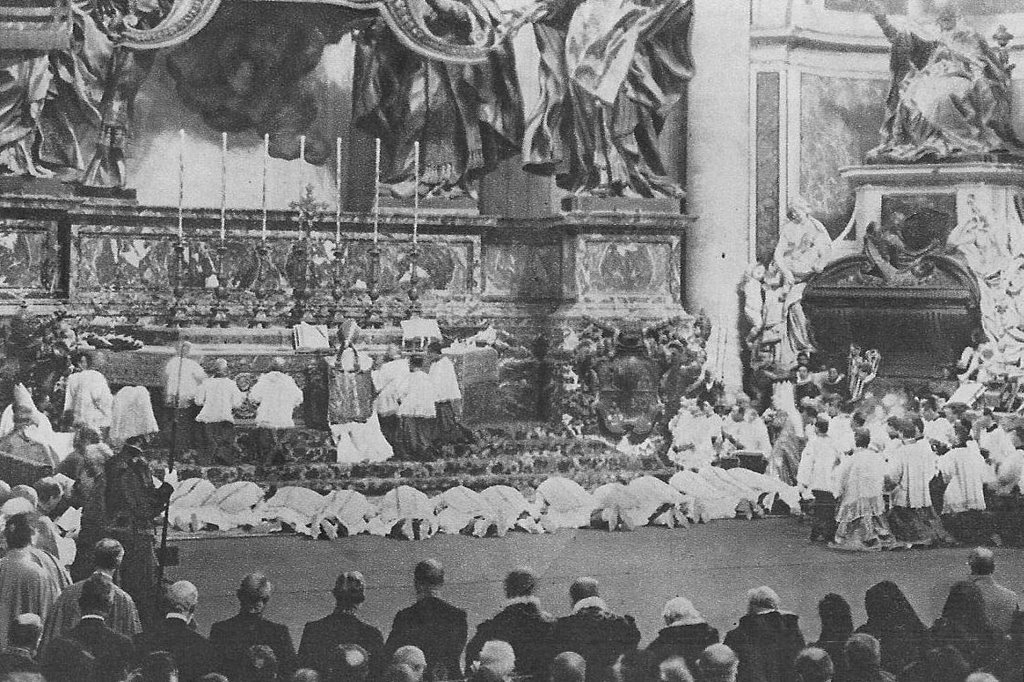
Saint Pius X says Holy Mass at the Altar of the Chair of Peter, 1906

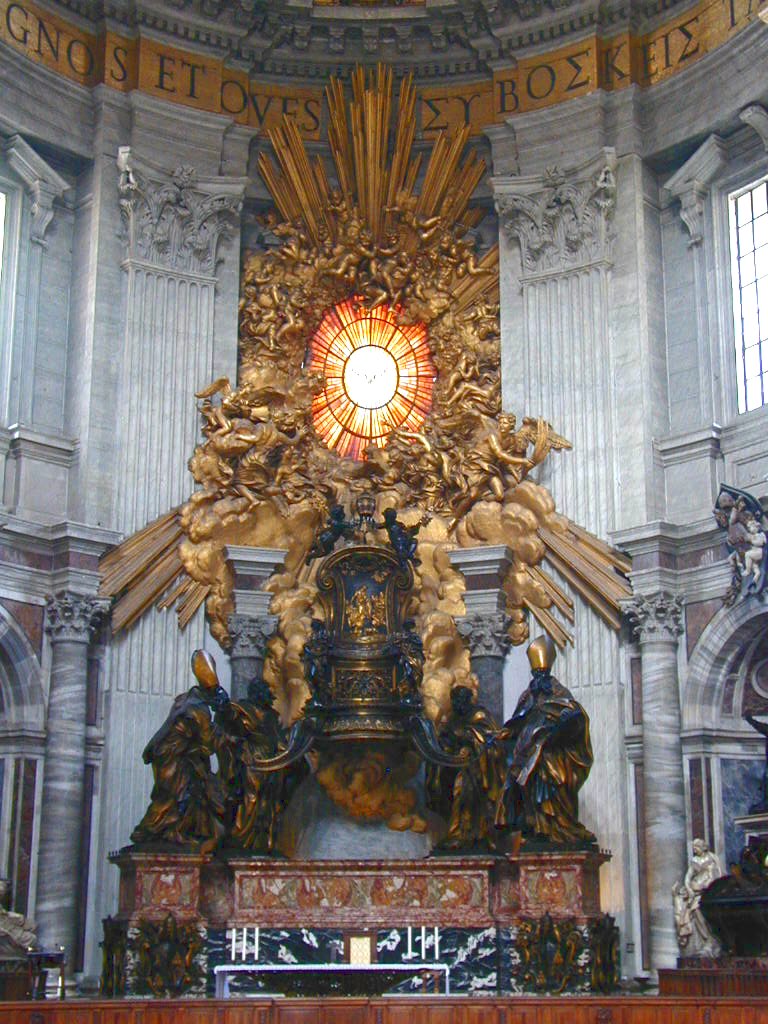
The center of Christendom, the mighty new Patriarchal Basilica of Saint Peter in the Vatican (whose 500th anniversary we celebrated so conspicuosly this year) has, in its apse, one of the most famous sculptural groups in the world, the Chair of Saint Peter, by Bernini.

The image is well-known to all Catholics: the Holy Cathedra, embedded in a chair-like bronze sculpture, apparently suspended in the air, surrounded by angels, an alabaster window with the Holy Ghost, and four Doctors of East and West.


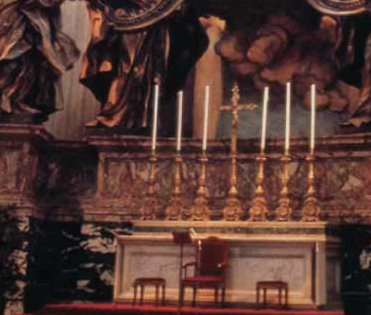
When Bernini finished this Counter-Reformation masterpiece, he included a marble altar and marble steps, moving (as it were) upwards towards the Cathedra, as it is plainly seen in this picture, with the traditional Roman altar arrangement (six candlesticks and a Crucifix).


And yet...

What many Catholics do not realize is that, sometime in the second half of the last decade of the past century, a liturgical expert in the Vatican (we would venture guessing a name...) decided to do something about that altar: the old, Traditional, look would not do. The complete removal of the altar was necessary. The Basilica had to be updated!


This is how the same place looks today: the traditional Altar, which had been in that place since the age of Bernini, was removed. Several yards to the east of it, a modern "anvil-like" altar has been added. Three marble steps to the old Altar remain, as a sort of pedestal for the celebrants, and as a phantasmagorical reminder of so many wonderful Masses celebrated versus Deum (westwards, circumstantially)...


Photographic collection tip: Cattolici Romani.

Marini speaks - Outside the Liturgical Reform, there is no Church

Earlier today, we remembered the Holy Father's plea to his flock: "Pray for me, that I may not flee for fear of the wolves."

Now, we publish the translation of a most enlightening interview of Archbishop Piero Marini, Papal master of ceremonies, to the Italian website Affari Italiani. The occasion for the interview was the presentation of Marini's new book "Liturgy and Beauty" in the Catholic University of the Sacred Heart in Milan (the famous "Cattolica"). This interview should be read for what it is: a warning, by certain areas of the Curia.


...
Archbishop Marini, after the Council, the liturgical reform cost a schism, that of Archbishop Marcel Lefebvre. What do you make of it?


"After every Council, there has always been a period of tension. There is always someone who does not agree or who does not approve that which has been done. Well, the fact is that we do not have policemen to order the faithful to accept that which the Second Vatican Council has decided (laughter).*"

And then?

"And then we must, first of all, understand that the liturgy is a sign of unity** and that, as Pope Paul VI said: 'The Church is not that of the past or of the future, but of the present, for which we must accept the Church living today. That is not a question of liberalizing the Missal or something else, it is just a question of accepting the Church of today, period. To be clear, I refer to the history of the Tridentine rite".

Yes...

"The Tridentine rite or that of Saint Pius V, which in reality is the Missale Romanum aggiornato according to the last dispositions of 1962 by the work of John XXIII, was left in place under certain conditions to avoid a traumatic passage from the old rite to the new for the older faithful. Afterwards, pope Wojtyla allowed that, in certain churches, the rite of Saint Pius V could be celebrated. But to walk beyond this is to walk beyond the Church, and that cannot be done. If the liturgy is a sign of unity for the Church, I cannot establish groups of faithful who at a certain day and at a certain time pray in one way, then another group who in another time pray otherwise. And then we come to the Lefebvrists"

Yes, we come to them. What do you think of them?

"It must be clear once and for all: they must accept what the Second Vatican Council has decided, otherwise no reconciliation will be possible. And then, what do these people want? The majority of the faithful has adapted itself; without the new rite, which was not a child of the Curia but a work of international inspiration, the celebrations and foreign trips of pope Wojtyla would have been impossible to make. Now, because they cannot adapt, what is the difference? I wish to tell you a story"

Please...

"Some years ago, they came to greet me and I received them. One of them spoke and said: 'Your Excelency, the new rite is a heresy.' 'Why?,' I asked: 'because -- that Lefebvrist told me -- 'in the old rite the celebrant kneeled, worship the Host, lifted himself, showed it to the faithful and then kneeled again to worship it.' 'Ah -- said I -- and now?' 'And now this is a heresy because the celebrant only kneels after the ostension, in reality asking first for the consentment of the community before proceeding to the consecration.'"

And then what did you do?

"What did I do? Well, we simply wished to abolish a duplicate and he talks to me about heresy? 'Here, this is my phone number,' I told him, 'when you have a need, call me'."

In your words, while you presented the book, I felt a certain nostalgia for the past. What for?

"Yes, at times I feel so nostalgic. Because at the time in which the liturgical reform was effected I was only 23, for which I saw the last three months of the Council, but this is part of my feelings. However, in a historical point of view, we had at the time a distant objective, the complete reform of the liturgy, which we wished to accomplish. We have worked through the perspective of the renewal and of the return to the Church of the Holy Fathers, eliminating every crust of time from the Roman liturgy. However, the enthusiasm has had some degenerations..."

Of what kind?

"I think that in Belgium and in the Netherlands, on the wave of experimentalism, more than 300 eucharistic prayers were created, then it slowly returned to normality. But I fear this, the return of neoritualism, that is, of the priest who celebrates Mass thinking: 'Well, I have said my Mass following the rite by the book, I am done.' And that is not good, the celebration is not only a passive respect for the liturgical rules, there is always some space for the celebrant."

Antonino D'Anna

*[Translator's note: the Council never decided a new Roman Rite. That was a post-Conciliar decision.]

**[Translator's note: which must come as a huge surprise to Eastern Catholics. The Second Vatican Council -- the actual text, not its "Spirit"-- has this to say: "The Holy Catholic Church, which is the Mystical Body of Christ, is made up of the faithful who are organically united in the Holy Spirit by the same faith, the same sacraments and the same government and who, combining together into various groups which are held together by a hierarchy, form separate Churches or Rites. ... the variety within the Church in no way harms its unity; rather it manifests it, for it is the mind of the Catholic Church that each individual Church or Rite should retain its traditions whole and entire", Orientalium Ecclesiarum. What is most curious is this, though: while the unity of liturgy has never been considered a sign of Catholicity, it is pathetic to argue that there is any unity whatsoever in the new Rite. This stale discussion, which shows that the last aggiornamento some went through was in the 1960s, tries to ignore the fact that there are not two similar new Masses, and there is no possible standard, which the Archbishop himself confesses by parading the "space for the celebrant" -- from one parish to another, the liturgical difference is greater than that between the Traditional form of the Roman Rite and any Eastern Rite.]