Rorate Caeli

Resources and Essays

Three new offerings for web-surfing Traditional Catholics ...

The first is a position piece on the Second Vatican Council and what should be our attitude towards it. This will certainly be controversial, because opinions are so divided on this subject, and people feel quite strongly about their particular opinions (myself included). A summary quote:

To sketch a rather broad outline that is admittedly too oversimplified, there are four basic approaches that have been taken to the council: first, those on the far left listen much more to the "spirit" of the Council, and use this "spirit" as their interpretive key which they bring to the texts themselves; second, those in the conservative middle accept the council as it stands, but reject the abuses of the council documents as belonging to the aforementioned "spirit" of Vatican II; third, those slightly to the right of the middle underscore the fact that this council was "pastoral" and not "dogmatic," and while accusing the council of having professed "errors," they cling to the fact of the council's non-infallible nature as justification for "ignoring" the council and continuing about their lives as though it had not happened; fourth, those on the far right accuse the council of out-right heresy, affirm its attempt at speaking infallibly, and thus conclude that it was a false council, convened and promulgated by men who were not true popes.


This essay takes a decidedly gray position somewhere between the second and third options listed above. Read more of Heretical or Ambiguous? A Necessary Response to the Second Vatican Council. Let the arguing commence!

The second piece is a short, conversational essay on how to become better acquainted with Scripture:

The title of this essay was chosen carefully: the word "amateur" comes to us from the French, which itself derives from the Latin amator - a lover. The goal here is not so much to become a "scholar" of Scripture, but a lover - a true amateur. So how does one become a lover of Scripture, such that one's love of the bible eventually becomes a kind of familiarity, an ability to see the logic behind the texts?

First and foremost, frequent contact with the texts is necessary. You don't become a lover by spending one day every two weeks with a person; you become a lover by spending lots of time with that person, every day, learning about them, getting beyond superficial details until you almost know that person's mind. The texts of Scripture need to be in front of you on a daily basis, even if only for half an hour every day. I achieved familiarity with Scripture because my mother (to whom I will be forever indebted) sat down with her children every day and read two chapters of Scripture with them. After reading two chapters of Scripture a day for some twelve years, a person cannot help but become familiar with the stories, persons, and passages of Scripture. I would suggest a similar plan for someone wanting to become better acquainted with God's word: try reading two chapters a day. Even after six months, you'll be in a much better position to understand Scripture.


The essay includes quite a few resources for those who wish to pursue Scripture Study more deeply. Read more of How to Become a Scripture Amateur: On Studying the Bible.

Finally, the third piece is pure resource, but one that is necessary. It is the full English text of Pope Paul VI's General Audience of January 12, 1966 - the speech in which he admitted that the Council made no infallible dogmatic pronouncements. I have not been able to find this text in its fullness in the English language anywhere on the Internet - hopefully this resource will prove useful to many.

Enjoy the weekend.

Will Dias propagate the Faith?

Ivan Cardinal Dias, Archbishop of Bombay, may "very likely" be the next Prefect of Propaganda Fide (Congregation for the Evangelization of Peoples), Il Foglio reports, as a replacement of Cardinal Sepe, who, for the past couple of weeks, has been considered the most probable future Archbishop of Naples.

In its Thursday edition, L'Indipendente recognized the Dias trend, which has been confirmed by Il Foglio today. (Dias was mentioned twice by us in the past few days- here and here).

Noah's Drunkenness, Ham's Sin, and Canaan's Curse

Sometimes reading Scripture can be like trying to solve a mystery-crime: you have to look for clues, collect the evidence, and see where it leads. For those of you who enjoy such pursuits (the "Scripture geeks" among us), I offer my latest essay, which - believe it or not - has some rather strong implications for our modern culture:


Among my many childhood memories, one particularly early memory (relating to the interpretation of Scripture) stands out. When I and my siblings were young, we would gather in the mornings with our mother to read two chapters of Scripture - this was a daily habit. Over the course of several years, we covered nearly all of the Old and New Testaments, sometimes circling back around and covering old territory again.

While reading through Genesis, I was perplexed by the story of Noah's drunkenness in Genesis 9. In that story, Noah drinks too much wine, and falls asleep in his tent. His son, Ham, comes into the tent, sees his father's "nakedness" (as the text says), and invites his brothers in to see it as well. They decline, instead bringing a blanket to cover their sleeping father. When Noah wakes up from his drunken stupor, he learns what had happened, and proceeds to curse ... Ham's son? So says the text. As a youngster, I could not understand why Noah would curse Ham's son for a sin that Ham himself committed.

Through varied study over the last several years, I have since come across several scholarly papers that attempt to address this issue, and as the ideas have been batted around, it seems that a child-hood riddle has now at last been solved - at least to some extent. It will be the purpose of this essay to relate and regurgitate some of that material in order to answer the question: what was Ham's sin, and why did his son have to bear the brunt of the curse?

...

What are the problems raised by the story of Ham's sin in Genesis 9? There are several.

First, why does Noah react with such intensity against what appears to be such a minor infraction? Ham's sin is, on the surface, apparently nothing more than a rather juvenile prank - he sees his father's nakedness, and goes to tell his brothers. Does that really warrant a cursing of Ham's lineage in perpetuity?

Second, the text says that Noah uttered his curses after he "awoke from his wine and knew what his youngest son had done to him." (9:24) How in the world did he know what Ham had done? It seems that there would have to have been some kind of visible effect of the sin of Ham (perhaps he left a sandal behind in Noah's tent?) in order for Noah to have knowledge of it. Perhaps one of Ham's brothers played the tattle-tale and told Noah what Ham had done - the text doesn't say.

Third, why does the text describe the sin as an active offense - "what his youngest son had done to him" - rather than a passive offense, which is how we would normally consider an act of voyeurism? Ham only looked at Noah, says the text; it isn't as though he actively caused Noah any harm.

Fourth, and most obviously, why is Ham's son Canaan the recipient of the curse, and not Ham himself? What did Canaan have to do with the sin of his father? It is so much a matter of common sense that it hardly warrants stating explicitly: Canaan is nowhere mentioned in connection with the sin, and so strict justice would demand that the offender himself should be punished, not his offspring.

Fifth, why was Noah naked in the first place? It is plausible that a man might get drunk; it is also plausible that, after getting drunk, the man might pass out for a while. But who gets drunk, strips naked, and then passes out? Did he start out naked when he began drinking (a bizarre thing in itself, if it were true)? If not, why would he take the time to take off his clothing before passing out?

Sixth, why would one man seeing another man naked be considered a sin at all, even if they were father and son?


Read more of Noah's Drunkenness, Ham's Sin, and Canaan's Curse.

Colombia: Abortion legalized "for the mother's health"

The Death Organizations (the United Nations, the European Union, and others) and the Death Foundations (the International Planned Parenthood Federation, the Ford Foundation, Human Rights Watch, and others) have won their first judicial battle in Latin America through their lawyers "by proxy".

Colombia, whose law forbids abortion for any reason, has now become the first Latin American country to legalize abortion "for the health of the mother", by a Court decision. Other "extreme situations" were also allowed by the Colombian version of Roe v. Wade (abortion of a rape-related pregnancy; abortion when the life of the mother is at risk; when the foetus has a "life-threatening malformation"), but the recognition of a Constitutional right for abortion "for the health of the mother" is the most important step.

As is well-known, abortion for the "health" of the mother is, in concrete terms, abortion on demand. The mother only needs a medical recognition of the "health risk" (including "mental health") to proceed with an abortion.

Abortion for "medical risk" is the legal framework for abortion on demand in many countries, including the United Kingdom (except for Northen Ireland) and Spain. And now it will become the gateway for abortion on demand in Latin America.

Colombia, a nation scarred by the violence of the Marxist guerrillas, will now become a no man's land for babies, victims of Marxist-influenced feminism.

Divino Niño Jesús:
Tengo mil dificultades: ayúdame.
De los enemigos del alma: sálvame.
En mis desaciertos: ilumíname.
En mis dudas y penas: confórtame.
En mis soledades: acompáñame.
En mis enfermedades: fortaléceme.
Cuando me desprecien: anímame.
En las tentaciones: defiéndeme.
En las horas difíciles: consuélame.
Con tu corazón paternal: ámame.
Con tu inmenso poder: protégeme.
Y en tus brazos al expirar: recíbeme.

Amén.*

____________________

*Standard English version: "Divine Child Jesus,/ In my difficulties: help me/ From the enemies of my soul: save me/ In my errors: enlighten me/ In my doubts and pains: comfort me/ In my solitudes: be with me/ In my diseases: invigorate me/ When others despise me: encourage me/ In temptations: defend me/ In difficult hours: strengthen me/ With your paternal heart: love me/ With your immense power: protect me/ And, into your arms, when I die: receive me. Amen." The Divine Child Jesus (Divino Niño Jesús) is one of the most famous devotions of Colombia.

Pope: Humanae Vitae is "always up-to-date"

In another interesting speech today, to participants of a seminary promoted by the Pontifical Institute John Paul II for the study of Marriage and Family of the Pontifical Lateran University, the Pope had some relevant words regarding the most important encyclical of Paul VI, whose very foundations were recently attacked by Eminent clerics:

"The idea of 'teaching how to love' followed the young priest Karol Wojtyla and, afterwards, motivated him when, as a young bishop, he faced the difficult moments which followed the publication of the prophetic and always current Encyclical of my Predecessor Paul VI, Humanae vitae".
Yes, the teaching of Casti Connubii and Humanae Vitae is perennial, it is always "up-to-date". Let us remember one of Humanae Vitae's most important passages:
Though it is true that sometimes it is lawful to tolerate a lesser moral evil in order to avoid a greater evil or in order to promote a greater good, it is never lawful, even for the gravest reasons, to do evil that good may come of it—in other words, to intend directly something which of its very nature contradicts the moral order, and which must therefore be judged unworthy of man, even though the intention is to protect or promote the welfare of an individual, of a family or of society in general.

Strong words from the Pope to the Church in Quebec

The Diocese of Saint-Jean-Longueuil, in the Montreal region, is divided into four great "pastoral regions": the "Anglophone" region, which covers the whole diocese and oversees English-speaking communities; and the geographical "Centre", "Sud-Ouest", and "Longueuil Nord" regions. Each of these "Pastoral regions" is guided by a "Regional Animator" -- in all cases, laywomen. This is just an extreme sign of a common practice throughout Quebec (as in most dioceses in North America), in all levels of Church government, especially in parish churches.


Today, in his speech to the bishops of Quebec, who, in the past couple of weeks, have been making their "Ad Limina" visits to the Pope and to the Roman Dicasteries, the Pope had some strong words regarding the irreplaceable position of priests in the government of the Church:

Meanwhile, the reduction of the number of priests, which makes at times impossible the celebration of Sunday Mass in certain locations, puts in doubt in a disturbing way the place of sacramentality in the life of the Church.

The needs of pastoral organization should not compromise the authenticity of the ecclesiology which is expressed. The central position of the priest who, in persona Christi capitis, teaches, sanctifies, and governs the community, cannot be minimized.

The ministerial priesthood is indispensable for the existence of an ecclesial community. The importance of the position of lay people, whose generosity in the service of the Christian communities I salute, can never hide the absolutely irreplaceable ministry of priests for the life of the Church. Therefore, the ministry of the priest cannot be entrusted to others without truly hurting the authenticity of the Church's own self.

Furthermore, how may young men wish to become priests if the position of the ordained ministry is not clearly defined and recognized?


The outrageous letter of the Canadian Religious Conference, openly defending anti-Catholic principles and practices, is probably related to another of the pope's warnings in his speech:

I therefore invite consecrated people, male and female, to grow in their ecclesial sentiment and in their need to work in an always closer relationship with their Pastors, welcoming and spreading the doctrine of the Church in its integrity and in its integrality.
Finally, the Holy Father recalled the most important speech of his pontificate, the epoch-making Christmas Speech to the Curia, of December 22, 2005:

Ecclesial communion, founded on the very person of Jesus Christ, demands fidelity to the doctrine of the Church, notably by a just interpretation of the Vatican II Council, that is, as I have had the occasion to say, "the 'hermeneutic of reform', of renewal in the continuity of the one subject-Church which the Lord has given to us" (Speech to the Roman Curia, December 22, 2005) In fact, if we thus read and receive the Council, "it can be and can become increasingly powerful for the ever necessary renewal of the Church." (ibid.)

Curial Reforms: Changes in the 'Vatican Bank'

"Vatican Bank"... The mere view of the unofficial name of the Istituto per le Opere di Religione (IOR-Institute for Religious Works) brings alive hundreds of conspiracy theories, mostly linked to the undeniably shady period, in the 1970s and early 1980s, during which the IOR was guided by American Archbishop Paul Marcinkus, recently deceased.

Today -- after the changes promoted by Pope John Paul II and many years after the payment of hundreds of millions of dollars to those who had been affected by the schemes of the bankrupt Banco Ambrosiano, of which the Vatican Bank had been a major stockholder in the Marcinkus years -- the IOR, which is the manager of the financial assets of the Holy See and of other ecclesiastical entities, is once again solid, under the guidance of Italian financier Angelo Caloia, generally considered a reliable manager.

Nevertheless, for some undisclosed reason, the current IOR bureaucracy did not please the Pope entirely, and Vaticanist Andrea Tornielli reports in this Thursday's edition of Il Giornale that "ten middle-high level employees of the IOR have been forced into 'early retirement' in the past week". The [early retirement] "did not only cover employees past the 65-year-old mark, but even younger" ones. The changes are significant considering the fact that the IOR itself is a very small structure.

Tornielli believes that the changes in the Vatican Bank are probably related to the general idea of "rationalization of the Curial offices" and the reduction of their bureaucracy, old ideas of Pope Ratzinger.

Or maybe the changes involve other issues.

Tradition and the Church of Rome

For the third consecutive week, the Wednesday catechesis of the Holy Father involved the study of Tradition, linked to the ministry of Bishops and their Apostolic Succession, and the eminent position of the Holy Roman Church, remembering the glorious teaching of the most famous Primate of the Gauls, Saint Irenaeus:

Irenaeus, then, ... focuses on that Church, "the very great and the very ancient church, known to all" which was "founded and established in Rome by the most glorious apostles Peter and Paul"... .

In this way, for Irenaeus and for the universal Church, the episcopal succession of the Church of Rome becomes the sign, the criterion, and the guarantee of the uninterrupted transmission of the Apostolic Faith: "For it is a matter of necessity that every Church -- that is, the faithful everywhere -- should agree with this Church, on account of its preeminent authority (propter potiorem principalitatem) inasmuch as in her the Apostolic Tradition has been always preserved" (Adversus haereses, III, 3, 2).

The episcopal succession -- verified on the base of its communion with that [succession] of the Church of Rome -- is therefore the criterion of of permanence of the particular Churches in the tradition of the apostolic faith, which through this channel could reach us since the origins. "In this order, and by this succession, the ecclesiastical tradition from the apostles, and the preaching of the truth, have come down to us. And this is most abundant proof that there is one and the same vivifying faith, which has been preserved in the Church from the apostles until now, and handed down in truth."(ib., III, 3, 3).

According to these testimonies from the ancient Church, the apostolicity of the ecclesial communion consists in the faithfulness to the teaching and to the praxis of the Apostles, through whom the historical and spiritual link of the Church with Christ rests assured.

Moscow Patriarch: "This pontificate will be remembered"

The Italian news agency ANSA reports:

Benedict XVI will be the Pope of the ecumenical turning point. Who says this, in an interview to ANSA, is Alexis II, Ecumenical [sic] Patriarch of all the Russias: "We expect from him concrete facts to solve the existing difficulties; one may expect that, exactly for this reason, the pontificate of Benedict XVI will become famous and will be remembered". The Patriarch of Moscow adds: "The declarations of Benedict XVI on the will to develop the relations with the Orthodox Church inspire hope that the situation will change for the better."
ANSA has not yet released the full text of the interview.

Is the "Traditionalist question" involved in this larger project, as some sort of "preamble"?...

Where Are the Parents?

This is a comment, slightly edited, that I made recently on Pertinacious Papist, which, as you may have gathered, is where I spend a great deal of time. It was not made on one of my more temperate days, so be forewarned. I offer it as one quite familiar with the cruel and indecent ravages visited upon innocence by contemporary culture:

Where, indeed, are the parents?
.
This is precisely the thought that makes my blood pressure skyrocket when I listen to people on EWTN and Catholic radio, priests and bishops among them, burble about the smurfy wonderfulness of World Youth days, Kingdom Bound groovefests (which most of the Catholic kids in attendance don't even realize is not a Catholic event-- much less their parents vegetating at home), etc.
.
As one who is old enough to remember from his college days the utter dishonesty of hippie, pseudo-hippie, and spoiled-suburban-schmuck-wants-to-be-a-hippie events, I can only goggle at the bubbleheadedness of people who think that they can awaken a love for Jesus in the hearts of soft, coddled, indulged little butterballs by delivering it in such cheesy wrappings.
.
Back then, Woodstock and similar “hippie” festivals were supposed to be about love. They were really about getting laid as fast and as frequently as charm and biology allowed. If you were a teenage boy, drugs and alcohol were wonderful inventions in themselves, but their primary function was to facilitate getting a certified female on her back with a minimum of time and effort.
.
Everyone was shocked, SHOCKED!, by the misogynistic humor of Andrew Dice Clay several years back. What these Wrong Way Corrigan bluenoses didn’t get was, Clay’s humor captures, with jewel-like clarity, the typical teenage boy’s view of typical teenage girls. IT’S THE TESTOSTERONE -- AND THE CULTURE -- STUPID!
.
Oh, and in case anyone is wondering, no one parachuted 42nd street whores into Woodstock to service these pimply-faced omnivores. YOUR DAUGHTERS, AND YOUR PARENTS’ DAUGHTERS, DID THAT!
.
The icon at contemporary Christian festivals may be Jesus instead of the Maharishi, and the message may be one of salvation instead of insemination, but if you don’t think plenty of the latter occurs along the way, I think you are sadly mistaken. The dress is just as provocative, if not more so, than it was then, and the fine young Christian teenage boys still have testosterone popping out of every pimple – you do the math.
.
Popular Christian music has become an industry. People get rich at it. It has prospered by aping its secular analogues, and plopping simplistic Christian themes into the mix. The result may not be the piggishness of Woodstock, but it ought not to be confused with heavenly choruses either.
.
It is hard to believe, even now, that John Paul promoted these things. And that buffoons like Fr Stan, the rapper-priest, still peddle the myth that Christianity can be sustained by such freakiness. And that parents don’t have the common sense to see through the hype.
.
Do they even want to?

The words of Caiaphas


After his quite startling words in the General Audience of March 15 (in English)...

In choosing the Twelve, introducing them into a communion of life with himself and involving them in his mission of proclaiming the Kingdom in words and works (cf. Mk 6: 7-13; Mt 10: 5-8; Lk 9: 1-6; 6: 13), Jesus wants to say that the definitive time has arrived in which to constitute the new People of God, the people of the 12 tribes, which now becomes a universal people, his Church.

With their very own existence, the Twelve - called from different backgrounds - become an appeal for all of Israel to convert and allow herself to be gathered into the new covenant, complete and perfect fulfilment of the ancient one.


...Pope Benedict repeats the theme of the complete and absolute universality of the redemptive work of Jesus Christ in his homily (in Italian) of the Mass for the Ordination of Priests for the Diocese of Rome, on May 7:

At last, the Lord speaks of the service of unity entrusted to the shepherd: "And other sheep I have, that are not of this fold: them also I must bring, and they shall hear my voice, and there shall be one fold and one shepherd" (Jn, 10, 16).

This is the same John repeats after the Sanhedrin's decision to kill [uccidere] Jesus, when Caiaphas said that it would be better if only one man should be killed [morto] for the whole people than that the whole nation perished. John recognizes in these words of Caiaphas a prophetic word and adds: "And not only for the nation, but to gather together in one the children of God, that were dispersed" (11,52).

The relationship between the Cross and unity is revealed; unity is paid with the Cross. This is especially revealed by the universal horizon of the action of Jesus. If Ezechiel, in his prophecy of the shepherd, had in sight the repristination of the unity of the scattered tribes of Israel (cf. Ez 34, 22-24), what is now considered is not only the unification of the dispersed Israel, but the unification of all the children of God, of mankind -- of the Church of Jews and Pagans.

Judas' Death and its Deeper Meaning


What's so important about Judas' death? Why do the Gospels relate this material to us in such graphic detail? Why does St. Peter quote from the Psalms as his justification for filling the vacancy left by Judas in the apostolic college?

There is more to Judas and his death than meets the eye. A few snippets:

Both Psalms mention a condemnation that involves "blotting out" the memory of the wicked, and both refer to a desolation or casting out, so that "habitations" are left empty.

It is interesting, too, that both of these Psalms contain prophecies of the Passion of Christ. In Psalm 69, the prophet speaks in the person of the Messiah: "They gave me also gall for my food, and made me drink vinegar for my thirst" (vs.21), and the fulfillment of this prophecy is recorded in all four Gospels (cf. Matt. 27:48, Mark 15:36, Lk. 23:36, Jn. 19:29-30). Psalm 109 opens with the lines, "the mouth of the sinner and the mouth of the crafty man have been opened against me: they have spoken against me with a crafty tongue. And they have compassed me with words of hatred; and fought against me without a cause." (vv. 2-3) This is an apt description of what Our Lord experienced when His enemies "[spoke] against me with a crafty tongue" and "compassed me with words of hatred." Verse 25 of the same Psalm says, "I became also a reproach to them: when they saw me they shook their heads," a text that St. Mark probably has in mind when he writes of the Passion, "And those who passed by derided him, wagging their heads, and saying, etc." (Mk. 15:29)

Thus both Psalms are bound up with the fates of both Jesus and Judas - and their close proximity to the Passion is likely what made these texts suggest themselves to St. Peter at that moment. That is to say, they predict certain details of the Passion, but they also speak of what must happen to the Betrayer after the Passion is accomplished: he is to receive his own just recompense, leaving desolation behind him, and an "office" that must be taken by "another." St. Peter sees that these things have taken place, all except for the replacement of Judas in his "office of overseer."

However, a closer look at the texts cited by St. Peter shows that he has altered the first one slightly

...

The shifting from the plural their in the original to the singular his in St. Peter's quote may appear pragmatic at first: St. Peter needs to apply the quote to a singular individual, not to a group of people, so he alters the quote to suit his purposes. Or, perhaps he alters the text to bring it into line with the second text that he quotes, which refers to a singular individual ("his office"). But there is a third option: St. Peter knows that the true fulfillment of this text is multi-faceted - that it applies to an individual, but that ultimately the fate of this individual is only a micro-fulfillment of what will ultimately befall the collective that is personified by this individual.


Read more of Double-Meaning in the Death of Judas.

Also posted: the second part of Jonathan Field's on-going series on Mary as Mediatrix of Grace: A Trinitarian Approach.

Draw the living waters - 50 years of Haurietis Aquas - I

100 years after Pope Blessed Pius IX had extended the feast of the Sacred Heart of Jesus to the Universal Church, Pope Pius XII, of most glorious memory, decided to celebrate the occasion with one of the brightest lights of his pontificate, the Encyclical Letter Haurietis Aquas, signed on May 15, 1956 (also available in Dutch, French, German, Italian, Polish, Portuguese, Spanish).

As he usually did with the greatest themes (the Church, in Mystici Corporis Christi; the Sacred Liturgy, in Mediator Dei), he presented a true guidebook to the subject: one may safely say that all one needs to know and admire, all doubts and misunderstandings, all issues related to this most august object of adoration, the Sacred Heart of Our Lord, are answered in this Encyclical.

Are you in trouble? Draw the waters of Haurietis Aquas. Are you distressed? Read a few pages of this document bursting with love. Are you desperate regarding the interminable crisis of Holy Mother Church? Feel the balm of Divine Charity expressed by the elegant and assuring words of a great Pontiff.

Alas, many faithful have never read the whole Encyclical (these days, one may safely say many have not even heard of it). Therefore, as we are wont to do in these anniversaries, we will present little aspects of this encyclical in a series so you may feel encouraged to meditate on the wonders of the Sacred Heart and read the entire document -- or re-read it, if that should be the case.

---

The text of the encyclical is particularly dedicated to those who view the devotion to the Sacred Heart as something quaint and distant. It is dedicated to those men who view this devotion as "more suited to the use of women", when it is truly a universal devotion of adoration of Divine Charity incarnate, suited to all. It is dedicated to the learned who believe this devotion is "not quite suitable for educated men".

"We therefore urge all Our children in Christ, both those who are already accustomed to drink the saving waters flowing from the Heart of the Redeemer and, more especially those who look on from a distance like hesitant spectators, to eagerly embrace this devotion. Let them carefully consider, as We have said, that it is a question of a devotion which has long been powerful in the Church and is solidly founded on the Gospel narrative. It received clear support from tradition and the sacred liturgy and has been frequently and generously praised by the Roman Pontiffs themselves. These were not satisfied with establishing a feast in honor of the most Sacred Heart of the Redeemer and extending it to the Universal Church; they were also responsible for the solemn acts of dedication which consecrated the whole human race to the same Sacred Heart."
It is a particularly appropriate devotion for this age in which "the machinations of evil men" abound; evil men "who, as if instigated by Satan himself, are now more than ever zealous in their open and implacable hatred against God, against the Church and above all against him who on earth represents the Person of the divine Redeemer and exhibits His love towards men", the Roman Pontiff, "the Vicar of His Love".

It is a devotion necessary in this age in which the Church seems to be filthy; that is not so: she remains spotless and young, but "not a few children of the Church mar, by their too many sins and imperfections, the beauty of this Mother's features which they reflect in themselves".

"When so many evils meet Our gaze - such as cause sharp conflict among individuals, families, nations and the whole world, particularly today more than at any other time - where are We to seek a remedy, venerable brethren?"

"Can a form of devotion surpassing that to the most Sacred Heart of Jesus be found, which corresponds better to the essential character of the Catholic faith, which is more capable of assisting the present-day needs of the Church and the human race?"

"What religious practice is more excellent, more attractive, more salutary than this, since the devotion in question is entirely directed towards the love of God itself?"

None. This devotion to the Love Who became flesh, that Heart which first beat in the Immaculate Ark, is more than ever necessary.

Cor Iesu Sacratissimum, miserere nobis!

Nothing Lacking for Validity: On the New Rite of Episcopal Consecration

Fr. Anthony Cekada published a pamphlet against the New Rite of Episcopal Consecration called Absolutely Null and Utterly Void.

In it, he spent a great deal of time debunking Fr. Pierre-Marie's arguments that the New Rite is based on Eastern Rites and is therefore valid. Fr. Cekada scored a hit here, because he made a good case for the lack of comparison between the New Rite and the Eastern Rites.

Not a few Traditionalists have been perplexed by his pamphlet, but unfortunately, there has been very little written on the validity of the New Rite with which to counter Fr. Cekada's arguments.

I hope this new piece, Nothing Lacking for Validity, will be the beginning of a reversal of this imbalance.

Cardinal no muy Amigo:
When a man is not a man and a woman is not a woman.

Amidst the maddest succession of anti-family legislation proposed by any single government in Europe (probably ever), Zapatero's Socialists' latest proposal, likely to be introduced before the next general elections, would establish a "Gender Identity Act" (Ley de Identidad de Género).

As it often happens in such circumstances, the media picked the friendly cleric, Cardinal Amigo of Seville, to hear his opinion. From El País (Caution: some may find the Cardinal's words offensive):

The future approval of a Gender Identity Act to regulate the change of the sex and of the name of transsexuals is a "legal matter" which is not at all "frivolous", the Cardinal-Archbishop of Seville, Carlos Amigo, affirmed yesterday. A person's sex, "simply determined by an external inspection of the genital organs" may not be one's identity, he added. Amigo directed the regulation of such matters to "the experts".

A person's sex is "simply determined by an external inspection of the genital organs", and such identification may not be the most accurate, opined the Archbishop. In this, he concurs with the essence of the complaints of transsexual persons, who feel [they belong to] a sex which is not the one their genitalia portray. "Sex determination is made simply by an external inspection of the genital organs and one sex or the other is determined, but there may be a person whose only feature as a woman or as a man is this external appearance and that is not the identity of that person", he remarked.

Amigo was questioned after, in the past week, several groups of transsexuals began a campaign so that the Government fulfills its electoral pledge to regulate the change of name and sex in the Civil Registry with no need of complete surgery for the re-determination of sex.
The reporter transcribed the same sentence by the Cardinal three times, which may mean the Cardinal actually spoke it thrice or that the reporter was just surprised...

The Pope will visit Spain (Valencia) next July to take part in the World Meeting of Families (are the friendly Cardinal's words a coincidence?).


Tip: Radio Cristiandad (sidebar)

The Lord of History and His very tiny Remnant

Cardinal Dias' country, India, has as the national anthem of its secular Republic a religious poem written by a monotheistically-minded pagan, Nobel-laureate Rabindranath Tagore. Right after India's independence was proclaimed, the "Jana Gana Mana" was declared its national anthem, the only song which would not be offensive to Muslims (and to Christians), as it is a song of praise not to a deified nation, but to the "Dispenser of the fate of India", God.

When honest Christian Indians sing this anthem, they have one Lord in mind, the Lord of History, Jesus Christ. But the greatest problem of the Church in India in the past few decades is that there are very few honest Catholics left, especially in positions of leadership. Instead of using the common Indian spirituality and notion of the Divinity -- as missionaries did since the age of Saint Paul in the Areopagus and Saint Thomas in the Malabar Coast -- to bring pagans to the knowledge of the one and only Lord, to the one and only true Dispenser of the Destiny of all nations, Our Lord Jesus Christ, the Church in India, its dioceses, and its seminaries, have become cesspools of theological darkness and of paganized rituals. It is a Church which refuses to propagate the Faith and instead paganizes the Christian faithful.

As one of our commentators remarked regarding Cardinal Castrillón's letter to Cardinal Dias: the disgusting and deleterious situation of paganized seminaries in India and throughout Asia and Africa should be the cause of greatest concern! In a Church which has become diluted in the great Indian "spiritual melting pot", the alarming testimonies of the irresolute seminarians ought to be closely examined. "Separatist Traditionalist tendencies", while themselves problematic, do not seem so alarming when compared to a Church which seems to have left Christendom behind in search of Pantheism.

The propagation of the Faith is impossible with clerics who light candles to Ganesh, with priests and theologians who have been left untouched by the great proclamation that Jesus is Lord, Dominus Iesus (an old article on this very grave matter by Sandro Magister is available here -- in Italian only)

A few days before Cardinal Castrillón Hoyos sent his curious letter to Cardinal Dias of Bombay regarding the return of diocesan seminarians from a FSSPX-SSPX seminary, the catechesis of the Holy Father for the General Audience had been on the Magnificat, the last one of the series begun by Pope John Paul in 2001.

Though following the theme proposed by his predecessor, this beautiful catechesis was purely his own, filled with the deepest etymological formulations and eschatological conclusions:

In the original Greek of Luke's Gospel, we have seven aorist verbs that indicate the same number of actions which the Lord carries out repeatedly in history: "He has shown strength... he has scattered the proud... he has put down the mighty... he has exalted those of low degree... he has filled the hungry with good things... the rich he has sent empty away... he has helped... Israel".

In these seven divine acts, the "style" that inspires the behaviour of the Lord of history stands out: he takes the part of the lowly. His plan is one that is often hidden beneath the opaque context of human events that see "the proud, the mighty and the rich" triumph.

Yet his secret strength is destined in the end to be revealed, to show who God's true favourites are: "Those who fear him", faithful to his words: "those of low degree", "the hungry", "his servant Israel"; in other words, the community of the People of God who, like Mary, consist of people who are "poor", pure and simple of heart. It is that "little flock" which is told not to fear, for the Lord has been pleased to give it his Kingdom (cf. Lk 12: 32). And this Canticle invites us to join the tiny flock and the true members of the People of God in purity and simplicity of heart, in God's love.

May we remain in Your tiny flock and be true members of Your Body, Lord of History, through the prayers of the Mother of God and of Saint Francis Xavier, Apostle of the East!

---

As Saint John, the beloved disciple, left the cauldron of boiling oil prepared for his martyrdom next to the Latin Gate (Porta Latina) unscathed and healthier than before, may the Lord grant strength to His Church through her current ordeals.

Quem nos, in hoc discrimine,...quam te, Pie, invocabimus?


Belli tumultus ingruit...

Wars and tumults fill the earth;
Men the fear of God despise;
Retribution, vengeance, wrath,
Brood upon the angry skies.
Holy Pius! Pope sublime!
Whom, in this most evil time,
Whom, of saints in bliss, can we
Better call to aid than thee?
None more mightily than thou
Hath, by holy deed or word,
Through the spacious earth below
Spread the glory of the Lord.
Holy Pius! Pope sublime!
Whom, in this most evil time,
Whom, of saints in bliss, can we
Better call to aid than thee?
Thine it was, O pontiff brave!
Pontiff of eternal Rome!
From barbaric yoke to save
Terror-stricken Christendom.
Holy Pius! Pope sublime!
Whom, in this most evil time,
Whom, of saints in bliss, can we
Better call to aid than thee?
When Lepanto’s gulf beheld,
Strewn upon its waters fair,
Turkey’s countless navy yield
To the power of thy prayer.
Holy Pius! Pope sublime!
Whom, in this most evil time,
Whom, of saints in bliss, can we
Better call to aid than thee?
Who meanwhile with prophet’s eye
Didst the distant battle see;
And announce to standers-by
That same moment's victory.
Holy Pius! Pope sublime!
Whom, in this most evil time,
Whom, of saints in bliss, can we
Better call to aid than thee?
Mightier now and glorified,
Hear the suppliant cry we pour;
Crush Rebellion’s haughty pride;
Quell the din of rising war.
Holy Pius! Pope sublime!
Whom, in this most evil time,
Whom, of saints in bliss, can we
Better call to aid than thee?
At thy prayer may golden peace
Down to earth descend again:
License, discord, trouble cease;
Justice, truth, and order reign.
Holy Pius! Pope sublime!
Whom, in this most evil time,
Whom, of saints in bliss, can we
Better call to aid than thee?
To the Lord of endless days,
One Almighty Trinity,
Sempiternal glory, praise,
Honour, might, and blessing be.

V. Pray for us, blessed Pius.
R. That we may be made worthy of the promises of Christ.

Let us pray:
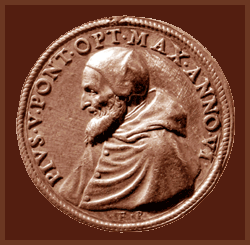
God, who to the destruction of the enemies of Thy Church, and to the restoration of Thy holy worship, didst vouchsafe to elect blessed Pius to be Thy high-Priest; grant us so to be defended by his protection, and so to remain steadfast in Thy service, that overcoming the snares of all our enemies, we may enjoy perpetual peace. Through our Lord Jesus Christ Thy Son. Amen.

From the Raccolta [hymn placed next to the Shrine of the Holy Pontiff in the Liberian Basilica.]

A Must-Read: Mary as Mediatrix of Grace

In all the hub-bub this last weekend surrounding Bishop Tissier de Mallerais' interview, a very good article was posted to my site by Jonathan Field, one of my more frequent guest writers.

Now that things have died down a bit, I want to take the moment to recommend this tremendous essay on Mary as the Co-Redemptrix, approached from a Trinitarian point of view - a valuable essay from the standpoint of apologetics as well as deepening our own understanding of Our Lady's role.

This essay (part one of a series) shows that we do have another mediator working for us: the Holy Ghost. It goes the step further and shows the intimate relationship between the Holy Ghost and Our Lady - the quasi-incarnatus of the Holy Ghost.

Read Jonathan Field's Mary as Mediatrix of Grace: A Trinitarian Approach (Part 1).

Le mieux est l'ennemi du bien !

There is a saying in French: «the best is the enemy of good » (le mieux est l’ennemi du bien).

I received an e-mail yesterday from a French diocesan priest who is a reader of the Rorate Caeli Blog. This priest told me of his surprise when he read the article by Brian Mershon which discusses an unwillingness on the part of certain priests in regards to the liberalization of the Tridentine Mass. I read the article and, I too, was surprised, especially on reading the following sentence by Father Santos: "A general indult could make things worse, not better, with a multitude of well-intentioned, but inept celebrations."

The arguments seem to be good and show a certain concern for the dignity of the Liturgy, which is, of course, legitimate. Priests are required to celebrate well the Holy Mysteries for the glory of God.

Father Fromageot makes another good point by saying: "The Classical Roman rite has not been available everywhere for a long time, so when you just have it freed, it just doesn't begin again as if it were here just yesterday."

But now, we have to consider the matter in reality, not just in theory. What would happen if tomorrow the general Indult were given? We are certainly not going to see a tidal wave of Tridentine Masses celebrated around the globe. The priests desirous of celebrating the Ancient Rite of the Mass are few when compared to the total number of priests in the Latin Rite. As my fellow French priest says, most of them have already been trained to celebrate this Mass. At least, he speaks about that with which he is familiar in France. The situation might be a little bit different in the United States, but not too much. I don’t meet regularly with Novus Ordo priests who want to celebrate the Old Mass, and when I do meet some, most of them know it already or are learning how to say it.

The Ecclesia Dei communities definitely have a mission regarding the training of Novus Ordo priests, and thanks be to God, this is already taking place. Many diocesan and religious priests from all over Europe, and sometimes priests from more distant countries, go to the Benedictine Abbeys of Le Barroux or Fontgombault to be trained for the Traditional Mass. Here, in Atlanta, we have taught two priests from Tennessee how to celebrate it. I know that other Fraternity apostolates train priests in the Tridentine Rite as well.

The majority of priests don’t care about the traditional Liturgy and sometimes they are opposed to it. So, a liberalization of the Traditional Mass will not affect them directly. This being the case, Father Fromageot is certainly right when he asserts that it just doesn’t begin again as if it were here just yesterday. But I do not agree when he speaks about the side benefit of the restrictions of the Classical Roman Rite, because those restrictions are simply an abuse of authority.
The Missal of Saint Pius V has never been abrogated and every priest of the Latin Rite can celebrate it in good conscience without any particular authorization. In fact, a general Indult would simply be the acknowledgement by the Highest Authority of the Church of a right already granted, which would be good.

And the matter is serious, because it involves the Catholic Faith and consequently salvation of souls. I don’t mean that all the Novus Ordo Masses contradict the Faith directly, but, as a matter of fact, it appears that the new Liturgy, at least as it is celebrated most of the time, has created a new way of worshiping God, and, ultimately, a new religion. This is a fact easily noticeable in the field. On the other hand, the Traditional Missal is a guardian of Orthodoxy.

Understand well: I am not saying that because you say or attend the traditional Mass, you are infallibly in truth – the Sedevacantists, for example – and I am not saying that because you say or attend the Novus Ordo you are infallibly in error: there are some places, though very rare indeed, where the Novus Ordo is well celebrated and where true Doctrine is taught.

We have fought for almost 40 years for the Traditional Mass. Today it appears that our fight is bearing fruit. The liberalization of the Old Missal would be one of these fruits. It is certainly not the time to put obstacles in the way. If a general Indult could make things worse, we will not be the ones for whom the situation worsens, but for the enemies of the Traditional Mass. It will also be an important step toward a reconciliation with our brothers of the Society of Saint Pius X.

To conclude, I will use the argument of Father Santos about the Novus Ordo. This one has to be well celebrated as for any rite of the Church. It has to be said in Latin according to Vatican II, at least for the main parts. But it appears that many priests do not, in fact, celebrate the Novus Ordo as they should, with reverence and according to the spirit of the Church. So I think that some restrictions concerning the Novus Ordo would be good, at least until priests can celebrate it well. By the time that occurs, perhaps the Old Mass will be then predominant.
You say that it is a dream? Perhaps...… but why can not allow ourselves to dream sometimes? For, amen I say to you, if you have faith as a grain of mustard seed, you shall say to this mountain, Remove from hence hither, and it shall remove; and nothing shall be impossible to you.
Sursum Corda!
In Christo Rege
Father Laurent Demets

Cardinal López Trujillo:
Martini's words "nothing more than his own personal opinions"

The Church cannot change. The Church cannot declare it is morally possible to do an intrinsically evil act to achieve a personal or social good. The enemies attack the Church, from the outside and from within, but she stands firm.

From Alejandro Bermúdez's Catholic News Agency (ACIPrensa):

Church ‘will not budge one inch’ on issue of condom use, says Cardinal Lopez Trujillo

In an exclusive interview with Colombia’s Radio Cadena Nacional (RCN), Cardinal Alfonso Lopez Trujillo, president of the Pontifical Council for the Family, said ... that the Vatican “maintains unmodified the teaching on condoms” and said the recent statements by Italian Cardinal Maria Martini “are nothing more than his own personal opinions which do not reflect [Church] teaching.”

Cardinal Lopez Trujillo said Pope Benedict XVI has not ordered any studies about modifying the prohibition on condom use. “As a dicastery we do not have any instruction or any indication to the contrary, to carry out a study about something new with regards to condoms,” he stated.

...

The Church believes the only way to truly combat AIDS, Cardinal Lopez Trujillo said, is through fidelity and chastity, which are the only morally acceptable means. Contraception, the Church teaches, damages the integrity of the full gift of self, which is intrinsic to the sexual act.


The original Spanish article is available here (for those who may be curious, one millimeter -- "ni un milímetro", not one millimeter, as the Cardinal put it -- is approx. 0.03937 in).

No, No, NO to Women in the Priesthood

In light of the breaking news concerning the excommunications in the CPA, it looks like I may have misplaced my writing energies somewhat by dealing with the subject of Women in the Priesthood.

Still, it's a relevant topic today, and one that keeps coming up in the media. This essay goes beyond the argument from Tradition (which is never convincing to those who reject Tradition anyway) and examines the reasons that are rooted in Creation itself (as understood from Sacred Scripture).

What do gardens, women, and temple sanctuaries have in common? Enough to make the ordination of women an impossibility.

Breaking News...or is it?

Liu Bainian, secretary general of the Chinese Catholic Patriotic Association ... said China's position was clear.

"It is only reasonable that the Vatican should sever its ties with Taiwan and also not interfere with China's domestic affairs," he said.


Well, it certainly seems 40 years of (admittedly confusing) "Ostpolitik" with the Chinese, particularly in the past 12-36 months, have yielded exactly...nothing (though this stern statement has probably been the most direct one regarding the "People's Republic" in more than a generation). It shows, however, that the joy and hope of the past decades have not mollified the essentially misleading character of the religion-meddling Communist regime, as Pius XII repeatedly wrote, including in one of his last Encyclicals, Ad Apostolorum Principis, dedicated to the dramatic situation of the Church in China:

...by particularly subtle activity an association has been created among you to which has been attached the title of "patriotic," and Catholics are being forced by every means to take part in it. This association - as has often been proclaimed - was formed ostensibly to join the clergy and the faithful in love of their religion and their country, with these objectives in view: that they might foster patriotic sentiments; that they might advance the cause of international peace; that they might accept that species of socialism which has been introduced among you and, having accepted it, support and spread it; that, finally, they might actively cooperate with civil authorities in defending what they describe as political and religious freedom. And yet - despite these sweeping generalizations about defense of peace and the fatherland, which can certainly deceive the unsuspecting - it is perfectly clear that this association is simply an attempt to execute certain well defined and ruinous policies.

For under an appearance of patriotism, which in reality is just a fraud, this association aims primarily at making Catholics gradually embrace the tenets of atheistic materialism, by which God Himself is denied and religious principles are rejected. ...

It is obvious that no thought is being taken of the spiritual good of the faithful if the Church's laws are being violated, and further, there is no question of vacant sees, as they wish to argue in defense, but of episcopal sees whose legitimate rulers have been driven out or now languish in prison or are being obstructed in various ways from the free exercise of their power of jurisdiction. It must likewise be added that those clerics have been cast into prison, exiled, or removed by other means, whom the lawful ecclesiastical superiors had designated in accordance with canon law and the special powers received from the Apostolic See to act in their place in the government of the dioceses.

It is surely a matter for grief that while holy bishops noted for their zeal for souls are enduring so many trials, advantage is taken of their difficulties to establish false shepherds in their place so that the hierarchical order of the Church is overthrown and the authority of the Roman Pontiff is treacherously resisted.

And some have even become so arrogant that they blame the Apostolic See for these terrible and tragic events (which have certainly been deliberate accomplishments of the Church's persecutors) even though everyone knows that the Church has been unable, in the past and at present, when such information has been needed, to obtain requisite data about qualified candidates for the episcopacy simply because she was prevented from communicating freely and safely with the dioceses of China.

...filio Ancillæ tuæ...

When my father saw me at the baths, now growing towards manhood, and endued with a restless youthfulness, he, as already hence anticipating his descendants, gladly told it to my mother; rejoicing in that tumult of the senses wherein the world forgetteth Thee its Creator, and becometh enamoured of Thy creature, instead of Thyself, through the fumes of that invisible wine of its self-will, turning aside and bowing down to the very basest things.

But in my mother's breast Thou hadst already begun Thy temple, and the foundation of Thy holy habitation, whereas my father was as yet but a Catechumen, and that but recently. She then was startled with a holy fear and trembling; and though I was not as yet baptised, feared for me those crooked ways in which they walk who turn their back to Thee, and not their face.

Woe is me! and dare I say that Thou heldest Thy peace, O my God, while I wandered further from Thee? Didst Thou then indeed hold Thy peace to me? And whose but Thine were these words which by my mother, Thy faithful one, Thou sangest in my ears? Nothing whereof sunk into my heart, so as to do it. For she wished, and I remember in private with great anxiety warned me, "not to commit fornication; but especially never to defile another man's wife." These seemed to me womanish advices, which I should blush to obey.

But they were Thine, and I knew it not: and I thought Thou wert silent and that it was she who spake; by whom Thou wert not silent unto me; and in her wast despised by me, her son, the son of Thy handmaid....
Confessions, book II

Sancta Monica, ora pro nobis.

Let the Dead Bury the Dead

“There is something rather odd in the way America has come to fight its wars since World War II”. So begins a recent opinion piece by Shelby Steele, entitled “White Guilt and the Western Past”, and subtitled “Why is America so delicate with the enemy?”
.
A good, if rather loaded, question, and Steele, a historian and Hoover Institute fellow, is not a bad choice to attempt an answer. Let’s follow his argument for a bit.
.
He starts by making an obvious point that virtually everyone overlooks: America could end the Iraq insurgency virtually in a heartbeat, if it had the resolve to do so. It doesn’t. “Despite our vast power,” he says, “we are only slogging along . . . in Iraq against a hit-and-run insurgency that cannot stop us even as we seem unable to stop it. Yet no one --including, very likely, the insurgents themselves--believes that America lacks the raw power to defeat this insurgency if it wants to. So clearly it is America that determines the scale of this war.” And that scale, he adds, is, by design, one of “minimalism and restraint”.
.
Why?
.
Gird your loins, my fellow pale-skinned Anglo-Saxon overlords, here it comes: what has hobbled the western world, particularly the U.S, in its conduct as a superpower, is “the world-wide collapse of white supremacy as a source of moral authority, political legitimacy and even sovereignty”. Ah yes, the presumption of the supremacy of white skin, as sort of a shorthand for western culture. The presumption which built empires, transferred wealth on a massive scale, and consigned many men, women, and children of unfortunate hue to slavery, exploitation, and grim death, had, Steele writes, played itself out by the end of World War II. One third world revolution after another, he says, led to its utter defeat as an organizing principle:
.
And this defeat exacted a price: the West was left stigmatized by its sins. Today, the white West--like Germany after the Nazi defeat--lives in a kind of secular penitence in which the slightest echo of past sins brings down withering condemnation. There is now a cloud over white skin where there once was unquestioned authority.
.
The effect of this cloud, Steele says, is restraint and circumspection, “because people stigmatized with moral crimes--here racism and imperialism--lack moral authority and so act guiltily whether they feel guilt or not”:
.
The collapse of white supremacy--and the resulting white guilt--introduced a new mechanism of power into the world: stigmatization with the evil of the Western past. And this stigmatization is power because it affects the terms of legitimacy for Western nations and for their actions in the world.
.
Is any of this starting to sound familiar? I am not seeking to validate a more brutal application of power in the Middle East – such advice might well come from an exasperated Caesar, and perhaps be directed toward a pusillanimous underling such as Pontius Pilate. But I would suggest that there is a ghostly analogy between Steele’s analysis of America’s behavior as a nation in the aftermath of Vietnam, and the behavior of many leaders of the Catholic Church over roughly the same period. For the Church, that behavior has been minimalistic, both in terms of governance, and in terms of proclamation of the faith. Over the past forty years, Catholics have witnessed a frenzy of watering down and smoothing over. The liturgical and sacramental life of the Church has been so “nuanced” – in favor of ecumenical and communal affectations, and at the expense of the personal and the plain statement of truths of faith – that millions of poorly catechized Catholics sleepwalk through life believing that their Church, and the glitzy Church of the Rousing Performance around the block, are essentially interchangeable.
.
Is such behavior in large part a matter of guilt? Well, it depends. Guilt is one more concept that has undergone extensive renovation. Catholics, after all, are almost unique among modern day Christians in their recognition of individual guilt – the guilt born of original and actual sin. Outside the Church, and to some extent perhaps even within, guilt is often considered to be an institutional phenomenon – Halliburton behaves sinfully, or Exxon, or the IRS. But individuals, unless they are CEOs (or popes), are usually innocent victims. Because individuals are considered to be powerless in the twin grips of voracious, irresistible inner appetites on the one hand, and voracious, irresistible institutional powers on the other, they cannot be considered self-directed. They cannot, in other words, choose to do good and avoid evil, or vice versa. Viewed with scientific dispassion, they are rather like microbes, bacteria, or slime molds, reacting blindly to the prodding of their environment. Viewed with misbegotten compassion, they are children.
.
To be sure, the Catholic Church has not banished concepts of sin, guilt, and individual responsibility. But is it too much to say that the approach to catechesis and pastoral oversight on the part of a significant number of bishops and priests has become infantilized, in the sense that they do not presume to minister to individuals accountable for their own moral decisions, so much as to children, or child-like adults, who ought not to be held responsible, who cannot be expected to understand, who need to be indulged, whose impulses ought never to be curbed, and whose delicate feelings must never, never be hurt? Is the intractability of our leaders’ predecessors on these issues now considered a matter for which expiation is required? Is their unwillingness to bend dogma and curtail centuries of tradition to suit the assumed needs and reflect the supposed preferences of modern man-children something about which our current leaders ought to feel guilty?
.
Is the Catholic Church guilty of being the Catholic Church? Would suitable expiation be the recasting of it as a day-care center?
.
Let there be no doubt, there is much for us all to feel guilty about. For the actions of our sexually aberrant priests, for example, and especially for their coddling by bishops (sometimes sexually aberrant themselves), there is no escaping of responsibility. But there is also no escaping the fact that the Church has many enemies, and that the guilt smear described by Shelby Steele in the context of international politics has also been used as a tactic against the Church, sometimes with devastating effect. The litany of real and supposed transgressions by the Church never seems to go away, no matter how many apologies, expressions of regret, and unilateral assumptions of responsibility are heaped on the altar of political correctness by popes and bishops. It is always what the Church did to Jews, what the Church did to Muslims, what the Church did to Galileo, what the Inquisition did to putative billions, what Cortez did to Aztecs, what Pius IX did to modernist ideologues, what Pius XII didn’t do, etc, etc. Forget the fact that many of these real and perceived injustices are actions of individuals rather than of the Church as an institution – the Church, it is felt by many, must assume the burden of guilt for all of them, and many more besides.
.
It sometimes seems that, even for many inside the Church, a leaf may not fall silently to earth, but that the Church instituted by Jesus Christ is obligated to profess guilt over it.
.
“Today, “ Shelby Steele writes, “words like ‘power’ and ‘victory’ are so stigmatized with Western sin that, in many quarters, it is politically incorrect even to utter them”:
.
For the West, "might" can never be right. And victory, when won by the West against a Third World enemy, is always oppression. But, in reality, military victory is also the victory of one idea and the defeat of another. Only American victory in Iraq defeats the idea of Islamic extremism. But in today's atmosphere of Western contrition, it is impolitic to say so.
.
One might say the same thing of words like sacrifice, redemption, transubstantiation, confession, repentance, concupiscence, and justice, to reel off a few (let’s not forget Latin). And, in the greatest of all battles, that of good against evil, where the prize is not gold or oil but the souls of men, how can minimalistic tolerance be an acceptable substitute for victory? “White guilt,” Steele says, in reference to America, “is a vacuum of moral authority visited on the present by the shames of the past.” Catholic guilt, in part the impetus to the current kinder, gentler, more indulgent “engagement” with an increasingly hostile and materialistic culture, is no less “a vacuum of moral authority”.
.
Let the dead bury the dead.

Tradidi quod et accepi

An interesting passage from the Holy Father's Wednesday Catechesis, the second week in a row studying Tradition:

This [understanding of Tradition] is well evidenced in a few passages of the Pauline epistles: "I delivered unto you that which I also received" (1 Cor 15,3). And this is important. Saint Paul, as it is known, originally called by Christ with a personal vocation, is a true Apostle and nonetheless, even for him, what is fundamentally important is the faithfulness to that which he has received. He did not wish to "invent" a new Christianity, a "Pauline" one, so to speak. He insists, however: "I delivered unto you that which I also received." He delivered the initial gift which comes from the Lord and is the saving truth. Afterwards, near the end of his life, he writes to Timothy: "Keep the good deposit committed to thy trust by the Holy Ghost, who dwelleth in us. " (2 Tm 1,14)

"Great concern about the separatist mentality"

This is the complete text of the letter written by Cardinal Castrillón Hoyos, as head of the Pontifical Commission 'Ecclesia Dei', to the Archbishop of Bombay, India, Ivan Cardinal Dias, regarding the return of three of four diocesan seminarians who had gone to a Seminary of the Priestly Fraternity of Saint Pius X (FSSPX/SSPX) in Australia (the Holy Cross Seminary) and then returned to Bombay.


PONTIFICIA COMMISSIO
ECCLESIA DEI

No. 260/91
Rome, 24 February 2006

Your Eminence,

I wish to acknowledge with gratitude your kind letter to me of 5 February 2006 regarding the return to your flock of three seminarians who had left your Archdiocesan Major Seminary in 2002 to enter to the seminary of the Society of St Pius X in Goulburn, Australia. I am particularly appreciative of the memoranda by these seminarians which you have enclosed and I rejoice with you that they have responded to the grace to return to the fullness of the Catholic faith and life in India. I am very pleased to know that they have found in Your Eminence a paternal welcome back to the bosom of the Catholic Church and I pray that their experience will make them value ever more the importance of being in full communion with the Successor of Peter.

The testimony of these seminarians gives reason for great concern about the separatist mentality which surrounded them in the seminary in Goulburn and which they finally had the grace to reject. I sincerely hope that it will be possible to save their vocations. Their testimony could be a powerful apologetic argument in favour of Catholic unity.

I believe that in dealing with these seminarians, Your Eminence has found a sound way to proceed in any similar cases in the future.

Grateful to your kindness in sharing this information with me and assuring you of my sentiments of fraternal esteem, I remain

Sincerely yours in Christ,

+ Cardinal Dario Castrillon Hoyos


The implications of the contents of the letter are unknown, as the FSSPX is indirectly accused of harboring a "separatist mentality" in its seminaries -- or at least in its Australian seminary. Three of the four seminarians had written some strong testimonies in 2004 regarding what they had considered doubtful and unorthodox practices in the Diocesan Seminary of Bombay [it is not clear if the three who wrote the testimonies are exactly the same three who returned, but at least two of them are, naturally].

No God, no Christ, no Faith

The Pontifical Academy of Social Sciences published today the conclusions of its last meeting on the Bollettino, in English and Italian. One may search in vain for the words "God", "Jesus", "Christ", "Faith", or "divine" in these conclusions... That is a sure way to understand the crisis young people face these days!

Inadvertently playing the game of the enemy

This article by Brian Mershon is a good summary of the news (or, should we say, lack of news*) regarding the hypothetical "liberalization" of the Traditional Mass in the past few weeks.

There is one deeply-bothering detail, though: the constant objections raised by certain priests regarding what one could call the "practical" (or "pastoral"...) aspects of this hypothetical liberation -- i.e., that a "general indult could make things worse, not better, with a multitude of well-intentioned, but inept celebrations".

Dear priests, Sacerdotes "secundum ordinem Melchisedech", this is NOT the time for such objections. To do this now is to considerably aid the work of the enemy -- and one knows how deeply the numerous enemies of the Traditional Rites of the Latin Church hate any thought of "liberalization", and how often they have waved the banner of "pastoral difficulties" to delay, threaten, distort, and divide.

This is not only a cart and horse situation -- those who raise such objections at this moment are inadvertently working for the wrong side. One would imagine that it would be appropriate to at least WAIT for the hypothetical document to be released, with all its details, and then raise the "pastoral objections" which could currently be used by the enemies.

Understanding the inherent value of the Traditional Roman Mass, they should be the first to be be wary of any limitations to those their fellow priests who wished to celebrate it (and, while it may be unusual for those who have never celebrated it, it is no rocket science...). The practical problems are implementation problems which should be voiced at the correct time -- and this is not it.
_____________
*It is great to see an article filled with relevant information, as Mr. Mershon was able to write in a situation of almost complete "news blackout".
This is true journalism, where sources are named and conclusions are not reached carelessly.

Cart and Horse

The Diocese of Rochester, NY, on the requirements for First Communion:
.
The readiness of the individual involves the following:
Is the person baptized and does he/she have the use of reason (about the age of seven)?
Does the person express a desire to celebrate Eucharist?
Does the person participate in the worship life of the community on a regular basis?
Has the person been formed in faith in an age appropriate manner?
Is there a commitment from this person to continue formation and participation in the worship life of the community?
Can the person distinguish Eucharist from ordinary bread?
Because sacraments are community celebrations, the parish also has a responsibility in sacramental preparation.Does your parish provide you (parents) with the necessary support and information to enable you to fulfill your role as primary educator of your child?
Does your parish provide opportunities for life-long faith formation?
Does the community welcome children into its life?
.
Very well. Does anyone notice anything, um, unusual about this list, acquired from the diocese’s web site? Could anyone phrase a question that perhaps ought to be on the list, but is not?
.
How about:
.
Has the person received the sacrament of penance?
.
Surely there has been an oversight here? Surely not! The darling urchins of the Rochester diocese are not required to receive their first confession before receiving their first communion.
.
In a section on preparation for first penance, we read:
.
While catechesis for the sacrament of Penance is to precede First Eucharist, the principle of individual readiness for the celebration of the sacrament must be respected. This means a decision may be made to delay First Penance but to proceed to celebrate First Eucharist.
.
The primary decision concerning the readiness of a particular child rests with the parent and child. They will be assisted by those involved in working with the child, especially the catechetical leader, catechists and pastor.
.
My understanding, admittedly based on anecdotal evidence, is that, in this diocese, the “principle of individual readiness” is more than “respected” – it is the standard.
.
So, if a parent, or pastor, or “catechetical leader” is down wid it, the child may be exempted from the bedrock catechetical principle that repentance and renunciation of sin, and the forgiveness of that sin by God through His priestly instrument, must precede reception of the body and blood of Jesus Christ in the Eucharist.
.
Judging from the relative sizes of communion and confession lines in most American churches today, many people have assumed that exemption quite nicely on their own, without any help whatsoever from bold, innovating catechists and clerics.
.
Yet another case of "extraordinary" circumstances morphing into a new tradition.
.
If there is a reader familiar with the argument for this practice, particularly one from the diocese of Rochester, NY, please respond. If I have misstated the facts, please don't hesitate to whup me upside my head (believe me, you won't be the first).

Bonos corrumpunt mores...

Is the bishop of that historic stronghold of the One True Faith in Germany, Fulda, aware of the company he keeps in the struggle for life? Kreuz.net reports:

Recently the diocese has published flyers in order to advertise [a] Pro-Life-Event. In these flyers another official organiser of the "Week for Life" is mentioned: a group called "Pro Familia".

"Pro Familia" is the German branch of the [International Planned Parenthood Federation].

Well, well, what is this international viper doing in a pro-life event?... Is the Lord Bishop of Fulda paying attention to the company he keeps?

EGO FLOS CAMPI

ET LILIUM CONVALLIUM

IESUS - MARIA - IOSEPH

Jesus, Lily of the Valleys
Mary, Queen of May
Joseph, Patron of Workers

Orate pro nobis!

A Paralyzed Church?

"What does the Pope do all day?", Alberto Melloni, the "progressive" Italian Church historian recently asked.

It seems to be a fairly common question these days, also in the mind of Bernard Tissier de Mallerais, one of the four Bishops consecrated for the Priestly Fraternity of Saint Pius X (FSSPX/SSPX) by Archbishop Marcel Lefebvre and co-consecrated by Bishop Antonio de Castro Mayer in 1988, in an interview with Stephen Heiner (read it here).

Amidst very stern words which cover the current pontificate, the Second Vatican Council, and the "Traditionalist question", Bishop Tissier de Mallerais reflects the malaise which grips the Catholic world: "... he has been the Pope for one year and he has done nothing!"

Update: I would just suggest this interesting article by our contributor Jacob Michael, especially on aspects of then-Professor Ratzinger's "Introduction to Christianity".