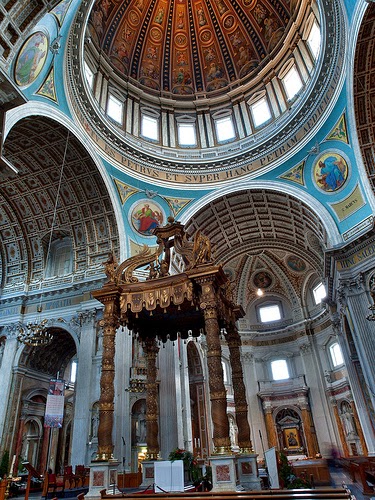
Rorate Caeli

Event: conference on the Traditional Latin Mass

From the hosts:

The next event of Juventutem Louisville will be on Friday, May 16th, at Guardian Angels (6000 Preston Hwy).  Fr. Leger will be giving a conference on the Traditional Latin Mass.  The conference will be a great introduction to the TLM for “newcomers” to the liturgy, but will also be a good refresher for those who have familiarity with it!  Food and social time will begin at 6pm followed by the conference at 7pm.

Francis: importune us to "give you the milk of grace, of doctrine and of leadership"!

May the Lord help us shepherds always to be faithful to the Master and wise and enlightened guides of the people of God entrusted to us. I also ask you, please, help us to be good pastors. Once I read something beautiful about how the people of God help bishops and priests be good shepherds. It is a text of St. Caesarius of Arles, a father of the first centuries of the Church. He explains how the people of God must help the shepherd and gave the following example. When the calf is hungry, he does to the cow, to the mother, to get milk. The cow, however, does not immediately give it to him: it seems that she is keeping it for herself. And what does the calf do? He knocks against the cow’s udder with his head so that the milk comes out. It is a beautiful image! “So you too,” the saint says, “must be like this with the shepherds. Always knock at their door, at their heart, so that they give you the milk of doctrine, the milk of grace and the milk of leadership.” And I ask you, please, to importune the shepherds, to disturb them, all of us shepherds, so that we can give you the milk of grace, of doctrine and of leadership. Importune [us]! Think of that beautiful image of that calf, how he importunes the mother so that she gives him something to eat.

In imitation of Jesus, every Shepherd “will sometimes go before his people, pointing the way and keeping their hope vibrant. At other times, he will simply be in their midst with his unassuming and merciful presence. At yet other times, he will have to walk after them, helping those who lag behind” (“Evangelii gaudium,” 31). May all shepherds be like this! But you must importune the shepherds, so that they give you the guide of doctrine and grace.


Francis
May 11, 2014

Photo: Ordination in St. Peter's Basilica, May 11, 2014. Source

Rorate Exclusive: Pope Francis received Bp. Fellay, SSPX Superior General, sometime in the past few months.


Rorate has learned and can exclusively confirm that Bishop Bernard Fellay, the Superior General of the Society of Saint Pius X (Fraternité Sacerdotale Saint-Pie X - FSSPX / SSPX), was received by Pope Francis in the Domus Sanctae Marthae sometime in the past few months. In order to protect our sources, we cannot detail the date and persons involved in the meeting, but only generally locate it in time - if the current pontificate so far can be divided into two halves, the meeting took place in the second half.

We can also add as part of this exclusive information that it was not a merely fortuitous event - that is to say, many off-the-record meetings with His Holiness have taken place since his election precisely because his being at Saint Martha's House make him much more accessible and available than many previous pontiffs. No, that was not the case at all - the pope was previously duly informed and duly met Bishop Fellay. The meeting was apparently short and cordial.

The Pope has a true interest in resolving this situation, it seems to be understood by our sources.

____________________

Note to new readers: the Society of Saint Pius X is a society of common life for priests and the formation of priests founded by Abp. Marcel Lefebvre in 1970, and it was involved in the controversial episcopal ordinations of 1988, in Écône, Switzerland. The penalties incurred by the living parties with that act were rescinded by order of Pope Benedict XVI in 2009. Doctrinal talks were conducted with the Vatican between 2009 and 2011, and the discussions fell through at the last moment on June 13, 2012. The Holy See considers the canonical situation of the Society as irregular and that, "as long as the Society does not have a canonical status in the Church, its ministers do not exercise legitimate ministries in the Church."

[When mentioning the content of this item anywhere and in any language, please mention Rorate by name and link to us, as a matter of courtesy. Thank you.]

Update: Italian version by Il Sismografo.

***

UPDATE (05/11/14): I.Media reports that Bishop Fellay came to the Vatican with Frs. Niklaus Pfluger and Alain-Marc Nély (respectively the First and Second Assistants to the Superior General of the SSPX). On this occasion, the two assistants of the Superior General of the SSPX were present at the daily Mass celebrated by Pope Francis at St. Martha House. Afterwards Bishop Fellay dined with Abp. Guido Pozzo and Abp. Augustine Di Noia (respectively the Secretary of the Pontifical Commission Ecclesia Dei and the Adjunct Secretary of the CDF) at the refectory of the same House. At the end of the meal, Bishop Fellay briefly met the Holy Father.

Vatican Insider has another account, with further details -- and an acknowledgment of Rorate's initial report.


UPDATE (05/12/14): the SSPX has released an official response, here, denying I.Media's additions.

UPDATE (05/13/14): the Holy See spokesman also denied I.Media's additions.

Blasts from the Past: Bergoglio's legacy; Pascal and speculation.

“Yes I know Bergoglio [, says a Jesuit superior from another Latin American country]. He’s a person who’s caused a lot of problems in the Society and is highly controversial in his own country. In addition to being accused of having allowed the arrest of two Jesuits during the time of the Argentinean dictatorship, as provincial he generated divided loyalties: some groups almost worshipped him, while others would have nothing to do with him, and he would hardly speak to them. It was an absurd situation. He is well-trained and very capable, but is surrounded by this personality cult which is extremely divisive. He has an aura of spirituality which he uses to obtain power. It will be a catastrophe for the Church to have someone like him in the Apostolic See. He left the Society of Jesus in Argentina destroyed with Jesuits divided and institutions destroyed and financially broken. We have spent two decades trying to fix the chaos that the man left us.”
Paul Vallely
Pope Francis: Untying the Knots
2013


______________________________


[Just to be clear: this second quote is unrelated to the quote above.]

In those cases in which the State is interested as well as Religion, your apprehension of man's justice has induced you to divide your decisions into two shares. To the first of these you give the name of speculation; under which category crimes, considered in themselves, without regard to society, but merely to the law of God, you have permitted, without the least scruple, and in the way of trampling on the divine law which condemns them. The second you rank under the denomination of practice, and here, considering the injury which may be done to society, and the presence of magistrates who look after the public peace, you take care, in order to keep yourselves on the safe side of the law, not to approve always in practice the murders and other crimes which you have sanctioned in speculation. ... Such is the style in which your opinions begin to develop themselves, under the shelter of this distinction [between speculation and practice], in virtue of which, without doing any sensible injury to society, you only ruin religion. In acting thus, you consider yourselves quite safe. You suppose that, on the one hand, the influence you have in the Church will effectually shield from punishment your assaults on truth; and that, on the other, the precautions you have taken against too easily reducing your permissions to practice will save you on the part of the civil powers, who, not being judges in cases of conscience, are properly concerned only with the outward practice. Thus an opinion which would be condemned under the name of practice, comes out quite safe under the name of speculation.
Pascal
Provincial Letter n. XIII
September 30, 1656

[Source for the first quote of a papal biography from a mostly Liberal perspective: The American Catholic blog, via P. Blosser. // We will return to this Pascal quote, closely linked to the presentation of the Kasper Doctrine on the destruction of the Christian doctrine on marriage, in short time.]

The Oh-so-very-bourgeois Antibourgeois Revolt and the Heresy of Formlessness

Alessandro Gnocchi


[T]he affirmation that graciousness is the prime matter for Grace is in evidence and has its origin in page after page of the Gospels, where the Good News makes itself known through good manners as the seal does through wax.  “Praesta, quaesumus, omnipotens Deus: ut, qui paschalia festa peregimus, haec, te largiente, moribus et vita teneamus” says the Collect of the Traditional Mass for the Sunday after Easter, Dominica in Albis.  “Almighty God, grant, we beseech thee, that we who have gone through the Easter mysteries may, through thy bounty, hold fast to what they contain in our practices and in our life.” And, in the Gospel for this Mass we see the gracious act of the resurrected Jesus in helping Thomas overcome his rude incredulity.  It is for Thomas, who eight days before had not been present at Jesus’ appearance in the Upper Room, that the Lord returns to show with ceremonial humility the wounds on his body:  “Put your finger here and see my hands. Reach out your hand and put it in my side. Do not doubt but believe”…."My Lord and my God!"  Thomas’ acclamation of faith comes from his being won over by the supreme act of graciousness towards him by his Lord and his God.  Thomas confesses Jesus’ divinity as no other apostle had done until then, and then he brings the Happy News as far as Persia and India, all the way to his martyrdom.

It is in this personal encounter that is so intimate and ceremonial, where the purest form of the sacred acts like a wax impression of the materiality of the gesture and the word, it is here that man has a fruitful relationship with God.  Here resides the strength of true conversions, provided that the ceremonial, were it also for the weakness of man, can be repeated by turning to the rite.  Saint Gregory the Great explains in the Third Nocturne of the Ascension:  “The slowness of the disciples to believe in the resurrection of the Lord, more than showing their weakness, functioned  in behalf of our own certainty of belief. In fact, their doubt was the occasion for the Resurrection to be shown as real with many encounters with the risen Lord as proof….The story of Mary Magdalene so ready to believe, is less useful to me than that of St. Thomas who doubts for some time, because this apostle, in his doubt, touched the wounds of the Lord and in this way took away from our hearts the wound of doubt”.

Gracious formality in everyday life responds to the liturgical nature of man.  In this way Saint Francis de Sales loved to teach that good manners are the beginning of holiness, or when Leon Bloy said that “only persons without depth do not trust appearances”.  But today one sees a type of Christianity that feels that it is more authentic the more it takes a negative attitude towards the least sign of reverence for form.  Religion as practiced now finds glory in getting to the substance of things, ending up by trying to find meaning in matter left to itself.  This oh so very bourgeois antibourgeois revolt has introduced a type of heresy of formlessness that feeds on an exegesis of the ugly as the only reading of the Gospel.

But the life and teaching of Jesus, the most true gestures of those around him, are all instances of a “waste” of beauty, born of spiritual devotion to the mystery of all that exists.   In great events and in small things, in kingly gestures and in the small, everyday cares, the characters in the Gospel are gentlefolk called to good manners.  

Among the clearest examples is the dinner at Bethany in the house of Simon.  This is a ceremonial occasion so full of gestures and ulterior meanings that one needs to look at the accounts of this meal in the different Gospel writers to fully understand the meaning of this event.  That evening, recounts St. Luke, Jesus entered the house of Simon the Pharisee and sat down at table.  “And behold, a woman of the city, who was a sinner, when she learned that he was sitting at table in the Pharisee’s house, brought an alabaster flask of ointment, and standing behind him at his feet, weeping, she began to wet his feet with her tears, and wiped them with the hair of her head, and kissed his feet, and anointed them with the ointment.”  The master of the house, looking in consternation at this display of so much attention given to a woman known as a sinner, had certainly organized a dinner with everything at the highest level, with a careful choice of foods to be served, correct service, every course of the highest quality.  But the one he had invited, the one for whom all this was prepared, reproached him, because those good manners of the Pharisee are not the acting out of the Good News that his guest is bringing to him as a gift.  “Do you see this woman? I entered your house, you gave me no water for my feet, but she has wet my feet with her tears and wiped them with her hair.  You gave me no kiss, but from the time I came in she has not ceased to kiss my feet.  You did not anoint my head with oil, but she has anointed my feet with ointment.  Therefore I tell you, her sins, which are many, are forgiven, for she loved much; but he who is forgiven little, loves little”  Minutiae of a sterile formalism, one would say today, but Jesus, perfect God and perfect man, sees that there is no formalism here.  Because the rite with which one adores the Lord and the ceremony with which one renders homage to one’s neighbor do not fulfill their purpose if everything is not done as prescribed.

You Report: 2014 Great Marian Procession for the West Coast, San Francisco


From our friends at the Traditional Mass Society of San Francisco:

A multitude of Catholic faithful from all over California and other states participated at the 6th Annual Great Marian Procession West Coast last May 3, 2014. The three mile processional walk started at the East Lawn Memorial Park and ended at the Cathedral of the Blessed Sacrament in downtown Sacramento, California where a Solemn High Mass in the Extraordinary Form was celebrated with His Excellency, Auxiliary Bishop Myron J. Cotta, in choro. The Mass was sung by the Choir and Choristers of St. Stephen the First Martyr Parish, which has been entrusted as a personal parish to the Priestly Fraternity of St. Peter (FSSP). The next Annual Marian Procession West Coast will take place on May 2, 2015. For future updates, be sure to visit http://www.BringMary.com.

The "absolutely non-negotiable point" for the Congregation for Religious: "faithfulness" to (their idea of) Vatican II

New Pontificate, new "non-negotiables". If for Benedict XVI, non-negotiable items were clearer and more definable, for the new Secretary of the Congregation for Religious, there is above all one point, what appears to have been the only relevant Catholic event in the history of the universe.


The Secretary of the Congregation for Consecrated Life, Franciscan José Rodríguez Carballo, for the past year number two of this Vatican organism charged with religious life, was in [Barcelona,] Spain this past weekend [May 3-4] to attend the meeting of the Union of Religious of Catalonia. [Infovaticana, en español]
----
This is a moment of "chaos, dark night, and twilight" for religious life, that sees the number of members and vocations fall, especially in Europe. But "it is a critical situation that is also an opportunity for the beginning of something new." ...

José Rodríguez Carballo mentioned as an important point of religious life fidelity to Vatican II: "For the consecrated, the Council is a point that cannot be negotiated." And he affirmed that those who search into the reforms of Vatican II all the ailments of religious life "deny the presence of the Holy Spirit in the Church."

He explained that in the Congregation for Consecrated Life, they are "particularly concerned" with this matter: "we are seeing true deviations." Above all because "not a few institutes give not only a pre-conciliar, but even an anti-conciliar formation. This is inadmissible, it is to place oneself outside of history. It is something that worries us greatly in the Congregation." [Catalunya Religió, en català] 


It is clear who is living outside of history - the anachronistic people running the Congregation for Religious stuck with false solutions thought for the reality of the 1960s that, when "faithfully" implemented, led to the near collapse of almost all consecrated life, and the corruption of most religious life that remained almost to the point of non-recognition. This tragic reality is acknowledged, but no amount of cognitive dissonance prevents the super-dogmatization of Vatican II. The latest Council as "super-dogma": how long and strongly did Joseph Ratzinger fight to get rid of this notion! How strongly the Franciscans of the Immaculate (certainly one, probably the main, institute Rodriguez Carballo had in mind in his words) tried to help Benedict XVI in the search for a way of continuity out of this crisis of legitimacy that the understanding of Vatican II as the one essential religious event in the history of Catholicism has fostered.


It is as if we were in the 1970s all over again and no lessons had been learned. What is facetiously said (the origin is uncertain) of a certain dynastic house, that "they never learn, and they never forget": that seems to be the only way to explain the obsession of the "Spirit of Vatican II exclusivists". As diehard Marxists who watched the collapse the Soviet Empire, after decades of suffering and bloodshed supported by them and their fellow travelers, their only explanation is not that maybe there is something wrong with Marxism, but that it was not "rightly implemented": time to try it all more faithfully once again. "Spirit of Vatican II exclusivism" would just be embarrassing, were it not filled with real-life consequences.

We now see clearly that the Pontificate of Benedict XVI was not the beginning of something, but merely a brief stop in the oasis in the middle of the desert: a respite for ourselves and our camels. Miserere nobis, Domine!

Cardinal Kasper in NYC:
The Ghost of Vatican II goes on a rampage.

While the attention of much of the Catholic blogosphere was focused on Cardinal Müller's "harsh" and "blunt" speech to the Presidency of the Leadership Conference of Women Religious -- a speech on which we will have something to say later on -- Cardinal Kasper went to Fordham University (May 5) for a "conversation" with Cathleen Kaveny, ethicist and legal scholar at Boston College, on his new book, "Mercy: The Essence of the Gospel and the Key to Christian Life". The "conversation" was well-advertised, done in front of a large audience (the event was reportedly "sold out"), and live-tweeted by Grant Gallicho (associate editor of Commonweal) and discussed on Facebook. 

The Cardinal was asked about his stance on communion for the divorced and remarried, to which he responded (as reported by Mr. Gallicho):


Evidently for Cardinal Kasper, the divorced and (civilly) remarried are not only eligible to receive Holy Communion, they are not even in a state of grave sin.

And on feminist theologians? Here is Cardinal Kasper's response as recorded by Fr. James Martin SJ on his Facebook page (which has nearly 74,000 likes and can be read by the public):


Cardinal Kasper's public endorsement of Elizabeth Johnson is very significant as she is one of the very few theologians ever to have a book publicly censured (in 2011) by the Committee on Doctrine of the US Conference of Catholic Bishops. The Committee was at that time led by Donald Cardinal Wuerl, who is nobody's idea of a "conservative". The awarding to her of the LCWR's "Outstanding Leadership Award" this year was also denounced only a few days before by Cardinal Müller as an "open provocation against the Holy See and the Doctrinal Assessment" because of "the gravity of the doctrinal errors in that theologian’s writings". Cardinal Müller predicted that this move "further alienates the LCWR from the Bishops"; but it certainly does not alienate them from Cardinal Kasper, who also went on to criticize the Congregation for the Doctrine of the Faith:

If you have a problem with the leadership of the women’s orders, then you have to have a discussion with them, you have to dialogue with them, an exchange of ideas,” he said. “Perhaps they have to change something. Perhaps also the Congregation (for the Doctrine of the Faith) has a little bit to change its mind. That’s the normal way of doing things in the church. I am for dialogue. Dialogue presupposes different positions. The church is not a monolithic unity.”

“We should be in communion,” he continued, “which also means in dialogue with each other. I hope all this controversy will end in a good, peaceful and meaningful dialogue.”
...
Kasper — often a sparring partner with his fellow German theologian, Cardinal Joseph Ratzinger, who later became Benedict XVI — said that critiques are part of academic discourse but said that the CDF sometimes “sees some things a little bit narrower.”


The Cardinal did not neglect to remind his audience of Pope Francis' support for his book:


The German cardinal who has been called the “pope’s theologian” said fresh Vatican criticism of American nuns was typical of the “narrower” view that officials of the Roman Curia tend to take, and he said U.S. Catholics shouldn’t be overly concerned.

“I also am considered suspect!” Cardinal Walter Kasper said with a laugh during an appearance on Monday (May 5) at Fordham University. “I cannot help them,” he added, referring to his critics in Rome.
... 
On Monday, Kasper told the audience that after Francis praised him by name just days after his election, “an old cardinal came to him and said, ‘Holy Father, you cannot do this! There are heresies in this book!’ ” 
As Francis recounted the story to Kasper, he said, the pope smiled and added: “This enters in one ear and goes out the other.”

Pope Francis had already praised the book in public last year, during his first Angelus (March 17, 2013):

In the past few days I have been reading a book by a Cardinal — Cardinal Kasper, a clever theologian, a good theologian — on mercy. And that book did me a lot of good, but do not think I am promoting my cardinals’ books! Not at all! Yet it has done me so much good, so much good... Cardinal Kasper said that feeling mercy, that this word changes everything. This is the best thing we can feel: it changes the world. A little mercy makes the world less cold and more just. 


In addition to his "conversation" in Fordham, Cardinal Kasper was interviewed that same day on the Brian Lehrer Show. The full interview can be heard there: The Brian Lehrer Show - The Pope's Theologian. Near the beginning of the interview, Mr. Lehrer sets the tone by describing his guest as "Pope Francis' theologian". Cardinal Kasper later affirms that the pontificate of Pope Francis is "a springtime of the Church" (6:43-6:45). 

Rorate will try to post a transcript of the most relevant and disturbing section of the interview. For now we point our readers to the section from 21:40 to 25:17, where Mr. Lehrer and the Cardinal discuss communion for ("remarried") divorcees, divorce itself, and birth control. Among other things the Cardinal boldly states that the Church is "not against birth control at all" and, claiming to have no desire to go into "casuistry" says that it is up to one's personal conscience and responsibility to decide on "how to do" birth control. He also declares that divorce may sometimes be "necessary", and since God's mercy gives everybody "a new chance, a new beginning" then the Church should do the same. 


On Paul VI, the perfect summary

One certainly could say more on the supposed beatification of Paul VI, but one could not say it better than Fr. Ray Blake in so few words:

There are so many conjectures about his private life, his friendships, those he allowed influence; there are so many questions which are unanswered, so many hints of scandal, of all the twentieth centuries popes Paul VI should be left to sleep quietly in his grave, with prayers of the faithful.

Well, it must be added that no graver attack on Holy Tradition was ever attempted, and in almost complete measure accomplished, than the near destruction of the ancient Roman Rite in the late 1960s/early 1970s, in particular the liturgy of Holy Mass. Enough is enough.

For the Record: Sacred Music after Vatican II
Congregation for Divine Worship's Questionnaire on Sacred Music

From the page of the Pontifical Council for Culture:

Fifty years on from the Second Vatican Council, the Congregation for Divine Worship and Discipline of the Sacraments and the Pontifical Council for Culture are undertaking, with a pastoral perspective, an enquiry into the state of sacred music in all its aspects (liturgy, formation, pastoral activity, concerts) with the aim of reflecting on the developments in the field of music and the desire to offer a contribution to the ministry of musicians for the glory of God and the sanctification of the faithful.

The Enquiry is aimed primarily at the Episcopal Conferences and Major Religious Institutes and Faculties of Theology.

You may download the questionnaire below for your own use and reflection.

[Source. Tip: priestly reader]

From our Mailbox
You Report: When Cardinal Zen visited our Parish
You Suggest: Le Barroux Abbot to celebrate Solemn Mass in the Netherlands

1. You Report, from a reader in Hong Kong:

Last Sunday (4/5), a Solemn High Mass was celebrated in the Rosary Church, Hong Kong.

Cardinal Zen was also present and gave sermon during the mass. He preached the importance of Hermeneutic of Continunity and reminded the faithful not to see the Second Vatican Council and the Council of Trent as two rivalling extremes.

He also reminded the faithful to always keep the Catholics in Mainland China in our daily prayers. Mainland Chinese Catholics are also at the heart of the Cardinal. He talks about them nearly every time as he comes to celebrate the Traditional Mass.


One interesting thing to notice is that, besides Cardinal Zen himself, there were also two Salesians present at the mass: the deacon, Fr Albert Ho, SDB and subdeacon Bro Carlos Cheung, SDB - worth noticing that the Tridentine Liturgy Community has mass every Sunday in the Salesian Parish.

________________________________

2. From a reader in the Netherlands:


Coming Saturday, May 10, at 11 AM, the Abbot of Sainte-Madeleine du Barroux, Dom Louis-Marie de Geyer d'Orth, will celebrate a Solemn Mass in the beautiful and immense Basilica of Sts. Agatha and Barbara in Oudenbosch, Netherlands, organised by the Dutch Latin Liturgy Society (Vereniging voor Latijnse Liturgie) which, until 2007, focused only on the Novus Ordo in Latin.

This is the first time this Society is organising a Holy Mass according the extraordinary form during their General Assembly.

Traditional-minded Catholics and the Traditional Liturgy:
Living well in the age of Francis
- a beautiful interview with the Abbot of Fontgombault


Founded in the 11th century [Rorate note: its original founder and first Abbot, Petrus a Stella / Pierre de l'Étoile, buried in the middle of the abbatial church, died exactly 900 years ago, in 1114], Fontgombault discovered Benedictine life once again in 1948, becoming a foundation of Solesmes. A fecund abbey, already at the origin of four monasteries erected later as abbeys, it recently took over the Abbey of Wisques.


A meeting with Dom Jean Pateau, elected Abbot in 2011


La Nef - How are you living your new position of Father Abbot?

Dom Jean Pateau - These years have gone by quite fast. Saint Benedict gave two golden rules to the Abbot: "Let him be convinced that it becometh him better to serve than to rule... and let him aim to be loved rather than feared." (Rule of St. Benedict, c. 64). By trying to put this in practice, with the help of God, Our Lady, and the community, I can say that I am a happy Abbot.

What is the role of a Benedictine abbey in the 21st century, in our age of materialism and hedonism? Is such a vocation still possible?

Paul VI told a group of laymen that, "modern man listens more willingly to witnesses than to teachers, and if he does listen to teachers, it is because they are witnesses." (1) Abbeys, through their presence, by way of the witness of lives offered to God, fulfill this role in an eminent way. For this, vocations are necessary. The unilateral promotion of the individual, the search for comfort typical of the man of our time, do not favor them. But that is not the worst of obstacles. The difficulty today, both regarding marriage as religious life, is that of making a lifetime choice for an entire life: to dare to donate oneself without foreseeing giving it up.

Fontgombault Abbey is the oldest of the foundations of Solesmes to have chosen to keep the extraordinary form of the Roman Rite: why this choice?

The extraordinary form was preferred, and remains so, because it seems to us particularly adapted to monastic life. Let us emphasize two crucial points. The more contemplative nature of the celebration promotes the vertical dimension of the liturgy. The moments of silence in the Offertory and the Canon favorable to introspection fall within this structure. Even though not exclusive to this form, it is necessary to add to this point the fact that concelebration is not used habitually, and that the Mass is said "turned towards God." Secondly, that could seem contradictory, I emphasize the participation of the body, required for so many gestures: genuflections, inclinations, signs of the Cross. From the consecration forward, these gestures, carried our on the Species of Bread and Wine, bring the attention of the priest to the Christ really present on the altar. In the monastic tradition, the body is widely associated to prayer. The monk's life is a liturgy. Provided that each of the gestures detailed in the Ritus Servandus be given its weight of spiritual meaning, its orientation towards God, the body in the extraordinary form is associated in a particularly intense way to the spirit and the soul by incarnating the word, by manifesting the humility of him who celebrates before the mystery of the God who is present.

With the passing of time, how to you assess the current liturgical situation, notably the cohabitation of two forms within the same Latin Rite [sic] after Summorum Pontificum?

Two expressions come to mind: thanksgiving and hope. Thanksgiving because this initiative of Benedict XVI has indisputably contributed to pacify the liturgical question. What a success for the devil to have sowed disagreement precisely in the celebration of the Sacrament of love! Today, the two forms are respected and, in an ever-growing number of parishes, are side-by-side. As for the future? Many young priests attached to the lectionary of the ordinary form, that they follow habitually, want a liturgy that is richer in the level of rites, associating more strictly the body to the celebration. Would it not be possible to propose in the ordinary form the prayers of the offertory, to enrich it with the genuflections, inclinations, signs of the cross of the extraordinary form? A rapprochement would [thus] easily take place between the two forms, giving an answer to a legitimate and, additionally, longed-for desire of Benedict XVI (2).

Following a pope who had Saint Benedict as patron, we now have one who has Saint Francis: what is your analysis of the previous pontificate, and how do you view that of Francis, and notably his wish for reform?

I would not venture making a assessment of the action of the Holy Spirit, but rather marvel before its power. Some oppose the two popes... I do not believe that the election of Pope Francis changed the plans of the Holy Spirit, but rather that He pursues his goal: to render the members of the Church more similar to their head, Jesus Christ, notably by their humility and their sanctity, so that the Gospel be taken to the ends of the earth. Is there not a real continuity between both pontificates? Popes Benedict XVI and Francis are two men deeply in tune with God. It is a lesson to each one among us. Fulfilling their program does not matter to them, while they busy themselves with discerning God's plan. Humility is their precious asset. The form changes. Benedict XVI is a professor, a most reserved and discreet theologian; Francis, a disciple of Saint Ignatius, a missionary. But did not Benedict XVI wish to reform the Curia? His teachings, his clear-cut speeches, did they not touch plenty of hearts? Would Francis not have concern for doctrine and truth? Let us remain in peace, waiting with confidence the gift of the Lord through the pontificate that begins. God knows where He is going!

Your abbey was involved in the 1990s in officious doctrinal discussions with the Society of Saint Pius X: how do you see the future of this delicate issue?

Every Christian should wish and work for unity, because it is the will of God. Benedict XVI did all that was within his power to reach it. Francis will do likewise. It is, one might say, in the Pope's genes. The Pope cannot choose otherwise. He is the flock's shepherd and he must reach the dispersed sheep. The Pope's heart is by nature stretched out to the peripheries of the Church, to the whole world. What about Christians? The Pope would be quite lonely if he were the only one to work for the unity of the Church! Nobody should therefore be satisfied with the current situation. The problem now is more one of ecclesiology than one of liturgy. The solution seems to me to be a response of faith, made before God, to two questions: What is the Church? Do we have the right to tear it apart? No one is exempt from the duty to answer these questions. We all must give account one day before God of the actions and words that may have favored or hindered the unity of the flock. I refer in this connection to the words pronounced by the Pope to the Congregation for Bishops on February 27, 2014, regarding the choice of bishops, but which can apply in the end to every discernment in ecclesial functions, and also to every Christian who manages to take his conclusions: "Are you certain that the Lord has spoken your name? Are you certain that it is the Lord who has numbered you among those called to remain with him in a unique way, and in order to entrust to you the mission that is not his own but rather was entrusted to the Lord by the Father?"

You have sent monks to aid the Abbey of Wisques (where the monks celebrate the ordinary form), with a lack of vocations: what is exactly the brokered agreement (notably in liturgical matters)?
There was no "brokered agreement". The condition for the move into Saint-Paul de Wisques was that the Fontgombault observance be established there. This should seem so clear to everyone that things have happened in a truly fraternal fashion. Otherwise, we wish to do everything so as to favor the monks of Wisques with stability in the monastery. The current modus vivendi meets the expectations of the whole of the community. While the recently arrived monks celebrate the morning masses in the various altars of the abbey in the extraordinary form, the old ones [who were there before] concelebrate in the ordinary form. The conventual Mass is said, other than exceptional cases, in the extraordinary form. Being in Wisques for the feast of Our Lady of Lourdes, day of the infirm, I presided over the concelebration [in the ordinary form] with our ancient ones, some of whom carry the weight of the years and have persevered, despite the collective and personal ordeals. The objective of the move into Wisques was of a double nature: to allow the monastery to survive while preserving thew unity of the monastic family of Saint-Paul. I rejoice that this objective be achieved for the sake of the unity of the family. The arrival of vocations will allow for the serene consideration of the future. Our nun friends of Notre-Dame [the female monastic community near Wisques] making use the ordinary form, the fathers of Saint-Paul celebrate there in this form. [***]


Fontgombault Abbey has spread several times [Randol, Triors, Gaussan/Donezan, Clear Creek, and now the refoundation of Wisques]: what explains these numerous vocations while other abbeys or religious congregations are in crisis?

The psalmist says that, "Unless the Lord build the house, they labour in vain that build it" (Ps 126/127). Many young men come to Fontgombault to discover Benedictine life. Not all persevere. God rules hearts according to the plans of His Providence, and provides the means to achieve them. The motto chosen for the monastery by Father Abbot Dom Édouard Roux at the moment of its refoundation is Fons Amoris, Fountain of Love. I believe that this fountain truly gushes forth in Fontgombault, and that it is good to come here to drink from it. For those who have the grace of living in this place, it remains to take note of this fact, and to discern what the Lord expects from them, so that their gifts may fructify and that this fountain may flow elsewhere.
...
__________________

(1) Allocution to members of the Laity Council, Oct 2, 1974, quoted in Evangelii Nuntiandi, n. 41.
(2) Cf. Letter to Bishops accompanying the motu proprio Summorum Pontificum.
__________________

Interview by Christophe Geffroy for La Nef, May 2014 issue. Main excerpts translated by Rorate.

*** An important note is necessary here. Some might understandably criticize the choice made by Fontgombault in allowing a bi-ritual ("bi-formal") existence in Wisques. Wisques was not a new foundation, but an existing abbey: what actually happened was a complete takeover, by request of the Solesmes Congregation, of an ailing abbey by the only abbey in the congregation with members to "spare" for this venture. This only abbey was an abbey dedicated to the Ancient Rite, not coincidentally. Any confrontational attitude would have been unwise, and a serene takeover of an "ordinary form house" by a traditional community shows in many ways a possible image of the future. The current bi-ritual situation (minority Paul VI celebration) at Wisques will resolve itself with time, as the "old members" are gradually replaced by the new vocations. It provides many in the Church with a template of respect and charity for the future, decades and centuries ahead.

Paulist seminary for sale

The Paulist Fathers were the first order of priests founded in North America, started by Redemptorist missionary converts, including Father Isaac Thomas Hecker, in New York in 1858.  On the Paulists' website, the history page states: "Hecker had come to believe that Protestant America, if approached in the right manner would become Roman Catholic."

Over the years, Paulists would focus on the conversion of Protestants to the Catholic Church, expanding from New York to college campuses and downtown centers around the U.S. and Canada. In 1914, Saint Paul's College in Washington, D.C., was established for Paulist seminarians. In 1922, Pope Benedict XV gave the Paulists (aka the Missionary Society of Saint Paul the Apostle, or the Congregation of Saint Paul) the church of Santa Susanna in Rome.

Following the Second Vatican Council, the Paulist Fathers and the order's Paulist Press shifted their focus toward "ecumenical and interfaith efforts" and "Jewish-Christian dialogue." In recent decades, Paulists have identified with the far left.

One-hundred years after the founding of the seminary, a real estate website lists it for sale.

The latest chapter in the 'visitation' of the Franciscans of the Immaculate

The Agenzia Nazionale Stampa Associata reported last Friday that the 81-year-old Fr. Stefano Manelli, founder and first Minister General of the Franciscan Friars of the Immaculate, was forbidden from going to Frigento (Avellino) on May 1 in order to visit the grave of his parents and to celebrate Mass.

His parents, Settimio (d. 1978) and Licia (d. 2004), became "Servants of God" in 2008 and 2009 respectively.

According to ANSA, the ban was decreed by the Apostolic Commissioner Fidenzio Volpi.


Solemn Mass (1962 Missal): in honor of a great priest and pro-lifer and in the presence of a Cardinal

Msgr. Foy is 98 years old and apparently the first priest of the Archdiocese of Toronto to celebrate his 75th anniversary as a priest. He is best known for his untiring defense of Catholic teachings on human life, marriage and the family, and especially for his public and repeated criticism of the infamous "Winnipeg Statement". That statement by the Canadian Conference of Catholic Bishops has never been officially withdrawn or explicitly repudiated by that same body, which makes Cardinal Collins' presence in this Mass more significant. (The Cardinal will also preach at the Mass.)

Some of Msgr. Foy's writings can be found here and here. Lifesite News has a short biography

Archdiocese of São Paulo: invoking Vatican II in defense of "LGBT"

This week the Archdiocese of São Paulo's "Justice and Peace Committee" issued a statement invoking the Second Vatican Council "in defense" of the "dignity" of "citizenship [civil liberties] and safety of homosexual people" to mark São Paulo's upcoming  18th Lesbians, Gays, Bisexuals, Travesties and Transsexual Pride Parade. 

The Archdiocese of São Paulo is Brazil's largest diocese, with nearly 6 million Catholics. It is headed by Odilo Cardinal Scherer, one of the frontrunner papabili of 2013.


Emphases ours. 

Committee of the Archdiocese of São Paulo defends the dignity of gays


The text was published just a few days before the 18th Lesbians, Gays, Bisexuals, Travesties and Transsexual Pride Parade, which will take place next Sunday

SÃO PAULO – Last Wednesday (April 30th), the Justice and Peace Committee of the Archdiocese of São Paulo published a release in “defense of the dignity of citizenship [i.e. civil liberties] and safety of homosexual people. The text was published just a few days before the 18th Lesbians, Gays, Bisexuals, Travesties and Transsexual Pride Parade of São Paulo, which shall take place next Sunday, (4th), at Avenida Paulista.

We cannot be silent in view of the reality experienced by such population, which is a target of prejudice and victim of systematic violation to their fundamental rights such as health, education, work, living, and culture, among others”, stated the Catholic Church related entity in a press release. The committee says also that the LGBTs “endure unbearable verbal and physical violence on a daily basis, culminating in murders, which are true hatred crimes”.

The entity invites “people of good will and, particularly, all Christians to reflect upon such deeply unfair reality faced by LGBT people, in order to actively use their best efforts to overcome it, guided by the supreme principle of human dignity”.

Still according to the press release, the entity’s stand, “faithful to its mission of announcing and defending the evangelic and civilizational values of human rights, grounded on the Pastoral Constitution Gaudium et Spes, approved by the Second Vatican Council: 'The joys and the hopes, the griefs and the anxieties of the men of this age, especially those who are poor or in any way afflicted, these are the joys and hopes, the griefs and anxieties of the followers of Christ'", says the document.

To give voice. The director of the Justice and Peace Committee of the archdiocese, Geraldo Magela Tardelli, stated that this is the first time the committee “formally” writes in behalf of homosexual people.” The committee has a mission, according to Bishop Paulo Evaristo Ars: 'we have to give voice to those who are voiceless’. At this time, we are noticing that there is a growth of violence against homosexual people, so we cannot be silent in relation to such violation to human rights”, stated the director.

According to him, the holding of the Gay Parade has determined the disclosure of the press release. “We think that this was the right time to disclose this release. We from the Church are engaged in defending the human rights and do not agree with any kind of violence, irrespective of color and sexual orientation of people”, says Tardelli.

Source. Among the "citizenship" "rights" included within the "dignity" of such persons is probably the "right" to homosexual "marriage" and adoption rights, recognized by national courts in the past couple of years, naturally without any episcopal action.

Translation into English by Fratres in Unum, with slight corrections.


***

It is remarkable that this statement came out barely 3 days after the canonization of the Pope in whose reign the following judgment was passed on calls to stop "discrimination" against homosexuals:


"Sexual orientation” does not constitute a quality comparable to race, ethnic background, etc. in respect to non-discrimination. Unlike these, homosexual orientation is an objective disorder (cf. Letter, no. 3) and evokes moral concern. There are areas in which it is not unjust discrimination to take sexual orientation into account, for example, in the placement of children for adoption or foster care, in employment of teachers or athletic coaches, and in military recruitment. Homosexual persons, as human persons, have the same rights as all persons including the right of not being treated in a manner which offends their personal dignity (cf. no. 10). Among other rights, all persons have the right to work, to housing, etc. Nevertheless, these rights are not absolute. They can be legitimately limited for objectively disordered external conduct. This is sometimes not only licit but obligatory.  ...  

Including “homosexual orientation” among the considerations on the basis of which it is illegal to discriminate can easily lead to regarding homosexuality as a positive source of human rights, for example, in respect to so-called affirmative action or preferential treatment in hiring practices. This is all the more deleterious since there is no right to homosexuality (cf. no. 10) which therefore should not form the basis for judicial claims. The passage from the recognition of homosexuality as a factor on which basis it is illegal to discriminate can easily lead, if not automatically, to the legislative protection and promotion of homosexuality. A person's homosexuality would be invoked in opposition to alleged discrimination, and thus the exercise of rights would be defended precisely via the affirmation of the homosexual condition instead of in terms of a violation of basic human rights.

Congregation for the Doctrine of the Faith
July 24, 1992

The Authentic Rite, Education, and Conversion
- and our tasks for the future


Editorial: Radicati nella fede, May 2014
Newsletter of the Catholic community of
Domodossola and Vocogno, Diocese of Novara, Italy

There is nothing which is merely outside ourselves that can guarantee the renewal of the Church or the rebirth of Christian life.

When we talk of the crisis of the faith in modern times, when we desire the re- flowering of Christian life for our people, we must be very much aware that it is not possible to put our faith in any guaranteed automatism of something that happens outside of ourselves: the rebirth will always begin with our being born again through the grace of God. Yes, it is in personal conversion that we must hope for the re-flowering of the Church.

The idea of spreading Christianity to the sound of reforms started precisely from an error in perspective. We believe that this was the error of the conciliar years. We shall try to explain.

Was there need for a renewal in the Christian life in the ‘50s and ‘60s? Certainly there was. Was there need for greater truth in priestly life, in convents, in lay associations, in Catholic schools, in families? We have no difficulty in admitting it: a certain formalism was placing the life of faith in danger…there was need for authentic freshness.

However, it was a grave mistake to imagine that authentic freshness in the Christian life was to be found in an entire series of reforms, which radically changed, if not distorted, the face of the Church. A renewal did not come out of these, nor a springtime but a long autumn which has [now] brought wintertime to the faith, a winter which has killed the life of grace in our countries and lands of historic Christianity.

We started changing everything, modernizing the Mass and with it, all the other aspects of Catholic life, thinking that this would stop the flight from the churches, with the result, which is there for everyone to see, that the churches ended up being emptied; the people who stayed and attend them, are certainly not more authentically Catholic than the people of the past.

A striking example is precisely the reform of the Mass: they changed it to render it less difficult and less heavy for people. Did a renewal come about? No, it didn’t: instead, an impoverishment [came about] and an ambiguous emptying of content: it is as if the “skeletal” new rite of the Mass no longer educated, creating space for all our little and big heresies.

The way to go was another: that of working fervently every day in the education of souls to live the Mass and [helping] them to understand its inestimable worth and immeasurable beauty. Intelligent, fervent priests were needed, able in prayer, study and sacrifice; deeply motivated souls were needed. Instead we confided in the deceptive way of an external reform which facilitated the rites for priests and the faithful…under the illusion that by fixing exterior things, souls would convert. And everything collapsed into a dreadful impoverishment: the Mass was banalised to run after the faithful who had lost their fervor, and reduced almost to a rite worthy of a merely natural religion.

Instead what the Church needed was holiness, and holiness is born from personal conversion.

The rite does not have to be changed, our heart instead does. The rite must be the stable rock upon which we lay our entire life. It is for this reason that we returned to Tradition, it is for this reason that we preserve the “Mass of Ages”. The rite must preserve the true faith and true Catholic prayer. It must place us in the correct position before God; it is only thus that grace will be able to work our conversion.

Saints, passionate for the work of God, are the ones who renew the Church and Christian life and not human games of continuous changes.

The one who wants continuous change is simply a bored man; and with bored men in search of exterior novelties, even religious, a Church of holiness is not built.

The true liturgical movement, meaning the one of Gueranger and Pius X, was done to favour authenticity in prayer by priests and faithful. It was done for souls to be immersed in the Holy Liturgy, truly praying with the Church so that this would give birth to a more authentic, intelligent Christian life. Instead in the liturgical movement there was an operation of betrayal, carried out by those who thought that facilitating was the equivalent of aiding prayer: it was not to be, as anyone with eyes can see the disaster… Christians rarely know how to pray nowadays.

There is nothing external that can substitute our conversion to sincere personal devotion, to an authentic love for Christ. Our conversion, however, worked through grace, will spring from the prayer of the Church which Tradition has given us and which is the prayer of Christ Himself.

So it is necessary also for us that:

1) there is a return to correct liturgy according to tradition, so that the treasure which is “prayed revelation” is not lost;

2) that priests and the faithful motivated intelligently, become authentic missionaries and teachers of prayer according to the heart of the Church. If the second point did not apply to us then we would fall into the same tragic error of the Council reformers who believed that it was enough to go back to something exterior (perhaps even the Old Mass) for life to be revived.

May Our Lady assist us in being faithful to our task.

[Translation: Contributor Francesca Romana. Image by Gonzague Bridault, Mass on the 800th anniversary of the birth of St Louis, Apr. 25, 2014, Saint-Eugène, Paris.]

The 1962 Missal is now the Missal of Saint John XXIII
And a Venetian tale

Or... "Making Glasses Look Half-full"...

The Easter of 1953 was the first that Cardinal Angelo Giuseppe Roncalli spent in Venice. Following the singing of Vespers and the Eucharistic Benediction, the Patriarch thought there would be nothing else [in the ceremonies].

Instead, the choir of seminarians intoned the Litany of Loreto in the fascinating rhythm of the patriarchal melodies.

It seemed that the angels and the saints, looking down from the mosaics of the golden dome, rose up in joyous jubilation. The Cardinal asked his assistant (old Canon Francesco Silvestrelli): "What is this?"

The Canon responds, "Eminenza, andemo a l'altar de la Nicopeia a ralegrarse con la siora Mare, perchè so Fio xe ressusità!" (Eminence, we are going to the altar of the Nicopeia [the highly venerated icon of Our Lady in Saint Mark's] to celebrate with the Lady Mother, because her Son is risen!)

That pious custom, followed by the faithful with intense fervor, moved Cardinal Roncalli to tears.

Having become afterwards John XXIII, he cherished the nostalgic memory, until the end of his life, of that melodious chant and of that delightful function in honor of the Madonna on Easter day.

He loved to recount his deep impressions from that Easter, and he repeated: "Let us go celebrate with the Madonna:... because Her Son is risen!"

[Source: Benedictine Monastery of Praglia, via Messa in Latino]

Alternative Catholic Media: Into the Catacombs

In Rorate, our team is privileged to include members who can write under their own names, and others who must resort to noms de plume... We get along quite well in our different capabilities. We all work in this in a spirit of complete voluntary work - how often have we rejected in the past several offers of advertisers!

Just this week, in a personal conversation with a fellow contributor, there was mention that this blog should not even exist. Despair not! What was meant was simply that, not many decades ago, in the moldy and unenlightened years before the glorious Council of the 1960s, the local diocesan paper or a similar periodical publication published by a religious order would have provided more than enough news for the average Catholic. For the learned Catholic priest and layman, academic or semi-academic journals would have sufficed for their needs. For many good and faithful Catholics with no access to the written word, or in the centuries before mass media organizations, the local priest's sermons or communications from the pulpit would have provided enough nourishment of Catholic news.

It is the general untrustworthiness of much of the official Catholic media and printing houses that has made blogs so popular. This is especially true regarding the obvious cognitive dissonance any serious Catholic feels between the placidity and jolliness of the official media, and the reality seen on the ground, from the abuse of children to the abuse of sacraments, from the abuse of liturgy to the abuse of confidence, from the promotion of dissidents to the hiding of the statistics of the general collapse of Catholic demographics and practice in most of the world since this wintriest of springtimes began.

What the events involving the Rev. Deacon N. Donnelly and his blog Protect the Pope show (the blog was founded, as the name indicates, precisely to protect the good fame and name of the Pope at the time of its foundation, Benedict XVI, who was under permanent attack throughout his pontificate, including in the official Catholic media, and is now unable to continue its operation) is that the use of pseudonyms is increasingly necessary for many Catholic bloggers, as many good Catholics consider they can only do this necessary work under the utmost discretion. 

We once again humbly beg the good people in Lancaster Diocese to please explain why pressure was applied in such a way that even Mrs. Donnelly felt unable to continue writing on her husband's behalf (not with indiscreet details, of course, but since the web makes this a worldwide affair, the absence of a diocesan statement makes it worse). We rush to add that it seems that the diocese of Lancaster is not unfriendly towards traditional-minded Catholics (remember this), so this matter is not at all tradition-related, just one that would require more openness about its causes since it indeed became a public global scandal through no fault of the parties involved.

***

For further opinion on the matter of pseudonymous blogging we suggest the following 2011 text by Fr. Ryan Erlenbush, "In defense of pseudonymous blogging." On the specific matter of Deacon Donnelly, we have nothing to add to our March editorial The Sound of Silence.

Prayers offered for the Rt. Rev. Bishop of Lancaster and the Rev. Deacon and Mrs. Donnelly.

Update (5:10 PM GMT): The Diocese of Lancaster published a statement on the matter by the local Ordinary.

Also worthy of notice: This 2010 article on anonymous Catholic Blogging by Unam Sanctam Catholicam.

EGO FLOS CAMPI
ET LILIUM CONVALLIUM


IESUS - MARIA - IOSEPH

Jesus, Lily of the Valleys
Mary, Queen of May
Joseph, Patron of Laborers

Orate pro nobis!