Rorate Caeli
Showing posts with label Traditional Catholic History. Show all posts

In memoriam: Wolfgang Waldstein (1928-2023) - by Roberto de Mattei

Roberto de Mattei
November 2, 2023


The funeral of Wolfgang Waldstein, an eminent legal philosopher and exemplary Catholic, who passed away on Oct. 17, 2023, at the age of 95, was held at St. Sebastian Church in Salzburg on Oct. 31, 2023. 

"As a Historian, I Believe That the Traditional Latin Liturgy Will Not Disappear" - Catholic Historian Yves Chiron presents his "History of the Traditionalists"


French journal La Nef published an interview with Yves Chiron on the occasion of the publication of his book dedicated to the Traditionalists (Histoire des traditionalistes, Tallandier). Below are the main excerpts published at Le Forum Catholique.

Where do traditionalists come from, who are they, and what do they defend?

Yves Chiron - The term "traditionalists" appears in the Magisterium with the Letter on the Sillon of Saint Pius X, in 1910 [Notre charge apostolique]. The Pope affirmed: "the true friends of the people are neither revolutionaries nor innovators but traditionalists. The term had already existed for several decades. Émile Poulat drew attention to a specific current: the Catholic counter-revolution, that is to say, Catholics (priests, bishops or laity) who, throughout the 19th century and into the 20th century, were hostile to the Revolution and its aftermath, not primarily out of nostalgia for the king, but out of a rejection of the principles of 1789. The Catholic counter-revolutionaries were hostile to intellectual and moral liberalism, so naturally they became anti-modernist, anti-progressive, etc. (...)

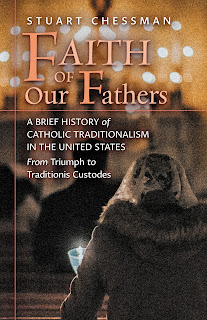
New Book Tells the Dramatic Story of Traditionalist Movement in the USA

In many conversations online and in person about the situation in which we traditional Catholics find ourselves in 2022, one thing I have seen again and again is a temptation to discouragement or despair on account of the threat—or the reality—of that which we love being torn out of our churches, our towns, our families.

"THE ROMAN SPIRIT: This is what we need!" - by Roberto de Mattei

Lateran Basilica


The Roman Spirit is something that one breaths in only in Rome.  The “sacred city” par excellence, the center of Christianity, the eternal fatherland of every Catholic, who is able to repeat with Cicero, “civis romanus sum”, claiming a spiritual citizenship that has as its geographical boundaries not that of a city but that of an Empire:  not the Empire of the Caesars, but that of the Church, Catholic, apostolic, and Roman.

New Edition of Davies’s Apologia Pro Marcel Lefebvre

This post has a very simple purpose: to alert Rorate readers that Angelus Press has brought out a new and very handsome edition, in three matching hardcover volumes, of the critically important work by Michael Davies entitled Apologia Pro Marcel Lefebvre. 


The first volume, published in 1979, recounts the years from 1905-1976, providing a comprehensive collection of source materials essential for serious research on the Archbishop. The words of Davies in his introduction have lost nothing of their timeliness:

Book review: Nothing Superfluous

A reader graciously sent us a book -- a while ago -- that we know through reputation of both the book itself and the priestly author is well worth the read: "Nothing Superfluous: An Explanation of the Symbolism of the Rite of St. Gregory the Great." Due to personal commitments we have not been able to read the book. In order to not delay us bringing this book to you, our readers, we provide you a review by one of our contributors, Dr. Peter Kwasniewski, originally written for New Liturgical Movement. 

While you can buy this book online from the Priestly Fraternity of St. Peter (click here), you can also call Fr. Jackson's (FSSP) parish in Colorado, pay them and they will mail you a copy. This latter method will ensure the proceeds go towards Father's parish restoration fund (click here for parish contact details). 


Nothing Superfluous — A Masterful Spiritual Guide to the Traditional Mass

Nothing Superfluous: An Explanation of the Symbolism of the Rite of St. Gregory the Great [i.e., the traditional Latin Mass]. By the Rev. James W. Jackson, FSSP. Lincoln, NE: Redbrush, 2016. $17.95.

This is a book whose publication I have been eagerly awaiting, ever since I saw the manuscript a couple of years ago and, subsequently, the tantalizing excerpts that have appeared each month in the newsletter of the North American district of the Fraternity of St. Peter.

Important Traditional Catholic news from France


1. On July 2, Bishop Alfonso de Galarreta ordained Fr. Daniel Sabur to the priesthood in Saint-Nicolas-du-Chardonnet. He will celebrate the ancient Chaldean Liturgy every Sunday for a Chaldean community that will meet in the Society's chapel in Saint Mathias de Pontoise. On the very next day he celebrated his first Mass (Chaldean Liturgy) in that chapel with 200 faithful (mostly Chaldeans) in attendance. It is the first-ever Chaldean Rite community under the SSPX. (Source: La Porte Latine,) 

ANOTHER UPDATE: Help keep The Roman Forum going

THURSDAY UPDATE: Rorate readers raised nearly $7,000! Dr. Rao still needs $3,000 to save the Forum. Please consider giving! This will be our last appeal. Please consider giving today.
---------------------------------------------------
Please see an urgent message below from Dr. John Rao. If you can, please click here and donate now:

Dear Friends,

We have nearly fifty people registered for the 24th Annual Summer Symposium at Gardone, with application still open until March 31st. Unfortunately, we also have some very serious hurdles to overcome in order to offer our normal program, which is needed this year more than ever.

As you know, the Roman Forum no longer has any endowment whatsoever, and now relies solely on donations for all of its activities. We are still $10,000 short of the $30,000 required to run the Summer Symposium. The money is used to pay for our twelve speakers' participation (airfare, room and board), as well as scholarships for priests, seminarians, and students. We have nine more speakers to support, and a backlog of fifteen scholarship applicants. This year's Summer Symposium lectures on Half a Millennium of Total Depravity (1517-2017): A Critique of Luther’s Impact on the Eve of His 'Catholic' Apotheosis" will be going into a book to be published by Angelico Press. We very much intend it to  serve as a means of fighting the campaign to glorify Luther which will indeed characterize 2017. 

Fundraising is a very, very unpleasant work, and I promise that this, my second general request for help, will be my last appeal for help for this project. Quite frankly, I have a great fear that without your immediate assistance we may no longer be able to keep the Roman Forum going past this summer at all.

See our original post on this urgent matter below from December 29.


Free Catholics books, in English and Spanish


A faithful reader of ours has compiled as many free online books as she could find. Amazingly, while the site has never really been promoted, when you Google search "Catholic books" it's still one of the top sites returned. People have found it on their own and found it to be a Godsend. In fact, as I was showing this site to Mrs. Adfero, she told me she too has used it to read books for free. 

Catholic audio books -- listen for free!


We got word of another wonderful website, with over 450 free Catholic audio books for you to enjoy. Yes, that's right -- FREE. No credit cards, no payment. Just click, listen and get one step closer toward salvation.

"The Catholic Church in Crisis"
- a 1978 essay by Fr. Louis Bouyer

The Catholic Church in Crisis

LOUIS BOUYER [1]

Translation © COPYRIGHT 2015
 John M. Pepino


What has come to be called “the Lefebvre affair” deserves a close investigation. At first glance, one may think that it reveals only the somewhat strange mentality, a ghetto mentality, of Catholics who are incapable of coming out of their isolation, of their life within a closed community in a safeguarded dream.  In reality, once one examines it seriously, it reveals a deep malaise in French Catholicism and, therefore, in French society as a whole. And it would be a mistake to believe that this malaise is a recent one: it goes back a long way and its symptoms will never be healed so long as we refuse to go back to its sources. And still there would be more to say. It could never have developed, branched out, and lastly grown such monstrous and grotesque buds, had modern Catholicism’s most characteristic trait not come about, namely: a phenomenal, and not altogether healthy, development of the papacy. And here again what is at stake is the whole evolution of French society and, more generally, of that Western society which was long synonymous with “Christendom.” If such is the case, it won’t be a waste of time to push our analysis of the “Lefebvrist” phenomenon further than is usually done.

I

First of all, who is Archbishop Lefebvre, and what exactly has he done to provoke such reactions in and around the Church of France? Is he not himself a typical reactionary who blurs, as is only to be expected, clerical reaction with political and social reaction? One could doubtless find many of his own words to provide an apparently ample justification for this simplistic description. But the actual facts are far from being as simple as they seem. Let us first note that Archbishop Lefebvre belongs to one of the greatest French missionary families: the Congregation of the Holy Ghost Fathers, whose superior general he was for a time. In that capacity he was for a long period the Archbishop of Dakar, and manifestly enjoyed full confidence on the part of the Holy See, which had made him its Apostolic Delegate for that entire region of Black Africa. Note carefully that at the time we were right at the end of the so-called “colonial” period, when the Church—for once!—was ahead of an inevitable politico-social process, decolonization, as she Africanized mission territories like that entrusted to Archbishop Lefebvre as quickly and as widely as possible. Now it is a matter of fact that he behaved in such an open and generous manner that all the African bishops, many of whom he had appointed himself, have remained to the bitter end his firmest defenders before the Holy See.  The Holy See’s delay in taking its well-known action against his post-conciliar activity—which action the French episcopate had been awaiting with understandable impatience—is principally due to these African bishops’ indefectible loyalty. This is all the more remarkable that, quite frankly, the same bishops hardly exhibit any comparable warmth towards his colleagues in France as a whole, and this despite the latters’ principled liberalism or progressivism. This was bluntly revealed in a particularly awkward scene that poor Cardinal Marty had to endure in Rome at the end of a synod of bishops where the Africans had generally voted to get the French off the permanent synodal organs.[2]

    
        Actually Archbishop Lefebvre, by virtue of his family background, belongs to the Northern French sort of Catholicism that formed generations of sincerely and deeply “social” employers without whose support Catholic Action generally, and the Jeunesse ouvrière catholique specifically,[3] would never have developed as extraordinarily as they did in our country between the two wars. You may call this “social Catholicism” paternalistic, but you’ll have to admit that it is a peculiar sort of paternalism that can encourage, or even to a large degree finance, such initiatives. The popularity that Cardinal Liénart long enjoyed among the genuinely working class of the North (where, for his part, he had stayed) as well as that which Archbishop Lefebvre stills enjoys in so-called “liberated” Africa is proof enough that one cannot be satisfied with sticking people into ready-made pigeon holes. Pigeon hole for pigeon hole and at the risk of scandalizing some people, I would say that  Archbishop Lefebvre’s Catholicism is basically in the tradition of Péguy,[4] which may explain his surprising success among the most popular social classes of France just as well as, if not more than, among more or less well-off circles. By this I first mean a Catholicism characterized, or even perfectly expressed, by that veneration of Joan of Arc “the good Lorraine girl,” “the saint of the homeland,” that so strikingly typified 1930s French Catholicism. It was a veneration that seemed even to eclipse that rendered to the Virgin, though not perhaps that of “Lourdes” (“Be Queen amongst us!” and so forth). In this Catholicism, “the Good Lord” was more or less identical with the Sacred Heart stamped on the blue-white-and-red flags that fluttered about Joan’s statue in the rue des Pyramides. Action Française,[5] of course, handily took hold of it, but it also got along well with a certain “1848” kind of socialism;[6] it was deeply popular but for all that also authoritarian and regimented—it came close to the satirical spoof by Muller and Reboux’s famous Cahiers: “ . . .  A yearly subscription gets you military honors; a two-year subscription gets you eternal salvation!”

The Glory of the Low Mass - Together with the Martyrs in the Catacombs

The tiny transept had its little altar, with a Greek cross in relief against a purple disk. Overhead the enormous curve of the vaulting hung heavy, and so low that a man could touch it by stretching an arm; it was as black as the mouth of a chimney, and scorched by the fires that had consumed the cathedrals built above it.

Presently the clap-clap of sabots became audible, and then the smothered footfall of nuns; there was silence but for sneezing and nose-blowing stifled by pocket-handkerchiefs, and then all was still.

Video Suggestion: "Archbishop Lefebvre - A Documentary" online

From a reader:

Many are aware of the role of French Archbishop Marcel Lefebvre as the consecrator of bishops in the events that took place in Écône, Switzerland, on June 30, 1988, in a climate of extreme tension with the Holy See. What is less well known is his work as the most important character of the Church in the continent where its growth is truly explosive in our age -- Africa -- in the crucial decades of deconolization, and that he set in place around forty dioceses in the continent, before being a leading figure during the Second Vatican Council.

A Christmas Special on Traditional Catholic History in Italy
- by Roberto de Mattei

Let us remember those who, around the world and against all odds and a mostly hostile hierarchy, worked to preserve the Traditional Mass and Rites of the Latin Church. Let us cherish their memory, let us pray for their souls.

Once again, a blessed Christmas to you and yours!

***

An Anti-Modern Triptych: Elvina Pallavicini, Fr. Francesco Putti, Giovanni Volpe

by Roberto de Mattei
Il Foglio
December 18, 2014


In our lives we have all known personalities, who, even if not enjoying the limelight, can with full rights be part of history, at least minor history. 2014 is the anniversary of the death of three such personalities. 10 years ago Princess Elvina Pallavcini passed away and thirty years before her, Don Francesco Putti and the engineer, Giovanni Volpe. Their lives were connected and as I was a friend to each of them, I would like now to honor their memories together