Rorate Caeli
Showing posts with label Traditional Youth. Show all posts

New TLM Suppression: Diocese of Austin axes scheduled Latin Mass at Texas A&M University


News sent by our friends at Texas A&M in College Station:


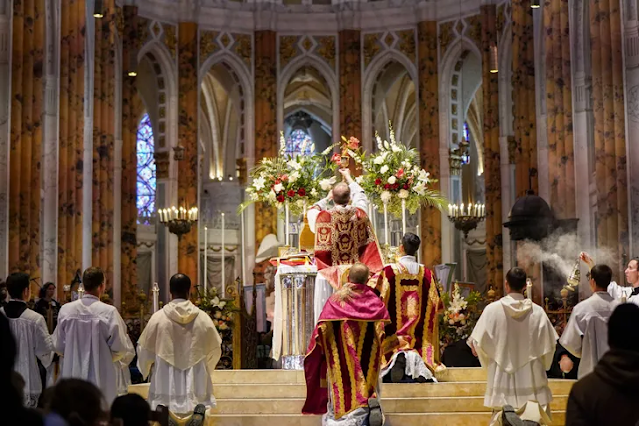
College Station, Texas – In a stunning intervention, the Diocese of Austin has forced the cancellation of a scheduled Traditional Latin Mass at Texas A&M University, silencing one of the most vibrant and growing expressions of Catholic faith among young people in America.

Cardinal Gregory: "Tradition dies a slow death, sometimes a bloody death"

On Wednesday 6 December, the Archbishop of Washington, Wilton Cardinal Gregory, took part in an event at the Catholic University of America as part of their Presidential Speaker Series, entitled "Celebrating Diversity" (h/t Diane Montagna). The full video can be found below, as well as on YouTube. In this talk, His Eminence notes that "even our American Catholic comfort zone can be rattled by the vastness of God's family of cultures, languages, and expressions of Catholic worship; so much diversity can throw some people off balance and quite frankly make them feel uneasy" (16:30). He also waxes lyrical about how the "synodal process" is rooted in the "ability to give one another grace and space as you journey together, with the freedom to express yourself freely without judgment" (29:44).

Traditional Liturgy: How many Faithful in France? And in the World? "Many of today's Catholics are 'Hidden Traditionalists,' waiting for a Mass worthy of the name."-- An Interview

By Paix Liturgique

October 4, 2023


Although we haven't published a review of traditional liturgy in France and around the world since 2019... we felt it necessary to return to the question of the number of Catholic faithful who wish to live their faith to the rhythm of traditional liturgy. We asked Christian Marquant, who has been interested in this subject for many years, to return to this theme which, as we shall see, remains a burning issue.

***

Louis Renaudin - Dear Christian, why is it important to ask the question of the size and therefore the number of the Catholic faithful who are attached to the traditional Roman liturgy?


Christian Marquant - In theory, it doesn't matter... no one, apart from learned researchers, is going to be interested in the number of Syro-Malabar or Syro-Malankar faithful... nor in the number of priests and faithful who still participate in the Ambrosian (reformed) rite in Milan, or the Mozarabic (cobbled-together) rite in Toledo and Salamanca, because in all these cases there is no controversy or underlying problem. However, when we consider the number, and therefore implicitly the importance, of those who wish to remain attached to the usus antiquior, i.e., to the Mass that has been the Mass of all Latin Christendom for over 1,000 years, we immediately find ourselves in a polemical field whose stakes are quite considerable for a large number of pastors and for members of the "modern" lobby. We are touching on the great division that has afflicted the Church since Vatican II, and to which the Holy Father indirectly alluded at the last consistory in his appeal for unity. A pathetic appeal to an almost empty St. Peter's Square...


Louis Renaudin - What division are you referring to?

Recent Interviews on the Undeniably Resurgent Latin Mass

Documentary filmmaker Cameron O'Hearn interviewed me at the end of June in a far-ranging conversation about various aspects of Catholic liturgical tradition. The conversation first appeared live on Facebook, and afterwards was published on YouTube:


Topics covered:

A New and True Springtime is Coming: A Young Priest Explains his Love for the Traditional Mass

The following letter is written by a young priest who is a curate at a Novus Ordo parish in Fairfield, Connecticut.  Father Tim Iannacone, ordained in 2017, was a parishioner at Saint Mary's Church in Norwalk, CT, where he served at the altar at the Solemn Mass in the Extraordinary Form.  It was there that he discovered the Traditional Roman Mass, a discovery, as his letter explains, that changed his life. His pastor asked him to write this letter to the parishioners not only as an explanation of the Extraordinary Form but also as a personal witness to the power and beauty of the Traditional Roman Mass and its effect on his life and priesthood. Fr. Tim is but one example of young priests who are discovering the Traditional Roman Mass, who have learned how to celebrate that Mass, and are brining the Mass to the people in their parishes.  The Second Spring is real and alive within the Church.  Thanks be to God.

Father Richard Gennaro Cipolla


Dear Brothers and Sisters in Christ,

Fr. Sam is away with our youth group this week for the annual mission trip, and he’s asked me to take on the weekly bulletin column. I’d like to share with you a bit about the Extraordinary Form of the Roman Rite, the Traditional Latin Mass. Typically, the Latin Mass is offered here on Holy Days of Obligation and certain feast days throughout the year. As this form of the Mass is not commonly celebrated, I want to explain some of the reasons behind its use in our parish.

Is the Church Crisis Driving the Faithful to the Latin Mass? An Interview with Dr. Kwasniewski

Recently, Judy Roberts interviewed me for an article she was working on for the National Catholic Register. Parts of the interview appeared at the Register on December 16th, but the full interview is presented exclusively here at Rorate.


Judy Roberts: In your experience, are more Catholics indeed seeking out Mass in the extraordinary form during this time of turmoil in the Church? What are they telling you as to why? 

Peter Kwasniewski: Statistics, to the extent that they are available, the creation of new traditional Mass apostolates, and anecdotal evidence shared via social media point to a steadily growing base of faithful who are attending this form of the Roman liturgy. 

I’m not sure if it’s growing more owing to the current crisis, but what I have noticed is an interesting trend. The “progressives” or “liberals” are emboldened under this pontificate to show their true colors more and more openly; the “conservatives,” that is, those who would have been classified as “John Paul II Catholics” or “Ratzingerians,” are diminishing; and the “traditionalists,” who once seemed a negligible minority, have not only shown themselves more numerous than hitherto imagined, but are now occupying the intellectual and moral high ground. The serious work of Catholic restoration is happening in large part due to their efforts.

Who are these people? Are they merely older Catholics who grew up with the traditional Mass and are nostalgic for the way things used to be or does this group also include younger people and converts? 

New Video on the Traditional Office of Tenebrae

Readers may be interested in this short video that explains the traditional Office of Tenebrae and why it is so powerful a way of entering into the Passion of the Lord. 

Interview with Dr. Kwasniewski at O Clarim

From O Clarim:

A NOBLE BEAUTY – Exclusive interview with Dr Peter Kwasniewski
Aurelio Porfiri

We celebrate this year the 10th anniversary of the motu proprio Summorum Pontificum, a document released by Pope Benedict XVI that liberalized the use of the pre-Vatican II Missal.

If we want to know something more about the Extraordinary Form of the Roman Rite (the pre-Vatican II Mass), we could read Noble Beauty, Transcendent Holiness (2017, Angelico Press) by Peter Kwasniewski, a very well known scholar in the field of liturgy. Dr Peter Kwasniewski, choirmaster at the Wyoming Catholic College (USA), certainly presents very strong arguments to defend his position, as can be seen in the following interview.

Porfiri: Your book uses the phrase “noble beauty” in its title. How would you describe the noble beauty of the liturgy?

Kwasniewski: There are many different kinds of beauty. There is the simple, domestic beauty we associated with well-made furniture, carpets, blankets, plates, and books. There is an austere beauty, such as one might find in the cell of a Carthusian. There is rugged beauty, such as we see in the landscapes of Iceland or Canada or Alaska. But there is a noble beauty that we associate with sovereignty, majesty, occasions of great public solemnity. The liturgy is our courtly audience with the king of heaven and earth. It should be characterized by a tremendous sense of spaciousness, elevation, dignity, and splendor. That is what I am driving at in my title.

Porfiri: What is your ideal reader? How you imagine your audience?

One reader described me as “giving old arguments new juice.” I was born well after the Second Vatican Council ended and after Paul VI had already promulgated a new Mass. All of the traditional things I love are things that almost went extinct. My friends and I had to stumble upon them and discover them anew. I see it with fresh eyes: I have no nostalgic memories. For this reason, my writings seem to speak especially to young people who are in the same boat. This book is largely an “apologia” for the ancient liturgy and the whole world-view it embodies—which is definitely not that of modernity. My ideal reader? Someone who has an open mind to the proposal that the past generations might have had more wisdom than we do.

You Suggest: ICR seventh annual Sursum Corda Weekend


From a priestly reader: 

Sursum Corda is a nationwide initiative to foster the spiritual lives of the young adults in the apostolates of the Institute of Christ the King. For the seventh year in a row, Sursum Corda is offering a social and spiritual weekend for young people ages 18 and up, August 11-14.

The event will be held on the beautiful grounds of Mundelein Seminary just north of Chicago. Canon Commins (Vicar at Saint Francis de Sales Oratory, St. Louis, Missouri) will be the chaplain for the camp, and several other canons are sure to be there as well. 

The program includes daily Mass, prayer in common and opportunity for confession, faith formation classes and discussions, and other social activities for young men and women.

The weekend begins with check-in at 3:00 PM on Friday, August 11 at Mundelein and will end on Monday, August 14 at 12:00 PM.

This year's admission fee is $250, which includes lodging and meals.  

TO REGISTER: Mail check AND registration form (CLICK HERE) to:

Institute of Christ the King
2653 Ohio Ave, St. Louis, MO 63118
To the Order of: Institute of Christ the King
For: Sursum Corda Retreat

REGISTRATION DEADLINE: July 21, 2017

Spaces are filling fast!

Address: University of St Mary-The Lake. 1000 E Maple Ave, Mundelein, IL 60060

For transportation possibilities, please contact your local Sursum Corda Group. You can also contact sursumcordastlouis@gmail.com if necessary.

New Book from Angelico Press: Noble Beauty, Transcendent Holiness: Why the Modern Age Needs the Mass of Ages

I am pleased to announce the publication of my new book with Angelico, now available on Amazon.

(The publisher's announcement:)

THE TRADITIONAL LITURGY OF THE ROMAN CATHOLIC CHURCH is a highly formal ritual unfolding in layers of elaborate gesture, rich symbolism, whispered Latin, and ancient plainchants. “Experts” after the Second Vatican Council were convinced that such a ritual was irrelevant to “modern man.” To the shock of some, the delight of many, and the surprise of everyone, the old Latin Mass (and much that went along with it) has tenaciously survived during the past half-century and become an increasingly familiar feature in the Catholic landscape. What are the reasons for this revival, especially among the young? And why is this development so important for the renewal of Catholicism? 

Peter Kwasniewski offers a lively account of the noble beauty and transcendent holiness of the traditional Roman liturgy, which humbles us before the mystery of God, stirs us with its pageantry, carries us into sacred silence, and bears us to a world of invisible realities. He contrasts this priceless treasure with the rationalistic reforms of the sixties, which yielded a Catholic liturgy severed from its own history, inadequate to its theological essence, unequal to its ascetical-mystical purpose, and estranged from its cultural inheritance. His conclusion: if there is to be a new springtime in the Church, the widespread restoration of the traditional liturgical rites will be at the heart of it.

Interview with Peter Kwasniewski in Czech Newspaper RC Monitor, on Liturgy, Music, Philosophy, Traditionalism

Mr. Andrej Kutarna, a writer, publisher, and photographer who lives near the city of Prague, asked me to give an interview in anticipation of the upcoming launch of the Czech edition of my book Resurgent in the Midst of Crisis: Sacred Liturgy, the Traditional Latin Mass, and Renewal in the Church. (See here for more details about the book launch on Friday, October 14, at which Cardinal Burke has graciously agreed to be present.) A Czech translation of the interview, slightly abridged, was published in this week's issue of Res Claritas Monitor 13 (2016), n. 18 (PDF link here; see pp. 11-14). The full Czech version may be viewed here at Mr. Kutarna's site.

Rorate Caeli has received exclusive permission to publish the original English interview in full:

Aristotle, Aquinas, Plato
Mr. Kutarna: How did you come to the TLM? How was your first encounter with the “Mass of the Ages”?

Dr. Kwasniewski: My journey into the traditional liturgy was gentle and gradual. I grew up in a very typical suburban American parish and sang in its children’s choir and, later, adult choir. The liturgy was very “contemporary” in style, but I didn’t know that at the time.

In high school two things happened: I got involved in a charismatic prayer group, which re-animated my faith, and I took a course in philosophy that brought me into contact with Plato, Aristotle, Augustine, and Aquinas. After a couple of years, my interest in the charismatic prayer group waned, but my intellectual life soared. I began to study theology, too, and had a vague longing for a form of prayer and liturgy that would correspond to the depth and breadth of philosophy and theology. Without knowing it, I was searching for the traditional worship of the Church, which was born of the ancient Fathers, developed by the medievals, and faithfully handed down to us from Trent onwards. 

Important Traditional Catholic news from France


1. On July 2, Bishop Alfonso de Galarreta ordained Fr. Daniel Sabur to the priesthood in Saint-Nicolas-du-Chardonnet. He will celebrate the ancient Chaldean Liturgy every Sunday for a Chaldean community that will meet in the Society's chapel in Saint Mathias de Pontoise. On the very next day he celebrated his first Mass (Chaldean Liturgy) in that chapel with 200 faithful (mostly Chaldeans) in attendance. It is the first-ever Chaldean Rite community under the SSPX. (Source: La Porte Latine,) 

Dr. Kwasniewski’s Lecture at Steubenville: “The Old Mass and the New Evangelization: Beyond the Long Winter of Rationalism”

On Monday, September 7, 2015, Dr. Peter Kwasniewski (one of our contributors and well known to lovers of the traditional liturgy) delivered a lecture at the Franciscan University of Steubenville. The event was well attended by students, faculty, and staff. Rorate is pleased to be able to publish the text in full -- an exclusive publication, for which we are very grateful.


***

The Old Mass and the New Evangelization:
Beyond the Long Winter of Rationalism

Peter A. Kwasniewski [*]
Gentile Gallery of the J. C. Williams Center
The Franciscan University of Steubenville
September 7, 2015

It is an honor and a joy for me to be here this evening. I am grateful to Dr. Michael Sirilla for the invitation to speak at the Franciscan University of Steubenville, which, for so many years, has maintained the reputation of a school where Our Lord Jesus Christ is “the king and center of all hearts” and where the Catholic Faith is taught, practiced, and loved. On a more personal note, I have the feeling of “coming full circle,” since I taught for the Austrian Program at the Kartause in Gaming, and at that time mingled with many wonderful people from the university—but never had a chance to visit the home campus.

As I was working on this talk, I came to see that my title, “The Old Mass and the New Evangelization,” really deserves to be a book, not a lecture. I decided to limit myself to an aspect that seemed especially fruitful—“Beyond the Long Winter of Rationalism”—even though one could approach the topic from so many angles.[1]

Rediscovering the Ancient Mass

Church and State together for beauty and the good of Mankind: President of Gabon supports new Church for Traditional Roman Rite

Communiqué of the Presidency of the Gabonese Republic - January 20, 2015 


Libreville, January 20, 2015 - Thanks to the vision and the personal support of the President of the Republic, not only the Catholics of Libreville, but all Gabonese - known for their love of beauty and the arts - will soon enjoy a masterpiece of architecture at the STFO district: the parish church of Notre Dame de Lourdes and its façade decorated with blue tiles.

O Beauty Ever-Ancient, Ever-New

First Mass of Dom Benedict of Silverstream Priory, November 2nd, 2014
Reading St. Thomas’s Commentary on the Sentences of Peter Lombard, I noticed that he makes an argument based on the Collect for Easter Sunday. I went to look at my Baronius Missal and found that, indeed, the prayer we use today in the usus antiquior is identical to the one he quoted back in the 1250s.

Tradition and the Young: Christ makes all things new


A beautiful video (press on CC or captions for subtitles in English) produced by the German District of the Society of Saint Pius X (SSPX): the wine of Tradition is always permanent and always new, it is always ready to fill new wineskins with love for Christ and His Church.

May Christ bring all traditional-minded Catholics together: the true Way of the Cross (Kreuzweg)* is filled with joy and hope.
_______________
*The video is a response to a newly-released anti-Catholic German motion picture with this title (Kreuzweg).