Rorate Caeli

Quo Primum, 444 Years


PIVS EPISCOPVS
SERVVS SERVORVM DEI
AD PERPETVAM REI MEMORIAM

Quo primum tempore ad Apostolatus apicem [From the very first, upon Our elevation to the chief Apostleship], We gladly turned our mind and energies and directed all out thoughts to those matters which concerned the preservation of a pure liturgy, and We strove with God's help, by every means in our power, to accomplish this purpose. For, besides other decrees of the sacred Council of Trent, there were stipulations for Us to revise and re-edit the sacred books: the Catechism, the Missal and the Breviary. With the Catechism published for the instruction of the faithful, by God's help, and the Breviary thoroughly revised for the worthy praise of God, in order that the Missal and Breviary may be in perfect harmony, as fitting and proper - for its most becoming that there be in the Church only one appropriate manner of reciting the Psalms and only one rite for the celebration of Mass - We deemed it necessary to give our immediate attention to what still remained to be done, viz, the re-editing of the Missal as soon as possible.

Hence, We decided to entrust this work to learned men of our selection. They very carefully collated all their work with the ancient codices in Our Vatican Library and with reliable, preserved or emended codices from elsewhere. Besides this, these men consulted the works of ancient and approved authors concerning the same sacred rites; and thus they have restored the Missal itself to the original form and rite of the holy Fathers. When this work has been gone over numerous times and further emended, after serious study and reflection, We commanded that the finished product be printed and published as soon as possible, so that all might enjoy the fruits of this labor; and thus, priests would know which prayers to use and which rites and ceremonies they were required to observe from now on in the celebration of Masses.

Pope's 3rd "conversation" with Italian liberal journalist E. Scalfari
- Vatican spokesman blames Scalfari, Repubblica criticizes the Vatican
- Don't shoot the Messenger

Dosso Dossi
Jove, Mercury and Virtue

Wawel Castle, Krakow


¡Qué lío! - what a mess!

First, the account of the media commotion (there seems to be one every single day) involving declarations by the Pope through unofficial means. The summary in English is by La Repubblica, the secularist newspaper co-founded by Italian liberal and atheist journalist Eugenio Scalfari himself -- our comment at the end.

________________________________

Francis says 2% of priests are paedophiles

Once again, Pope Francis appears to be out of step with conventional wisdom in the Vatican. In his third conversation with Eugenio Scalfari, La Repubblica’s founder and former editor-in-chief, the pontiff implied that there was room for manoeuvre on the issue of celibacy, that there were paedophiles among the cardinals, and that not enough priests condemned the mafia. But the Vatican immediately issued a statement suggesting he had been misquoted.

The Pontiff recalled that celibacy for priests was not instituted until the 10th century, “900 years after Our Lord’s death”, something which the church usually prefers to overlook. He also recalled that clerics could marry in some Eastern Catholic Churches. There were solutions to the “problem” of celibacy, “and I will find them.”

This unusually open approach to the issue follows on from his comments in May, when he told reporters on the plane returning from Israel that “celibacy is not a dogma”. He added: “It is a rule that I appreciate very much… but since it is not a dogma, the door is always open.”

Martyrs : Witnesses

The 19 Holy Martyrs of Gorkum,
hanged and mutilated by Protestants on July 9, 1572, in Brielle, Holland

I'm not interested in converting Evangelicals to Catholicism. I want people to find Jesus in their own community. There are so many doctrines we will never agree on. Let’s not spend our time on those. Rather, let’s be about showing the love of Jesus.
Franciscus
June 23, 2014

We will have much more on this meeting shortly.

_________________________________

On July 2, 1572, Feast of the Visitation, Fr. Leonard van Veghel, the pastor of Gorkum (Gorinchem, Holland), was under great pressure. He had been temporarily released from captivity by the Protestants to tend to Catholic laity - but only under the condition that he did not preach, unless he limited himself to pure Reformed doctrine. In his sermon, instead,

"He swore to remain faithful to the Catholic Faith, outside of which no salvation was possible. Attentive listeners said that at the end he stated that he would always proclaim, for as long as it was granted him to preach, the teachings of the Holy Roman Church, even if he had to pay for it with death." [C.J. van Blijswijk, De Martelaren van Gorcum: voorbeelden van trouw, Oegstgeest, 1993, p. 69]

Fr. Leonard, and 18 companions, paid the ultimate price one week later.

This short note is just to acknowledge publicly, coming from our humble selves, who owe them so much, the sacrifices of the thousands of Catholics martyred by Protestants, or "Evangelicals", in the past 500 years.

- Dear Martyrs, unforgettable Martyrs, you are still remembered, loved, cherished, as alive with us today as ever through the Communion of Saints.

- Dear Martyrs, your blood is a living witness, streams of blood shed for Our Lord, Our Lady, the Sacrosanct Sacrifice of the Mass, the inerrant Apostolic Doctrine, the missionary duty of the Church, and the legitimate rights of the Roman See, reflecting the Sacrifice of the Crucified and lighting our way.

- Dear Martyrs, as you did, may we also, through your powerful intercession, attain final perseverance and eternal life with you and Our Lord: "Blessed are they that wash their robes in the blood of the Lamb: that they may have a right to the tree of life, and may enter in by the gates into the city."

+
Rex gloriose Martyrum :
Ignosce quod deliquimus.

Amen.

So... Canonizations... Infallible or not?

Bishop Giuseppe Sciacca, a remarkable prelate and Canon Lawyer and current Adjunct Secretary of the Supreme Tribunal of the Apostolic Signatura, granted days ago the following interview to La Stampa (posted here for the record of current events):

Bp. Sciacca and Pope Benedict XVI

Is the Pope infallible when he proclaims a new saint?

“According to the prevailing doctrine of the Church, when the Pope canonizes a saint his judgment is infallible. As is known, canonization is the decree with which the Pope solemnly proclaims that the heavenly glory shines upon the Blessed and extends the cult of the new saint to the universal Church in a binding and definitive manner. There is no question then that canonization is an act carried out by the Petrine primate. At the same time, however, it should not be considered infallible according to the infallibility criteria set out in the First Vatican Council’s dogmatic constitution “Pastor aeternus”.”

So, according to you, this means the Pope can make a mistake when he proclaims someone a saint?

“That’s not what I said. I am not denying that the decree issued for a canonization cause is definitive, so it would be rash and indeed unholy to state that the Pope can make a mistake. What I am saying, is that the proclamation of a person’s sainthood is not a truth of faith because it is not a dogmatic definition and is not directly or explicitly linked to a truth of faith or a moral truth contained in the revelation, but is only indirectly linked to this. It is no coincidence that neither the Code of Canon Law of 1917 nor the one currently in force, nor the Catechism of the Catholic Church present the Church’s doctrine regarding canonizations.”

Monsignor, it has to be said though that the majority of those who support the infallibility idea have an important ally on their side: St. Thomas…

“Of course, I am well aware of that. Thomas Aquinas is the most prestigious author supporting this theory. But it should be said that the use of the concept of infallibility and of language relating to it, in a context that is so far from that of the 19th century when the First Vatican Council was held, risks being anachronistic. St. Thomas placed canonization half way between things that pertain to the faith and judgments on certain factors that can be contaminated by false testimonies, concluding that the Church could not make mistakes: in fact, he claimed that: “thinking that judgment is infallible, is holy.” As I said before and I repeat again, the “Pastor aeternus” rigorously defines and restricts the concept of papal infallibility which could previously also encompass and contain or be likened to the concepts of “inerrancy” and “indefectibility” in relation to the Church. Canonization is like a doctrine which cannot be contested but which cannot be defined as a doctrine of faith as all faithful must necessarily believe in it.”

An upcoming week of Traditional Events (incl. Pilgrimage ) surrounding Our Lady of Mt. Carmel in New York City

In honor of the 130th anniversary of the founding of the Pontifical Sanctuary of Our Lady of Mount Carmel in East Harlem, Upper Manhattan, New York (Map), and the arrival in America to staff the shrine of the Society of the Catholic Apostolate, better known as the Pallottines. 

- On Sunday, July 13th at 5:00 p.m. there will be a Ukrainian Greek Rite Liturgy celebrated for a pilgrimage of Eastern Rite Catholics that day.
- On Tuesday, July 15th  at 7:00 p.m. there will be sung at the main altar of the shrine church, Vespers of the Little Office of the Blessed Virgin Mary (1962), followed by a candlelight procession at 9:00 p.m., and a Solemn High Traditional Latin Mass at midnight (i.e. July 16th, at 12 a.m.); Rev. Canon Jean Marie Moreau of the Institute of Christ the King will be subdeacon and homilist.
- On the morning of July 16th, the feast of Our Lady of Mount Carmel, there will be a Traditional Latin Missa Cantata at 9 a.m.
- On Saturday July 19th, at 11 a.m., there will be a Solemn High Traditional Latin Mass at the altar of the Pontifically Crowned Madonna on the occasion of the third annual pilgrimage being made that day by faithful attached to the Extraordinary Form of the Latin Rite. The Rosary, Litany of Loreto, Investiture with the Brown Scapular and Solemn Benediction will follow at 2:30 p.m.

There have been several documented miracles that have been performed by the Blessed Mother at this shrine. The image located there was proclaimed miraculous by His Holiness Pope Leo XIII, and so crowned during the pontificate of Pope St. Pius X on July 10th, 1904. There are only three images of the Blessed Virgin that have been crowned by Pontifical Authority in North America.

The Church of Our Lady of Mount Carmel at 115th Street is one of the first Italian National Parishes in the United States. At one time more than 500,000 people attended the feast of Our Lady of Mount Carmel during the month of July before and after the feast day. The crown of the Madonna and child is gold, adorned with precious stones, the emerald of which was donated by the aforementioned pope.

The Crowned Statue is taken down in procession only on special occasions, this year's anniversary being one of those special occasions, and with the authorization of ecclesiastical authority.

For more information on the Saturday, July 19th pilgrimage please contact: nyctlmpilgrimage@gmail.com

Fontgombault: A Sermon for Saint Benedict
- and the memory of Petrus a Stella, Founder.
"Are you an aqueduct of God's grace ?"

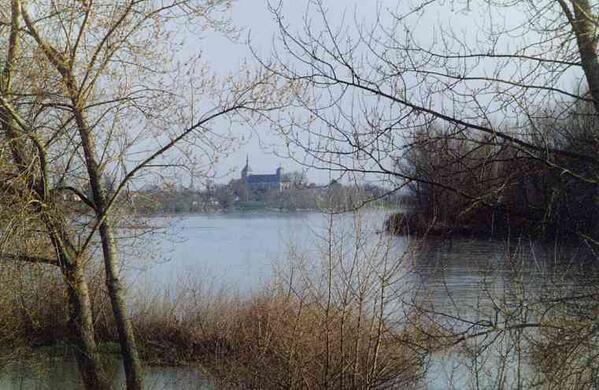
The Loire river - Fleury Abbey in the background

Sometime in the 7th century, the relics of Saint Benedict were translated from Monte Cassino to a monastery by the Loire, the Abbey of Saint Benedict upon the Loire (Saint-Benoît-sur-Loire), better known as Fleury Abbey. (There are some who say that the relics actually remained at Monte Cassino, but that is a matter for another day.)

In any event, the date of definitive placement of the relics at Fleury, July 11 (653? 655? 660?), became a second feast of Saint Benedict for all his sons and daughters - a Saint Benedict of summer, so the Patriarch could be festively celebrated, which cannot happen on the date of his death (Transitus, March 21), due to Lent or holy week. Both dates were always celebrated by Benedictines, while in the general Roman Calendar the remaining date was that of March. In the pauline calendar, the "Solemnity" of Saint Benedict was transferred from March 21 to July 11. Both dates, Transitus and Translation of Relics, are, for Benedictines, thoroughly traditional feasts.

This summer feast of Saint Benedict was celebrated today as well in Fontgombault Abbey, which also recalls this year the death, exactly 900 years ago, in 1114, of the original founder of the abbey, and first abbot, Petrus a Stella (Pierre de l'Étoile, "Peter of the Star"), and the translation of his remains, 60 years ago, to the nave of the abbatial church. The sermon of the Father Abbot for the date is available below.


Fontgombault Abbey - nave of the abbatial church
View from choir: tomb of Petrus a Stella in the foreground
________________________________

Sermon of the Right Reverend Dom Jean Pateau
Abbot of Our Lady of Fontgombault
(Fontgombault, July 11, 2014)


The Church invites us all to rejoice in the Lord, gaudeamus omnes in Domino, on this day when she celebrates St. Benedict’s feast day.

For more than 1,500 years, men have kept entering the school of the holy Patriarch, who was born in Nursia, Italy, around 480. He lived in troubled times, since the Roman Empire had collapsed four years before he was born; there were all kinds of dangers, rampaging of troops, requisitions, looting and plundering, violence, increase in foodstuffs prices, dearth and restrictions, starvation, epidemics. Benedict, “in his life repaired the house of the Lord”. His example, his Rule, his monasteries have been and remain an answer offered to men and women of all times, to those, “who desire life, and covet many days, that they may enjoy good” (Ps 33 [34]:13).

"No Confessions will be heard"
- A Confessor's Examination of Conscience

A guest-post by Fr. Bec (pen name)

Eugène Ernest Hillemacher
A confessional at Saint Peter's, Rome, on Easter Sunday (1847)
Musée d'Orsay
___________________________________________


A few days before Christmas last year, a sign appeared on the door of a confessional in a certain cathedral that read, "No Confessions will be heard from Sunday 22nd to Wednesday 25th."

​In this same church, priests have often been seen closing the confessional and walking past as many as twenty, thirty, and even more persons who have waited patiently but unsuccessfully to go to confession during the half hour scheduled before noon Mass. For several years, each time he has made it into that confessional, at least one of those penitents has requested more time or more confessors, to meet the obvious need.

At being made aware of this, my first reaction as a priest was to pity those souls, and to rashly judge the priests who were not hearing their confessions. But quickly I realized that neither of these was appropriate. Instead, I should offer to help, both penitents and priests, perhaps by sitting in the other confessional, perhaps hearing confessions for a longer time. Perhaps the people and the priests would accept such an offer of help from another priest.

But what if they did not? What else could a priest do in such circumstances? If pity and indignation are not appropriate, then what is?

O Lord, have mercy on those who seek Your forgiveness and healing through absolution! O Lord, have mercy on those men You chose to be priests to offer that absolution. O Lord, have mercy on me, who like them, am a sinner and a priest. Enlighten me, O Lord, as a priest and sinner. Show me what I should do. Show me how I can help.

If sinners should examine their conscience, admit their guilt and reform their lives, all with the help of Your grace, then I as a priest with the power and mission to absolve sinners, should do the same.

Confessor's Examination of Conscience :

If Pope says black is white, that's it, right?
- a very special young man knew better than that


From our 2012 series on the Life and Thoughts of Cardinal Merry del Val, on the centennial year of the death (dies natalis) of Pope Saint Pius X:

Beside the exceptional and amiable figure of St. Pius X, we have, in marvellous splendor, the figure no less exceptional and extraordinary, of his Secretary of State, Cardinal Rafael Merry del Val. Of noble birth, but still more of noble aspirations, as from the first years of his life he had one unique and most noble goal: to be a Priest of God.

ENLIGHTENING PRESENTIMENTS

Born on the 10th October 1865 in London, to the Spanish Marquis of Irish descent, Rafael Merry del Val, and to the Countess Josephine de Zulueta, English but of Spanish descent, the future Secretary of State received Baptism the following day, and was named Rafael. The prestigious Del Val family, illustrious due to the nobility of their blood no less than for their virtues, could boast that amongst their ancestors there was a martyr of the Church: Little St. Domingo del Val ... . The future Cardinal nourished a very special devotion to him.

Rafael Merry del Val was, therefore, an aristocrat , but far from being fascinated by noble society, he demonstrated even from his infancy the signs of a divine calling. At only eight years of age, when asked by an elderly Jesuit what he wanted to be when he grew up, he replied: “I want to be a priest.” And when he was saying goodnight to his parents that evening, he drew out of his sleeve a biscuit and raising it on high, said: “I will do this with the host when I become a priest.” He would also, from time to time during meals, take a glass of water and a biscuit, and raising it a little would exclaim: “This is what I will do when I celebrate the Mass.” Having learned at an early age to serve the Holy Mass, he took delight in preparing little altars and imitating the sacred ceremonies, as well as speaking of these things with various priests who, with admiration, perceived in the young Rafael the divine calling.

One day, whilst out walking with his governess, a funeral cortege was passing by. The little Rafael took off, mingling with the crowd which was following the coffin. When the governess after an anxious search finally found him and asked him why he had done such a thing, he answered candidly: “Mother told me that those who die go to Paradise: and I also want to go to paradise with that deceased person.” The Mother of the future Cardinal recounted also that on another occasion, whist she was explaining to him the meaning of papal infallibility, she decided to test him. Taking a book bound in black in her hand, she asked him: “Rafael, if the Pope said that this book is bound in white, what would you say about that?” The little boy, after a moment’s reflection replied: “Mother, the Pope would not be able to say such nonsense,” showing – by his reply – the acuteness of his most refined intelligence.

We are reposting this because some readers were curious about a recent mention of the matter in a Rorate article, in which a paraphrase of the Ignatian words was quoted: "if the Pope says that black is white then we should believe that it is white."

Unjustified Silly Season

Important

In an international competition of a popular sport, the final match will involve the teams of the countries of origin of the Pope and of the Pope Emeritus -- and religious correspondents immediately begin the silly season of the "competition" between the popes, what the "mood" between them will be, where will they watch the match, etc.

This is extremely offensive, especially considering the strong words of the Chaldean Catholic Patriarch specifically about this point, a plea ignored by the Western media, as Christians are expelled, executed, and victimized by genocide all through Iraq and Syria. It was not a coincidence that Patriarch Sako (not us!), the main Catholic cleric in Mesopotamia, chose to put his attention specifically on this amazing contrast: he knows how ridiculous and embarrassing the Church looks before the Muslims who terrorize them when Christians in the West put more attention on games than on the martyrdom of their brothers and sisters:


It was unclear whether Syrian troops, who apparently advanced in and around the northern city of Aleppo on Monday, July 7, would be able to halt the ISIL fighters. Yet, most Christians have already been forced to flee Syria and Iraq, where the head of the Chaldean-Catholic Church, Patriarch Louis Raphael I Sako, fears Christian life will eventually come to an end in the region.

"In ten years there will perhaps be 50,000 Christians left" in Iraq, he said in a statement released by Catholic charity Aid to the Church in Need and obtained by BosNewsLife. "Prior to 2003, this figure was about 1.2 million. Within ten years we have shrunk to a community of perhaps four to five hundred thousand faithful," he added.
...

FOOTBALL INTEREST

Sako fears Iraq will soon fall apart. "At present there are three fragments of Iraq, a Sunni one, a Kurdish one and a Shiite one. The Kurds already enjoy autonomy anyway. The Shiites do as well in a sense. Now the Sunnis are following suit. Iraq will therefore be divided up."

The bishop condemned Western states who he said "find football" in the current World Cup "more interesting than the situation here or in Syria."

He said Western policy only pursues economic interests. "The international community should put pressure on Iraqi politicians to make them find a political solution and form a government of national unity."

Sako views the Sunni oriented ISIL as a global security threat. The group, he added, "intends to found an Islamic state with oil wells in order to Islamize the world. I think this is a danger for all." [Source]
Not important
This sentiment is echoed strongly by the Primate of the Gauls, Cardinal Barbarin, who had stern words on the matter days ago:

"The eradication of religious minorities is not, alas, a collateral damage of the insane strategy of the murderers: it is their declared goal," says Cardinal Barbarin. And he adds, "Because these are men whare being murdered, in silence, between two waves of a Brazilian soccer stadium," he insists by evoking the global enthusiasm for the football world cup. [Source][Original article]

The silly season in the Church (and in the journalistic coverage of the Church of Rome, which even Catholic agencies cover as if it were a society column, in particular after 2013) must end: it's not the time, it's not the place, it's not the age. First things first.

You Report: Pontifical Mass in celebration of 7th anniversary of Summorum Pontificum


As we had announced here, the Archbishop of Santa Fe, Michael J. Sheehan, celebrated on Monday at the St. Thomas Aquinas Church in Rio Rancho, New Mexico, a Votive Mass on the 7th anniversary of the promulgation, by Benedict XVI, of the motu proprio Summorum Pontificum. A reader reports:


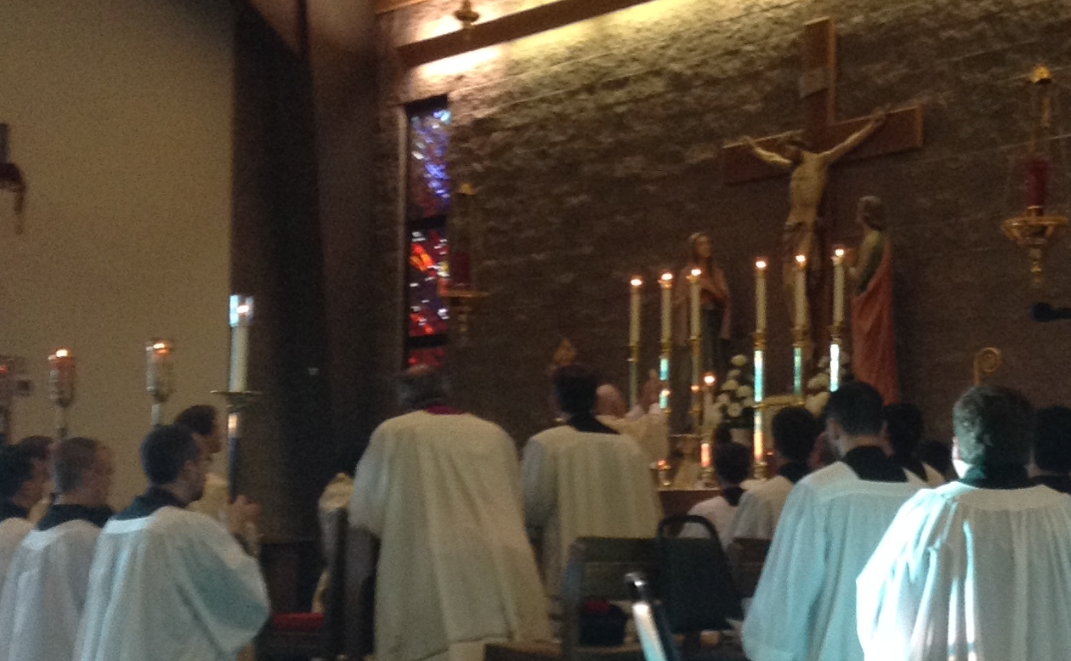
The Solemn Pontifical Mass (a votive Mass of the Most Precious Blood) was celebrated from the throne. The Canons Regular of St. John Cantius did an excellent job directing His Excellency, Archbishop Michael J. Sheehan , the priests, deacons, seminarians, and servers in the execution of the ceremonies of this Mass. Among those in attendance were priests, religious, and faithful from the Archdiocese. Thanks be to God for the many graces given to those who assisted at this Mass as well to all in the Archdiocese of Santa Fe.

"An Act of Parliament, directly oppugnant
to the laws of God and his holy Church..."


All which notwithstanding the jury found him guilty, and incontinent upon the verdict the Lord Chancellor [for that matter chief commissioner] beginning in judgment against him, Sir Thomas More said to him,

"My Lord, when I was towards the law, the manner in such case was to ask the prisoner before judgment, why judgment should not be given against him."

Whereupon the Lord Chancellor staying his judgment, wherein he had partly proceeded, demanded of him what he was able to say to the contrary. Who then in this sort mildly made answer:

"Forasmuch as, my Lord, this indictment is grounded upon an Act of Parliament, directly oppugnant to the laws of God and his holy Church, the supreme government of which, or of any part thereof, may no temporal prince presume by any law to take upon him as rightfully belonging to the See of Rome, a spiritual preeminence by the mouth of our Saviour himself, personally present upon the earth, to St. Peter and his successors, bishops of the same see, by special prerogative, granted, it is therefore in law amongst Christian men insufficient to charge any Christian."
...

TWO PLUS TWO MAKES THREE
"An after-Mass debate in a mixed-use Sacristy"
- Atto primo, scena unica -

A work of fiction, by Fr. René Tiepolino (nom de plume)

***
The Philosopher: All cats are mortal; Socrates is mortal; therefore Socrates is a cat.
The Old Man: - and has four paws. It’s true! I have a cat called Socrates.
The Philosopher: You see!
Eugene Ionesco, The Rhinoceros

***

In a mixed-use sacristy somewhere in the world following a Traditional Mass, the celebrant, Don Pietro Recitalamessa, is greeted by Auxiliary Bishop Annibale Psittacus, who will "preside over" the Ordinary Form shortly thereafter.


…………………………………………………


Don Pietro: Your Excellency, Everybody is talking about Professor Sheldon’s new thesis that 2 + 2 = 3. What is the official position of the Church?

Bp. Psittacus: The thesis has been accepted with enthusiasm by the whole Vatican - indeed we regard it as something of a breakthrough.

Don Pietro: And the Holy Father?

Bp. Psittacus: I had the honour to talk to an assistant to His Holiness yesterday over a cup of disposable coffee during an informal 11 o’clock chat-time by the Santa Marta coffee-dispenser. I am not yet at liberty to reveal the comments - they have not yet been spinned - suffice it to say that there has been talk of a Joint Declaration by the Church and the United Nations. The disposable Declaration is envisaged as part of the dialogue between the Church and the World. It was the Council that showed how enormously important this Dialogue really is.

Don Pietro: How does the Vatican understand the Professor’s formula?

Bp. Psittacus: As the rejection of logic. We are living in a post-logical era. The World has been living that experience for a long time. Then it entered the Church. Now it’s going to be recognized officially as such.

Sermon for the Fourth Sunday after Pentecost

“But when Simon Peter saw this, he fell down at Jesus’ knees, saying: ‘Depart from me for I am a sinful man’…And Jesus said to Simon: ‘Do not be afraid; henceforth thou shalt catch men.’”

By Father Richard G. Cipolla


A dear friend sent me an email with a You Tube recording on the Fourth of July.  It was that of Irving Berlin on the Ed Sullivan show singing "God Bless America", backed up by a Boy Scouts choir.  My first reaction was to delete this on the basis of sentimental kitsch that would clog my arteries.  But I did listen to it.  

Rorate Caeli Purgatorial Society: Eighty-third posting of Souls


Below, please find the eighty-third posting of enrolled Souls of the Rorate Caeli Purgatorial Society. It's another large list this month with over 1,000 Souls having Traditional Latin Masses said for them by the 40 priests of the Purgatorial Society.

Event: Archbishop Sample on the road for traditional Confirmations in Idaho

 
We received the following email from Fr. Dennis Gordon, FSSP, Pastor of St. Joan of Arc Parish in Coeur d'Alene, Idaho:
 
Praised be Jesus Christ. ... Archbishop Alexander Sample, Archbishop of Portland, Oregon, will be administering the Sacrament of Confirmation, followed by a Pontifical Mass at the Faldstool, to parishioners of St. Joan of Arc Parish, the personal parish for the Traditional Latin Mass run by the FSSP in Coeur d'Alene, Idaho. 
 
This will take place on Sunday, July 13, 2014, at 1:30 pm.
 
We are very grateful to Archbishop Sample for going out of his way so that we can have the Sacraments in the ancient rite, especially since he is flying in that morning for the Confirmations and the Pontifical Mass, and then returning to Portland that evening.

A win-win situation for Holy Innocents proposed in the New York Times

Monday's print edition (online Sunday evening) of the New York Times carries letters to the editor in response to the paper's front page article on Holy Innocents in the Archdiocese of New York.

The second letter to the editor is from a dear Rorate contributor, echoing the point previously made by us in our post on the situation:


Does the Latin Mass Have a Future in New York?

To the Editor:

The arguments by the Archdiocese of New York in favor of closing Catholic churches are always about two issues: parish finances operating in the red and a shortage of priests.

07/07/07+7

It will rise again, I tell you, [...] the Mass will rise again, as I tell so many who come to me to complain (and they do it, at times, crying); and to him who asks me how I can be so sure of it, I answer (as a "poet", if you would like) bringing him to my balcony and showing him the sun... It will be evening soon and there, in the church of San Domenico [in Fiesole], the friars will sing, at Vespers: Iam sol recedit igneus; but, in a few hours, those same Dominicans, my friends, will sing, at Prime: Iam lucis orto sidere - and thus every day.


The sun, I mean, will rise again, it will shine again after the night, to brighten up the earth from the sky, because...because it is the sun, and God thus established it for our life and comfort. Thus, I add, it is and thus it will be with the Mass - the Mass which is "ours", Catholic, of all times, and of all people: our spiritual Sun, so beautiful, so saintly, and so sanctifying - against the delusions of the bats, driven out [of their hiding places] by the Reform, [who believe] that their hour, the hour of darkness, will not end.

And I recall: on this large balcony of mine we were several in a past year, watching the total solar eclipse. I remember, and I almost seem to feel it again, the feeling of coldness, of sadness, and almost of disillusion in watching it, in feeling the air darken and freeze, little by little. I remember the silence in the city, while the swallows... while the birds disappeared, frightened, and the repugnant chiropters appeared, flying in the sky.

To him who said, when the sun was entirely covered: -"What if it were not visible anymore?" - a thought to which none answered, almost as if not realizing the joke in it... The sun is visible anew, in fact, the sun rises again, after a brief daytime night, as beautiful as before and, as it seems, more than before, while the air is filled again by swallows, and the bats go back into hiding.

As before, luminous and beautiful, and yet being the same, the sun seems greater than it was before, as in ... the Gospel [lesson] of the lost and found drachma.

As it was before, and greater than it was before: thus it will happen with the Mass, thus the Mass will seem to our eyes, guilty of not having esteemed it worthily before the eclipse; our hearts guilty for not having loved it enough.
Tito Casini
Nel fumo di Satana: verso l'ultimo scontro
Florence, 1976 (reposted)

_________________________________________


Incredible as it may seem, seven years have passed since His Holiness Pope Benedict XVl bestowed the great gift of Sumorum Pontificum upon the Church and its people.

President of the Philippines' Bishops' Conference: Before Francis, Church was a "dogmatic, self engrossed and authoritative sick institution".


From the official news website of the Catholic Bishops' Conference of the Philippines:


Pope Francis’s papacy ‘biggest challenge’ to PH church—Villegas 
MANILA, July 6, 2014–The papcy (sic) of Pope Francis is by far the “biggest challenge” faced by the Philippine Church, the president of the Catholic Bishops Conference of the Philippines (CBCP) said. 
Lingayen-Dagupan Archishop Socrates Villegas on Saturday said that the pastoral approach of the Supreme Pontiff in leading Catholics all over the world has transformed the church from being a “self-engrossed” institution into an “outreaching” community. 
“(Pope Francis) shakes up our old belief systems about spiritual shepherding. He jolts us from our complacency and status quo attitude. He humbles us with his simplicity. He disturbs us to make us better,” Villegas said in his speech opening the 109th CBCP Plenary Assembly at the Pius XII Catholic Center. 
“He has slowly moved the Church from being a dogmatic, self engrossed and authoritative [sic] sick institution to being a gentle, outreaching, compassionate and persuasive Church through the power of love and mercy,” Villegas added. 

The Ethnographer-Theologian visits a Mysterious and Exotic Continent:
- Tradition is the name of the true Catholic "mindset" -

"I've visited Peru. Now I understand the pope!"

"The main aim of Pope Francis's pontificate is to help lead the greatest possible number of souls to eternal life with Christ." No, no, that is not what was said. No, here it is:

The main aim of Pope Francis’s pontificate is to draw the world’s attention to the poor and to change the global structures that lead to poverty,// the Prefect of the Congregation for the Doctrine of the Faith said in a long interview last week. Speaking to the Austrian Pontifical Missions magazine Alle Welt, Cardinal Gerhard Müller insisted that it was not possible to truly understand Pope Francis unless one could understand the Latin American “mindset”. Cardinal Muller has long experience of Peru over several decades and is a close friend of the Peruvian liberation theologian, Gustavo Gutierrez.

The Western world would have to learn to see problems from the Pope’s point of view, which was very different from the European one, Cardinal Müller said. On account of his many visits to Latin America, he was very familiar with the way Pope Francis thought. It was very good for the world Church not always to see things through European eyes, the cardinal said, and to discover how other people saw Europe. [The Tablet]

When Catholicism worked and prospered in Latin America, it did not have a specific, particular, regional "mindset" that was any different from the "mind" of the Catholic Church. It was the same Christ-like mindset of all her great saints, men and women who, born there or coming from elsewhere in the Catholic world, gave all their blood for the work of Christ in those lands: Saint Rose of Lima and her sacrificial love for the Church, Saints Martin de Porres and Peter Claver and their true concern for the poor (that is, for the souls of the poor above all), Saint Philip of Jesus and his testimony for Christ unto crucifixion itself, Saint Toribio Romo and his renunciation of all earthly comforts for the most destitute while proclaiming loud and clear the exclusive Kingship of Our Lord Jesus Christ -- and of some of the holiest bishops ever to have lived on this earth, such as Saint Toribio Alfonso de Mogrovejo and Saint Ezequiel Moreno, who never wavered one second from the strictest doctrine of the Church, applied widely to all aspects of social life. In sum, if there was once a "Latin American mindset," it was the Catholic mindset, molded by Tradition.

It was for his universal, traditional, Catholic "mindset" that Father Toribio Romo was martyred, not for a "Latin American mindset."

It was easy to 'understand' Saint Toribio Romo's 'mindset':
he was simply a Priest

Reparation for a nation on its Independence Day

The following audio is a sermon by a traditional Catholic mission priest and friend of Rorate. While this is about the United States, there is really no nation left on earth it doesn't apply to, sadly.

Special guest-post:
"Pope Francis and the Society of Saint Pius X"
by Don Pio Pace

Following his very widely read first op-ed here, we are very honored to post this new article by a very wise, knowledgeable, and highly influential cleric, writing under the pen name of don Pio Pace.

His second contribution is one that is dear to the heart of all true Catholics of good will: what really happened with the Society of Saint Pius X in the final weeks of the Ratzinger pontificate? And, most importantly for the moment, what can we truly expect on this subject during the Franciscan pontificate?

____________________________________


Pope Francis and the Society of Saint Pius X


a guest-post by Fr. Pio Pace


In the seemingly endless soap opera of the reconciliation between Rome and the Society of Saint Pius X, an extraordinary historic offer presented itself in February 2013. A missed opportunity. It happened after the announcement of the resignation of Benedict XVI, on February 12, 2013: a personal prelature for the SSPX, a Prelature of Saint Pius X, that had been the object of the negotiations that had been interrupted in June 2012, was once again proposed to Bp. Fellay, the Superior-General of the Society, to be erected on February 22, 2013, feast of the Chair of Saint Peter. But the General House of the Society of Saint Pius X did not follow through with it. It would have been necessary, it is true, to lead from both sides, quickly and efficaciously, final negotiations, in particular regarding the adherence formula, that I will mention later on. The pre-conclave then opened up in March, marked by an extremely violent mood on the reform of the Roman Curia, based on the implicit accusation of impotence of the pontificate that had just ended: one of the failures attributed to Benedict XVI was to have invested in vain on a reconciliation with the Traditionalists, by handing them useless tokens, in particular by way of the Motu Proprio Summorum Pontificum and the removal of excommunications of Abp.Lefebvre's bishps. At that moment in time, before the conclave, taking into account the psychological weight that the Lefebvre question still had at the time, it is not doubtful that, if the last act of the Pontificate of Benedict XVI had been the canonical reintegration of the most visible opponents of the Council, this would have allowed a reduction of the deficit in the "balance of the pontificate" under the cardinals' consideration. And, above all, it would have been what all would be talking about! Instead, the fracture line between "restorationist" and "liberal" cardinals, that had marked the 1978 and 2005 conclaves, became obsolete in the 2013 conclave.

***

The new pontificate ignores the community founded by Abp. Marcel Lefebvre. Up until then, the SSPX prompted in the Church, at least in Rome, great interest in its events and gestures. There was great interest in its growth -- less so after 1988, but still quite noteworthy since Catholicism in the West is in continuous decline. The criticism, even if badly formulated, of Vatican II and the existence of this priestly reservoir hostile to the conciliar line was a permanent "interrogation," as it is said.

But all the attention that the pontificate of Benedict XVI had given to the "good interpretation" of Vatican II (inaugural address to the Curia, of December 22, 2005; farewell address of February 14, 2013, to the Roman Clergy) suddenly vanished. True, by having recently welcomed the Franciscans of the Immaculate on June 10, Pope Francis once again expressed his esteem for an interpreter of the Council who is in a line "of continuity," Abp. Agostino Marchetto  (Il Concilio Ecumenico Vaticano II. Per una sua corretta ermeneutica, Libreria Editrice Vaticana, 2012). But everyone knows that Francis is a outsider to this debate. While he is not a follower of a theoretical "rupture," he is not at all interested in the attempts that imply proving a "continuity" between the last council and the preceding Magisterium. Vatican II is not for him a collection of texts that contradict, bend, or reformulate this or that prior dogma; Vatican II is a pastoral work of opening up to the world, a "return to the Gospel." Period. As for the prior Magisterium, without calling it into question theoretically, he wishes to apply to it a kind of flexibility (the expression is by Cardinal Lorenzo Baldisseri, Secretary of the Synod of Bishops, a key figure in the Francis Curia), a flexibility that involves putting into parentheses the "rigidities" of doctrine, particularly in moral matters. The Pope has for the ancient Magisterium, for the teaching of Vatican II, and also for the theological concerns of Benedict XVI the respect one has for an elderly person, that nonetheless must not prevent the concern for the true life of the people of today and their concrete problems, for whom Catholicism must be above all a message of joy and mercy.

What is the place, in this context, for doctrinal discussion in general, and for criticism of the conciliar texts in particular? The orientation of Pope Bergoglio leads into part-time unemployment not only Traditionalist theologians, but also classical theologians, and even Progressive theologians -- the Pope being, by mental layout, impervious to this "leftwing" trend -- except for their moral liberalism. Now, that intense reflection and that theological-magisterial activity that had always taken place between the Pope and the Congregation for the Doctrine of the Faith does not exist anymore. One could qualify this stunning new situation that prevails in the Pontifical Palaces -- perhaps one must say "the Pontifical Inns" -- as being the ground level of magisterial teaching.

***

Nevertheless, if the Francis pontificate is in fact so lightly favorable to the expression of the critical charism of the Society of Saint Pius X, it could, paradoxically, make the obtaining of a canonical recognition easier. The meeting with the Pope that was set up for Bp. Fellay, about six months ago, in a hall of the Domus Sanctae Marthae, while he and his collaborators had a meal in the refectory in the company of Abp. Pozzo and Abp. Di Noia, shows that permanent contacts clearly reestablished between the superiors of the SSPX and the Ecclesia Dei Commission, and that they are approved by the Pope. On which bases were these relations reestablished? Precisely from the fact of the absence of interest of the Pope for the hermeneutical questions regarding Vatican II, it seems that the famous doctrinal "conditions" presented to Bp. Fellay were placed in the file boxes. It is anyway what emerges from the information that persons in charge of relations with the traditionalists let out: they gather that submitting to the signature of Bp. Fellay doctrinal declarations that were too strict was a mistake.

O Crux, Ave, Spes Unica:
The Mass of Tradition

Editorial: Radicati nella fede, July 2014
Newsletter of the Catholic community of
Domodossola and Vocogno, Diocese of Novara, Italy

________________________________


Last month, when we talked about the solemnity of Corpus Christi, we mentioned the great danger of forgetting the sacrificial nature of the Catholic Mass. A forgetfulness which leads slowly but inexorably to heresy. On this point we should never forget Michael Davies’ great work on the Anglican Reform, which underlines the danger of “what’s left unsaid” in liturgy: Cranmer’s Anglican Reform, in removing all of the explicit references to the propitiatory Sacrifice, successfully introduced Protestantism into England in the space of a generation and brought the country definitively into heresy.

Last month, however we pushed it further saying, that by forgetting the Mass is the Sacrifice of Christ on the Cross, the awareness of the Substantial Presence of Christ in the Most Holy Eucharist is inexorably lost: if we don’t have the Victim, we don’t have the Presence of Jesus Christ, since Christ is present in the Eucharist as Victim. A Mass increasingly identified as a commemoration of the Last Supper truly risks not being a Catholic Mass. It is undeniable that the last reform to the Mass, the one in 1969, made it more and more like the Protestant Holy Supper, Anglican or Lutheran - whichever it is.

There is still something else though: A Mass that is more and more “protestantized” has “protestantized” the Catholic faithful in its mission, so much so, that each day they resemble more and more Protestant congregations, “involved in the world. “

If we don’t have the Victim, we don’t have the Presence of Christ either. This is true for the Mass and the Blessed Sacrament but it is also true for the entire work of the Church. If Christ Crucified is no longer at the heart of the doctrinal preaching and pastoral work of the Church, the entire mission of the Church risks being frighteningly empty. Never before as in the last few decades have we seen so many pastoral efforts with techniques that have been refined for effective communication; never as in the past fifty years have there been so much talk of mission with hardly any good results. The Church has moved towards the world continuously announcing and announcing, and its relentless de-Christianization has taken place.

Who, among the Fathers of the Council could have imagined, that the Catholic Faith would have almost disappeared in the space of fifty years? Who among the Bishops of Vatican II, could have imagined the advent of the anti-Catholic and immoral society that we have today, where every law seems to be made purposely against the plan of God for man?

Yet, it is undeniable. This disaster is before our very eyes.

If we no longer have Jesus-Victim, we don’t have Jesus-Present either.

A Church that has been enthusiastically “encountering” the world since the ‘60s and has put the Cross of Christ in second place, has lost Christ Himself and has brought nothing or almost nothing to society. It needs to be said clearly: without the centrality of the Cross, without the centrality of Christ crucified, you lose Christ Himself. The ones who speak about Jesus without His Cross and its centrality, are suffering a terrible delusion. The ones who put the Cross of Christ “among the many other things” in the life of Jesus, but don’t’ envisage the center - in truth - they are not even talking about Christ. They are talking about a “confectioned” Jesus specially for the modern world, which like the Jews and gentiles of Saint Paul, judged Christ Crucified as a scandal and foolishness.

The decision was made to go into world and have friendly dialogue with it, avoiding the condemnations of the Church in the past; in order to have friendly dialogue, they had to “veil” or “hide” the Cross and the Sacrifice of Christ, so that the dialogue with modern society, with its religions, would be serene and amicable, resulting in the twofold tragedy of not having brought anything to the people of these times and, worse, in devastating the Sanctuary of the Presence of God, which is the Church.

We cannot avoid it: we must be the first to accept and embrace the scandal of the Cross, recognize it as the central content of the Church’s doctrine, life and mission, and so, not calculating the results, but confident in the infinite power of God’s grace, go into the world so that it will be converted and healed by the Cross of Christ.

Woe to those Catholics, woe to that Church, that wants to convey another Jesus without the Cross! It will lose its essence, strength, soul and its exclusive power of grace. In addition. it will become more and more useless and unbearable to the world that it wanted to reach. A Church without the Sacrifice and the Cross is detestable and unbearable to the world.

What is more, the world is now ready to savage such an empty Church.

In hoc signo vinces, is not only a memory from past history, it is the truth of every single moment: the victory is in the Cross and of those who bring it and show it to the world, without human calculations.

O Crux, ave, spes unica, Hail O Cross, our only hope; if there isn’t a return to this clarity in all things – truly in the entire Church - the disaster will be inevitable.

This return begins though with the Holy Sacrifice of the Mass.

If faced with this devastating picture of confusion we feel powerless; if powerless we are wondering what to do and above all where to begin, let’s remember that the rebuilding of the Church will always start from the Holy Sacrifice of the Mass. Let’s not make human calculations, let’s not make the same mistakes of the 60s, let’s not go into the world, with our techniques, not even to rebuild Tradition, but let’s start again from the Mass.

We say this first to priests and then to the faithful: let’s return immediately to the Mass of Tradition. Let’s return to the correct Rite of the Holy Sacrifice of the Mass and from there we can begin again the painstaking work of rebuilding the faith. Let’s not make the mistake of doing the opposite, first pastoral work, then a return to the Mass of Ages, it would be basically hiding the Cross of Christ again, in the expectation of better times, as the deluded missionaries did in the post-conciliar years.

The truth instead is Christ.


The truth instead is in the reality of His Redeeming Sacrifice, perpetuated in the Catholic Mass. The first duty of priests is to celebrate it. The first duty of everyone is to live by it, so that life, true life, will continue.

______________________
[Translation: Contributor Francesca Romana. Main image, and in details: Diego Velázquez, Cristo Crucificado (1632), Museo Nacional del Prado.]

Institute of the Good Shepherd news:
- 1 - Priestly Ordinations and Images
- 2 - New IBP Foundation in Brazil
- 3 - Vocational appeal

The most recent Ecclesia Dei foundation, the already burgeoning Institute of the Good Shepherd (IBP, for its Latin name), makes public several excellent items.


First, on Friday, June 27, in the IBP Church of Saint-Eloi, in Bordeaux, the amazing Bishop Giuseppe Sciacca, current Adjunct Secretary of the Supreme Tribunal of the Apostolic Signatura, ordained three new priests for the Institute, Fathers Grégory Lutz-Wiest, Karol Zaleski, and Mateusz Markiewicz, and two deacons. Other images available here. Congratulations to the Institute and to the new priests!

Second, for several weeks now this excellent piece of news has been made public -- in the largest metropolis of the Southern Hemisphere, São Paulo, Brazil, the Institute has now a permanent official presence. Fr. Matthieu Raffray, Superior for Latin America, broke the news about a month ago:

On April 10, His Eminence Cardinal Odilo Scherer, Archbishop of São Paulo, granted his agreement to Father Philippe Laguérie, Superior General of the Institute of the Good Shepherd, to erect canonically a house of the IBP in São Paulo. This house was thus established, according to Canon Law, by a decree dated May 11, 2014, on the Feast of Saints Philip and James. [Source]

_____________________


The IBP has only one major international "handicap" at the moment, and that is its lack of presence in English-speaking nations. It is our belief that the Institute of the Good Shepherd is highly interested in vocations from English-speaking countries -- if you are considering a traditional vocation, take a close look at the IBP, exclusively dedicated to the Traditional Mass and whose doctrinal firmness is assured. The IBP international Seminary of Saint Vincent is located in the village of Courtalain, in the Diocese of Chartres, France.

[Update: some ordination details corrected.]

Op-Ed: The True Lesson of Lampedusa

«Se vogliamo che tutto rimanga come è, bisogna che tutto cambi.»

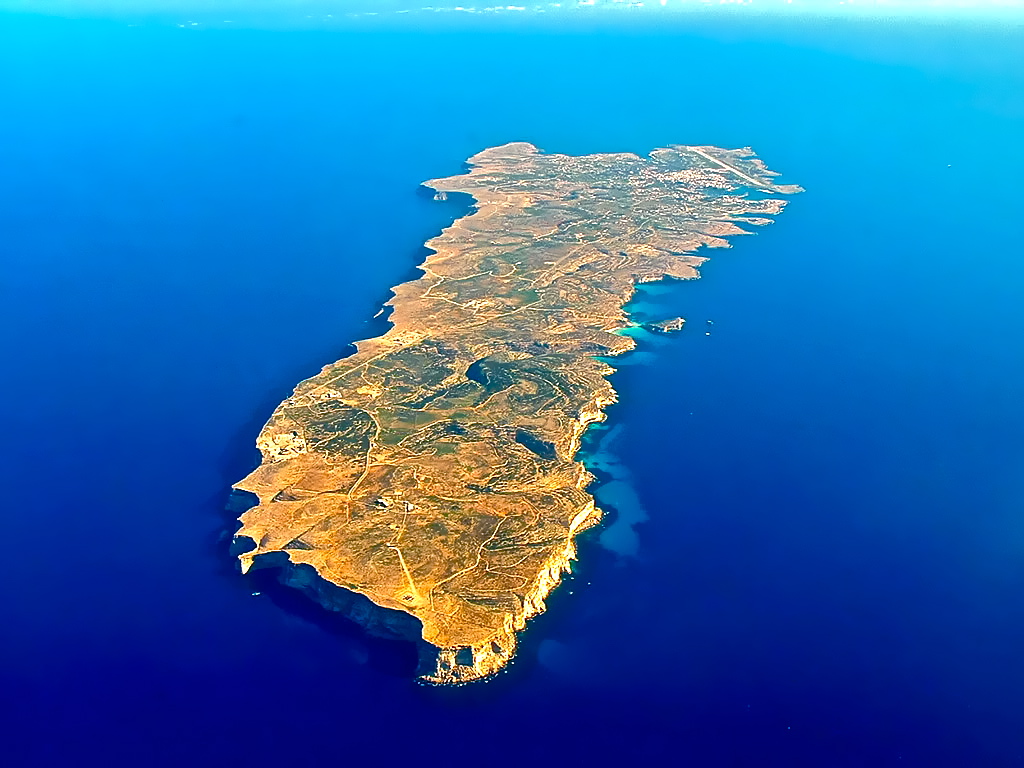
Lampedusa, the island that is the southernmost point of Italy, was visited by the Pope in his first visit, exactly one year ago, in July 2013. It is impossible to hear the name of the island, since the recent Libyan war overwhelmed by the arrival of an endless stream of immigrants, without thinking of the Princes of Lampedusa, in particular the 11th of that title, Giuseppe Tomasi di Lampedusa, whose own family's experiences in Sicily and united Italy during the revolutionary years of the unification of the peninsula inspired every page of his novel "Il Gattopardo". His most famous work was, as is known, published posthumously - here is a famous passage of that book, a dialogue between Prince Salina and his nephew Tancredi Falconeri:


"I'm leaving, Uncle, leaving in an hour. I came to say goodbye."

Poor Salina felt his heart tighten. "A duel?"

"A big duel, Uncle. A duel with little King Francis  [Francis II of the Two Sicilies]. I'm going into the hills at Ficuzza; don't tell a soul, particularly not Paolo. Great things are in the offing, and I don't want to stay at home. And anyway I'd be arrested at once if I did."

The Prince had one of his visions: a savage guerrilla skirmish, shots in the woods, and Tancredi, his Tancredi, lying on the ground with his guts hanging out like that poor soldier. "You're mad, my boy, to go with those people! They're all mafiosi, all troublemakers. A Falconeri should be with us, for the King." [Francis II]

The eyes began smiling again. "For the King, yes, of course. But which King?" [Reference to Victor Emanuel II of Sardinia, future king of unified Italy] The lad had one of those sudden serious moods which made him so mysterious and so endearing. "Unless we ourselves take a hand now, they'll foist a republic on us. If we want things to stay as they are, things will have to change. Do you understand this?" Rather moved, he embraced his uncle. "Well, goodbye, for now. I will be back with the tricolore." [The flag of unified Italy.] (Transl. Archibald Colquhuon , adapted according to the original.)


This passage in the very first pages of The Leopard (Il Gattopardo, published in the year of the election of John XXIII to the papacy), containing what probably is the most famous line in Italian literature in the 20th century, makes some wonder if that was not perhaps what many had in mind for the Council, and for other changes in the Church. Change that would not change. A call that was very popular, as Tancredi Falconeri's choice - popular, or rather populist?... 

They perhaps could not identify in that best-seller on the Risorgimento a warning on the aggiornamento: there is no such thing as intense change, even in "mere" externals, that does not entail or does not at least incorporate revolutionary irreversible transformation - because social structures and conventions, immemorial customs and precedents, cannot be controlled and kept under control by an institution whose very existence presupposes continuity and tradition, if that institution is willing to change with the times its very essence, or even the signs and mere symbols that surround its very essence. All that is left of true greatness that changes itself purporting to remain the same is a mountain of falsified and unattractive relics. That warning is the true lesson of Lampedusa.