Rorate Caeli

The end result of communion in the hand:
Mass sacrilege as hosts passed around from hand to hand in Pope Francis' two Masses in Manila

The Pope's visit to the Philippines from January 15 to 19 saw him celebrate Mass three times for the public -- at Manila Cathedral on January 16, at Tacloban on January 17, and a final Mass at the "Rizal Park" of Manila on January 18. This last Mass, the Philippine government claims, was attended by 4 million people, concelebrated by 2,500 priests and 200-250 bishops. (Numerous online sources mention 6-7 million at the Mass, but if the Philippine Star, one of that country's top broadsheets is correct, the actual breakdown is 4 million who attended the Mass, another 360,000 at the perimeters of the venue, and 2 million along the route of Pope Francis' motorcade from the Apostolic Nunciature in Manila to Rizal Park.)

More conservative estimates put the number at 3 million at the Rizal Park itself, if not a bit less than that. Regardless of the numbers, it was without doubt an enormous display of Filipino Catholic faith, in all its richness -- and poverty.

Update on new SSPX seminary: "A Building that Speaks of God"

We have followed with great interest the building of a new seminary in rural Virginia for the Priestly Society of St. Pius X (SSPX) and were asked to update our readers on its progress. Whatever you may think of the Society's position in the Church, one cannot but marvel at this structure -- especially while most seminaries are struggling to stay open if not already closed.

Video below:

You suggest: ICR monthly novena

It is becoming an annual tradition for us to help the great Institute of Christ the King Sovereign Priest with their fundraising novena. The following was sent to us by the ICR:

Join us in this New Year of 2015 as we embark on a spiritual pilgrimage to Bethlehem, emulating the actions of Three Magi on the feast of the Epiphany.  Through the novena to the Infant King, let us celebrate and meditate upon the Holy birth of Our Savior, God’s giving of His Only Son, and how we can pay homage and adoration to our Earthly and Heavenly King. With this in mind, please join us at the Shrine of Christ the King and participate in the monthly novena from January 17th to January 25th. The Christ Child has promised us: “The more you honor Me, the more I will bless you!”

And entering into the house, they found the child with Mary his mother, and falling down they adored him; and opening their treasures, they offered him gifts; gold, frankincense, and myrrh.”- Matthew2:11

The Three Wise Men and Shepherds brought gifts to the Child Jesus at His birth… What gift will you bring Him? This New Year, be sure to offer the Infant King your prayers and present Him with a candle or a flower as a visible symbol of your love, devotion and thanksgiving.

  • Submit your prayer offerings online and have your intentions remembered along with those of others throughout the world.
  • Offer thanks by presenting an Ex Voto message of Thanksgiving to the Infant King. Through this ancient tradition, read stories from people who have received God’s graces through the novena to the Infant King.
  • Read our monthly meditation which will provide you with spiritual insight to grow step by step in the virtues of the Christ Child. January’s meditation is on the Spiritual Poverty: Key to Heavenly Riches.

Cardinal Piacenza in Wigratzbad: Mercy, Primacy of Conscience and Primacy of Truth

From a teaching lecture given by Cardinal Piacenza, the Major Penitentiary, at a course on the Internal Forum in the Diocese of Ausburg for German speaking priests.

Iacopo Scaramuzzi
Vatican Insider (La Stampa)
January 15, 2015

“In Christianity, the placing of mercy and truth in opposition or at least contradistinction is always the result of a vision that is only partial”. This is what Cardinal Mauro Piacenza, the Major Penitentiary of the Tribunal of the Apostolic Penitentiary, says in a teaching lecture given at Wigratzbad, Diocese of Augsburg in Germany, on the occasion of a course on the Internal Forum for German speaking priests.

“At that place where Psalm 85 says (from which comes the title of my lecture): ‘Mercy and truth will meet each other’, we are dealing with a new reality, not made by human hands, something to be desired, something deeply awaited, but realized uniquely in accordance with the gift from God”, affirms the Cardinal, who is centering his reflections on the Sacrament of Reconciliation.

The Real Root of Extremism
- by Vittorio Messori

The Real Root of Extremism
Vittorio Messori
Corriere della Sera
January 14, 2015


I have always appreciated the sincerity of Rabbi Giuseppe Laras (renowned in Italian Judaism not only for his culture but also for his religious sensitivity) when he voices his opinions. So, in yesterday’s article in this newspaper, he doesn’t hesitate from the start in affirming that “we are at war, we are just at the beginning and yet we don’t want to admit it.”

As a realist, I would be inclined to agree with him. The third world war (called “cold” but always a war) ended, because of the enemy’s collapse and deserting of the field, but after that there was the new Pearl Harbor on a September 11th morn in New York City. Here, let’s say it with the clarity of Laras – [we have] the fourth world war. The hypocrisy of the dominant ideology today - political correctness – has been attempting exorcisms and in order to tranquilize us they have built an ideal of “moderate Islamism” encouragingly increasing it by repeating the mantra of “dialogue”. Nevertheless, those who know the Koran, those who know history and the society that has given it form over a thousand and a half years, know that those Muslims we call “extremists” (to use our Western categories) are not wrong in shouting (Kalashnikov in hand) that a “moderate” Muslim is a bad Muslim. Or, at least, he is a coward and that Allah will punish him. How many among those who are scandalized by this have read, without mental censures, the Koran entirely and maybe also the monumental collections of hadith - the sayings attributed to the Prophet?

"Theology of the Body" explained - a Traditional Catholic view

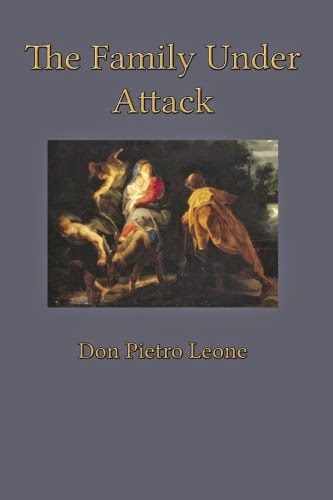
The following essay is part of Don Pietro Leone's book on marriage and family, The Family Under Attack (available on Amazon and on Amazon UK), and is exclusively published by Rorate Caeli by kind permission of thr author.

Fr. Pietro Leone also sends us the following message:

"I wish to congratulate the Editor of Rorate Caeli at the beginning of its tenth year for all his precious work in creating this most reliable and truly Catholic site. I wish also to thank him for publishing my writings over the last few years starting with my analysis of the New Rite of Mass and up to the extracts from my latest book 'The Family under Attack' of which the first appears today.

"I consider it important for Catholics of today to understand 'Theology of the Body' for what it is: to help them to know the Faith better, to practice it more fully, and so, with the help of Divine Grace, to reach the Promised Land of Heaven, where one day we may together sing the Eternal Mercies of God.

"I send my priestly blessing to all readers and promise to pray and to intercede for them before the Throne of the Highest, and that of The Most Holy Mother of God.

"I also ask them humbly to say a prayer for me."

Fr. Pietro Leone

***

‘Theology of the Body’ is the title that Pope John Paul II gave to a series of discourses delivered between September 1979 and November 1984. When we evaluate this doctrine in the light of Tradition, we see that in its principal positions it does not represent a development of Catholic teaching (in the sense of a clarification or deepening of that teaching), but rather a rupture with it, that is to say something novel. For this reason it cannot be described as Catholic doctrine, but rather as a series of personal meditations by the then Pope.

 As our source for this chapter we take the book ‘Theology of the Body for Beginners’ by Mr. Christopher West (Ascension Press, 2004), which affords a useful summary of this theory. This lecturer and writer has done much to popularize the said theory on the international level.

            The following critique (made in the briefest possible outline) will consist in the main of the application to this theory of the philosophical and theological principles established in the present book. This will involve a certain repetition of material already discussed, in the interests of providing a brief synthesis and analysis of the theory both in detail and as a whole.

             We proceed as follows: we evaluate this theory first as a personalist doctrine, then in its understanding of conjugal love in itself, and finally in its understanding of conjugal love in relation to God.

June 13, 2015: First Traditional Priestly Ordinations in Quebec in Decades

Right before the storm: Saint Joseph's Oratory of Mount Royal, Montreal - October 13, 1960

The Rev. Deacons Alexandre Marchand (from Gatineau) and Jacques Breton (from St-Hyancinthe) will be ordained to the most sacred priesthood on June 13, 2015 - the ordination will take place in the Diocese of Saint-Hyacinthe, and will be celebrated by the Abp. of Ottawa, the Most Rev. Terrence Prendergast.

These will be the first priestly ordinations according to the Traditional Roman Rite in Quebec since the alteration of the rites, in the late 1960s.

Congratulations to both, to the Priestly Fraternity of Saint Peter, and to the formerly Catholic lands of Quebec!

(Tip: Notions Romaines)

The Pope speaks on freedom to blaspheme: "If a close friend insulted your mother, you might punch him, right?"

In his airplane interview in the flight taking him from Sri Lanka to the Philippines, Pope Francis commented on the limits of freedom of speech:

[Question] Yesterday morning, during mass, you spoke of religious liberty as a fundamental human right. With respect to the different religions, up to what point can we go in terms of freedom of speech, that also is a fundamental human right?

[Pope:] Thank you for this intelligent question! I believe that they are both fundamental human rights: religious freedom and freedom of speech. We cannot...you are French, right? Well, then, let's go Paris, let's speak clearly. We cannot hide a truth today: each one has the right to practice his religion, without causing offense, freely, and we all wish to do this.

Secondly, we cannot offend, make war, kill, in the name of religion, that is, in the name of God.

That which is happening today surprises us, but let us always think of our history: how many wars of religion have we known! Think only of the Night of Saint Bartholomew [St. Bartholomew's Day Massacre]! How can we understand that. We also have had our sinners regarding this, but we cannot murder in the name of God, it's an aberration. To murder in the name of God is an aberration. I believe that is the main thing on religious liberty: we must practice it in liberty, without causing offense, but without imposing or murdering.

The year - One year


One year, the most meaningful of the cycles of nature. Man marks it with celebrations, birthdays, anniversaries - including the anniversaries of the birth (Christmas) and Resurrection (Easter) of the Lord that define the Liturgical Year itself. It is comforting for us today to begin anew the Sunday cycle following the intense time of Advent, Christmastide and Epiphanytide with the same Gospel as in every single year - as our forefathers, both in the West and in the East, always did: one yearly cycle of readings for Mass. A one-year cycle, dictated by nature, received through Tradition, reminding us each year of the great Truths of our Faith.

The first Sunday of the Season after Epiphany (before Septuagesima), which began yesterday, is next Sunday, the Second after Epiphany. It is, of course, the Sunday of the Wedding at Cana: it is fitting to begin the post-Epiphanytide Sundays with the first miracle of the Lord. There are great lessons and reminders in the day's Gospel, but the Roman Breviary reaches even more clearly with the voice of the Church, through Saint Augustine:

Book Review: "Submission" - a novel on Islam and the decomposition of Western Europe

Soumission [Submission] (publisher: Flammarion), the latest novel by Michel Houellebecq, reaches bookstores on January 7. For François Maillot, director of the La Procure [religious] bookstore in Paris, such a work prompts Christians to wake up.

François Maillot
[French Christian weekly] La Vie 
January 5, 2015

[...]
This book has not yet been released, and everyone already knows the plot. It is about France in 2022, which witnesses the confrontation, in the second round of the presidential elections, of the candidate of the National Front and the chairman of the Muslim party, Mohamed Ben Abbes. The narrator, François (I cannot but see in the choice of this name the designation of this character as the archetypal Frenchman...), a university professor who is a Huysman* expert, but who remained an atheist, witnesses this incredible electoral conclusion, while completely tied down in the problems of his personal life, limited to his university career and the angst of not being anymore capable of seducing women[...]. Faced with this political storm, a mysterious character of the secret services, Alain Tanneur, will give him the comprehension keys that will lead him to accept the idea of submitting himself to Muslim domination.

Christ Crucified: Scandal to the Muslims, Foolishness to the Secularists
- by Roberto de Mattei

Roberto de Mattei
Corrispondenza Romana
January 14, 2015

Marcher contre la Terreur, “March against Terror”, was the title which “Le Monde” the “Corriere della Sera” and the major Western newspapers used to present the grand, secularist demonstration of January 11th. Never has there been a slogan more hypocritical than this one, imposed by the mass-media as a reaction to the massacre in Paris on January 7th. What sense is there in speaking about Terror without adding the adjective “Islamic”? The attack on the editorial staff at “Charlie Hebdo” was carried out to the yell of “Allah akbar!”vindicating Mohamed, insulted by the caricatures and behind the terrorists’ kalashnikof there is a precise vision of the world: the Muslim one.

It is only now that Western secret services are beginning to take seriously the threats by Abdu Muhamad al Adnani published in a multi-lingual communiqué spread widely on September 21st 2014 by the on-line daily “The Long War Journal”. “We will conquer Rome, we will break its crucifixes, we will make slaves of the women, with the permission of Allah, the Exalted One”, the spokesman of “the Islamic State” declared to his followers and he didn’t simply replicate the extermination of the “infidels” wherever they may be, but also indicated the procedures: “Place explosives in their streets. Attack their bases, irrupt into their homes. Cut off their heads. So that they don’t feel safe anywhere! If you can’t find the explosive or the ammunitions single out the American infidels, the French infidels or any of their allies: smash their craniums with a rock, kill them with a knife, run them over with your cars, hurl them into mid-air, suffocate them or poison them.”

Purgatorial Society: Policy change

When we began the Rorate Caeli Purgatorial Society four years ago, we really had no idea what success would look like. Frankly, we started it out of frustration and sadness, after watching yet another loved one "canonized from the pulpit" while the priest -- who was begged not to beforehand -- told our family and friends to rejoice, because the deceased was in Heaven. No one was asked to actually pray for the repose of their soul.

Priest says TLM for Souls in Afghanistan.
If you want to see proof positive that the collapse of the liturgy led to the collapse of theology and faith you need look no further than your typical Novus Ordo funeral Mass. Purgatory went the way of Latin, communion on the tongue and altar rails.

When we first started the Society, so desperate for help, we even offered to pay priests for Masses and planned to go through family records just to enroll Souls. Who would have know that four short years later we would have over 50 priests saying weekly or monthly traditional Latin Masses (for free) for the Souls and roughly 100,000 Souls enrolled? God knew -- but we surely didn't.

Now to the change: Each month, our readers have been accustomed to seeing the long, long list of names published on this blog, along with a monthly call for more priests to volunteer and more names to be sent in. Each month, there's at least 1,000 names (usually many more) on that list, coming from hundreds of readers emailing. And, as our families grow, and work responsibilities increase, our personal time becomes ever more precious. And it's getting to the point that formatting these names and going through each email one by one has become too much for this group of volunteer bloggers to do and for our families to endure.

This became very evident during Christmas when our special call for names ended in thousands and thousands of names sent in -- a list that was just too daunting to even begin to tackle.
Priest says Dominican Rite Mass for Souls.

After consulting with the Purgatorial Society Priest Chaplain, and knowing the public listing of the names have nothing to do with them being enrolled or prayed for (they are enrolled as soon as you hit send on your email, even if they're caught in spam), we have decided to cease posting the long list of names every month.

Nothing else changes -- only the public listing of names.

We will continue reminding you monthly to send in your names. And, dear priestly readers, we will keep harping on you monthly as well to join the Society! The Souls need you. And there's 100,000 of them pleading with you for help. Don't let them down. We don't get paid for our work on Rorate -- but we will be greedy with your time and Masses!

Priest says TLM for Souls in Alaska.
How to enroll souls: please email me at athanasiuscatholic@yahoo.com and submit as follows: "Name, State, Country." Please follow this formatting strictly. If you want to enroll entire families, simply write in the email: "The Jones family, Ohio, USA". Individual names are preferred. Be greedy -- send in as many as you wish and forward this posting to friends as well.

Priests: We now have 50 priests in the Society -- why aren't you? Please email me to offer your services. There's nothing labor intensive involved: all you need to do is offer a weekly or monthly traditional Latin Mass with the intention: "For the Souls enrolled in the Rorate Caeli Purgatorial Society." This does not need to be a Requiem Mass -- only a traditional Latin Mass.

Armenian Catholic Cathedral of Aleppo bombed


THE DEATH OF CATHEDRALS - and the Rites for which they were built
- by Marcel Proust (full English translation)

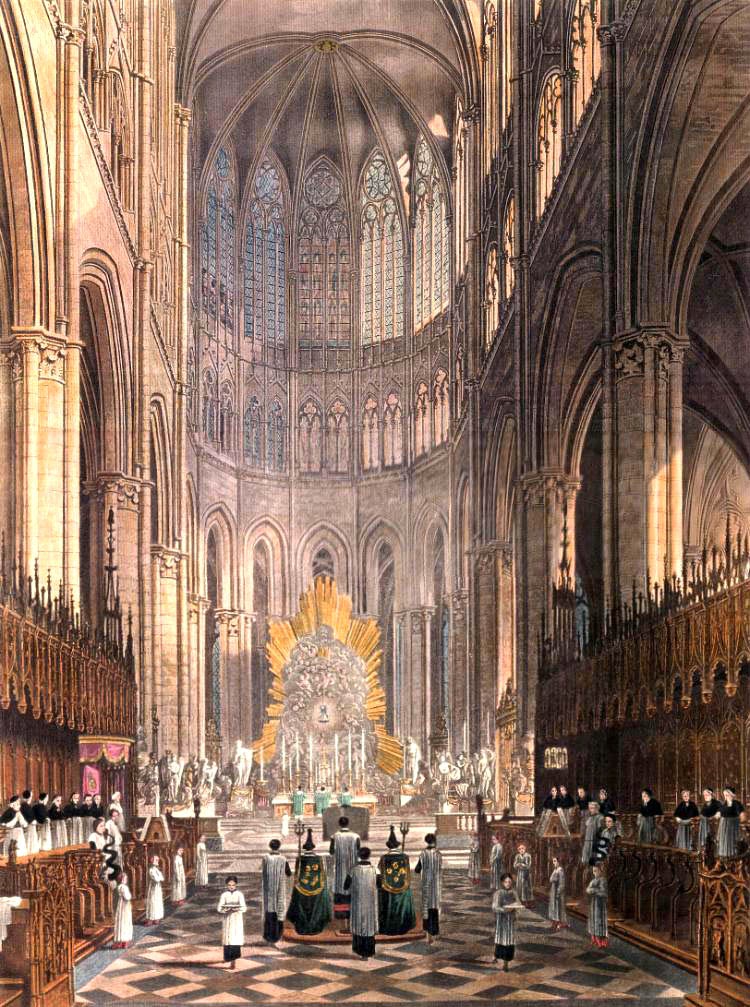
Notre-Dame d'Amiens in the 19th century
It is not a common event for a blog to publish a full translation of a great text of a major literary figure over one hundred years after its original publication, being able to claim it as a new event. Yet, this is just such a case.

On August 16, 1904, Marcel Proust had a major article published in the French paper of record, Le Figaro, called "La mort des cathédrales" (The Death of Cathedrals). The debate was raging in French political circles as Atheists and Freemasons, against the largely majoritarian sentiment of the population, pushed through Parliament the unilateral abrogation of the Napoleonic Concordat and the complete secularization of the French Republic (what would become the 1905 "Law of Separation" - for the appropriate Catholic view on the issues involved and its aftermath, read Saint Pius X's encyclicals on the issue, Vehementer Nos,  Gravissimo officii,  Une fois encore - and Pius XI's 1924 encyclical Maximam gravissimamque settling the matter). An important part of the debate was what exactly would happen to the upkeep and life of the highest point of French art and civilization, the Cathedrals.

Proust, an Agnostic in practice, but who never denied or stopped admiring his own Catholic roots and upbringing, could not stand in silence. Cathedrals as mere monuments, without the Traditional Catholic rites for which they were built, did not make any sense. What he could not know, the poor man, whose passion for the traditions and rites of the Church is palpable in the article, is that the Church herself would destroy and wipe out from most Cathedrals the venerable rites for which they were created. But, slowly and surely, they will return. As in Chartres in last year's ordinations for a traditional Fraternity. As in the occasional traditional Mass (such as the simple Mass celebrated each Sunday in that first Gothic jewel, Noyon). They will return.

Our deepest thanks to Prof. John Pepino for the remarkable translation of a landmark article, made especially for Rorate.

***

THE DEATH OF CATHEDRALS
Marcel Proust
Le Figaro
August 16, 1904

A Consequence Of the Briand Bill 
On the Separation of Church and State

Suppose for a moment that Catholicism had been dead for centuries, that the traditions of its worship had been lost. Only the unspeaking and forlorn cathedrals remain; they have become unintelligible yet remain admirable.  

Then suppose that one day scholars manage, on the basis of documentary evidence, to reconstitute the ceremonies that used to be celebrated in them, for which men had built them, which were their proper meaning and life, and without which they were now no more than a dead letter; and suppose that for one hour artists, beguiled by the dream of briefly giving back life to those great  and now silent vessels, wished to restore the mysterious drama that once took place there amid chants and scents—in a word, that they were undertaking to do what the Félibres have done for ancient tragedies in the theatre of Orange.[1]


Notre-Dame de Chartres
                Is there any government with the slightest concern for France’s artistic past that would not liberally subsidize so magnificent an undertaking? Do you not think that it would do what it did in the case of  Roman ruins for these cathedrals, which are probably the highest, and unquestionably the most original expression of French genius? After all, one may well prefer the literature of other peoples to ours, prefer their music to ours, their painting and sculpture to ours, but it is in France that Gothic architecture created its first and most perfect masterpieces.  All other countries have done is to imitate our religious architecture without ever matching it.

                And so, to return to my hypothesis, here come scholars who have been able to rediscover the cathedrals’ lost meaning. Sculptures and stained-glass windows recover their significance, a mysterious odor once again wafts in the temple, a sacred drama is performed, and the cathedral starts to sing once more.  When the government underwrites this resurrection, it is more in the right than when it underwrites the performances in the theaters of Orange, of the Opéra-Comique, and of the Opéra, for Catholic ceremonies have an historical, social, artistic, and musical interest whose beauty alone surpasses all that any artist has ever dreamed, and which Wagner alone was ever able to come close to, in Parsifal—and that by imitation.

Sermon for the Feast of the Holy Family

So God created man in his own image, in the image of God he created him; male and female he created them.  (Genesis 1:27)

It was in a time of what he perceived as a real crisis in European civilization towards the end of the 19th century that Pope Leo XIII instituted the Feast of the Holy Family, which feast was then extended to the universal Church by Benedict XV.  I like to think that Leo was spurred on to establish this feast and to write his Encyclical Quam Plurimes that made St. Joseph the patron of the Universal Church by the words of Blessed John Henry Newman in his Bigletto speech in Rome when Leo made him a cardinal.  For it was Newman who saw so very clearly the real consequences of a civilization permeated by a relativism that denied truth.  And it was St Pope John Paul II who on the 100th anniversary of Leo’s encyclical issued his own encyclical on the importance of St. Joseph and the Holy Family, Redemptoris Custos, the Guardian of the Redeemer.  That same Pope, reading the signs of the times and aware of a crisis within the understanding of the family, brought about in no small part by the sexual revolution of the 1960s, called a Synod on the Family and issued an Apostolic Exhortation, Familiaris Consortio, at the end of the Synod to explain and deepen the Church’s understanding of and commitment to the family.  And in this context we read: 

The family—based on marriage (between a man and a woman)—is the first and fundamental unit of society and is a sanctuary for the creation and nurturing of children. Together families form communities, communities a state and together all across the world each human is part of the human family. How these communities organize themselves politically, economically and socially is thus of the highest importance. Each institution must be judged by how much it enhances, or is a detriment to, the life and dignity of human persons.

Francis: You cannot follow Jesus Christ without the Church


From today's homily by the Bishop of Rome, Francis, during Mass in the Sistine Chapel for the Solemnity of the Baptism of the Lord -- when, just like last year, Francis continued Benedict XVI's practice of celebrating this feast's Mass "ad apsidem":

Teach your children that you can not be a Christian outside the Church, you can not follow Jesus Christ without the Church, because the Church is a Mother, and makes us grow in love for Jesus Christ.

This echoes what Francis had said at much greater length during his homily for the Mass of January 1, Solemnity of Mary, the Mother of God in the Novus Ordo calendar: 

A Letter from the Editor: The difficulty of making a papal pronouncement post in the Age of Francis


Dear Readers,

Will you allow me, in a very rare event, to share with you a moment of frustration?

The 125th Anniversary of Leo XIII's Sapientiae Christianae: The Duties of Christians as Citizens

Exactly 125 years ago, on January 10, 1890, Pope Leo XIII issued one of his greatest political encyclicals, Sapientiae Christianae—a document that, like nearly everything Leo XIII wrote, deserves to be much better known today than it is. As one can always expect with Pope Leo, the prose is crisp and vigorous, the doctrine lucid and coherent, the logic irresistible, the conclusions noble and demanding. It is the kind of encyclical that the Church in every age needs in order to find its way in a turbulent ocean of massive waves and contrary winds. The whole encyclical may be obtained from the Vatican website (see here), where all the encyclicals of Leo XIII are available—remarkably enough, considering that most of them contain doctrine to which later Magisterial pronouncements can be reconciled only with great difficulty.

Sacred Music as a Latin Mass magnet | January - May 2015: an Event Series in Vicenza, Italy, and an idea for the entire world


We receive the following from a reader in Vicenza (Veneto), Italy, where a group of Traditional-minded Catholics has had a fine idea for their small community: through a kind of Sacred Musical festival lasting several weeks and with the participation of organists, polyphonic choirs, a Schola Cantorum. Each Sunday, at Mass, the presence of musical beauty for the praise of God, with the intent of both delighting listeners and of bringing new people to Christ and His Church through His Mass:

IMPORTANT EVENT THIS SATURDAY - Pontifical Mass in San Nicola in Carcere, Rome, with Cardinal Burke


Cardinal Burke will be celebrating a Solemn Pontifical Mass in the Extraordinary Form at the Basilica di San Nicola in Carcere tomorrow morning (Saturday, 10th January) at 11.00 am.

The Basilica is centrally located at: Via del Teatro di Marcello, 46, 00186 ROME

"Nous y sommes... Ce n'est qu'un début."
This is just the beginning


A terrorist attack and a massacre in a newspaper in Paris. The following day, to the south of the city, a related individual shoots down a female police officer. On the very next day, a hostage situation in the outskirts of the Paris airport to the north of the city. Then, hours later, another hostage situation in the Porte de Vincennes region of Paris, shutting down completely the beltway (périphérique) around the city.

Just yesterday we said that, "such events will become each time more common in the upcoming decades as frightening wars of religion of unknown violence unfold by installments throughout the cherished cities and fields of that Europe all Christians love so much." At this very moment, experts on French television and radio networks are openly using the word "guerre" (war) about the moment, and one declares openly: "Nous y sommes... Ce n'est qu'un début." (We've reached it...this is just the beginning.)

The Church Today: The grave risk of a way of looking at things that is merely sociological and immanent

In ruins
Mario Faverzani
Corrispondenza Romana
January 7, 2015

In the aftermath of the statement of the bishop of Antwerp, Msgr. Johan Bonny, in which he declared himself in favor of a “formal recognition” of homosexual and bisexual relationships, we have a new little morsel to chew on, with respect to the upcoming Synod on the Family, in an interview published in the on-line edition of the weekly Paris Match,  given by Cardinal Oscar Andres Rodriguez Maradiaga, Archbishop of Tegucigalpa in Honduras.  Maraiaga is considered by observers as sort of a “vice-Pope”.  He is hardly a protagonist who takes positions that are outside the official box, and he is squarely with those who see the possibility of granting the Sacraments to the divorced and remarried, even at the cost of aligning himself against Cardinal Müller without any seeming anxiety on his part.  He found himself at the center of a cyclone after the press charges raised by the American Life League of the United States which showed that the powerful organization managed by him, Caritas International, turns out to be providing leadership to the World Social Forum, which is actively involved in the promotion and protection of the so-called “civil and sexual rights” based on gender ideology, the agenda of the LGBT alliance, a push to end discrimination against homosexuals, a universal liberalization of access to abortion and to various reproductive technologies, global control over population growth, Marxism, feminism, environmentalism, and so forth.

Pray for Police Officers


Freedom of speech?... Freedom to blaspheme?...

We will not join this debate. We take the opportunity of current events to pray for the souls of those who are always forgotten: our dear police forces.

French analyst: Pope Francis' harshness betrays his growing isolation and weakness within the Church

Prof. Odon Vallet, a liberal historian of religion who is highly influential in France (he is the "progressive" go-to man for analyses of Catholic current events in French media), has already been quoted in Rorate before. This is the interview granted by him to French weekly Le Journal du Dimanche on the Pope and the Curia.

"Pope Francis has 90% of the Curia against him"

Le Journal du Dimanche
December 23, 2015


INTERVIEW - Historian Odon Vallet interprets pope Francis' very harsh words for the Curia, the group of influent personalities in the Vatican. On Monday [December 22, 2014], the Pope presented a list of the 15 "infirmities" that affected the interior of the Holy See, including "spiritual Alzheimer's" and "existential schizophrenia". Odon Vallet is a historian of religions and the author of "God and religions in 101 Q & As" [Dieu et les religions en 101 questions-réponses], [published by] Albin Michel, and he sees a pope who is isolated and weakened.

For the record: First Things - "He is an ideologue and a meddlesome egoist."

Well... when you've lost First Things, you've lost mainstream American Catholicism.

From First Things, for the historical record of current events:

Sermon for the Epiphany: The Star and the Flame - and Christian Civilization

"For we have seen his star in the East, and we have come to worship him." (Matthew 2:2)

The Manifestation of the King of Kings

The doctrine of the Kingship of Christ has been relegated almost entirely to a claim about the private commitment of individual believers to live according to the Gospel, and surely, while this is where our Lord's kingship must always begin, it cannot be where it ends. As Pope Pius XI's encyclical Mortalium Animos warns against a relativistic conception of ecumenism, so does the same Pope's encyclical Quas Primas warn against a narrow subjective conception of the reign of Jesus Christ, who is, in fact, whether we acknowledge it or not, the King of Kings and Lord of Lords, the Judge of the living and the dead, the One who can and should reign in the social, cultural, political and economic spheres. He has reigned thus before; and if He does not now reign, that is not to our credit, but to our shame.

All this has been on my mind as I ponder the magnificent Gregorian propers for the feast of the Epiphany -- chants that bring the exceptionlessly comprehensive Kingship of Christ very much to the fore, to be pondered, loved, and longed for. Of course, most Catholics no longer hear these or any songs that convey the traditional doctrine, but -- blessed be God! -- Catholics who attend the usus antiquior Mass today, the Twelfth Day of Christmas, will hear these propers spoken or sung. They are always used in the classical Roman Rite because the Church of Rome always believes and professes one and the same doctrine.

Blessing of Epiphany water


The photo above comes from the great St. Anne Church, a Priestly Fraternity of St. Peter (FSSP) parish in San Diego (they have a new website here).

Fontgombault Sermon - Epiphany - "The Wise Men really found Jesus."

Epiphany

Sermon of the Right Reverend Dom Jean Pateau
Abbot of Our Lady of Fontgombault
(Fontgombault, January 6, 2015)


Invenerunt puerum. 
They found the child. (Matt. 2:11)

Dear Brothers and Sisters, 
My dearly beloved Sons, 

After the shepherds, after Simeon and Anna, whose encounters with the Child Jesus at the Crib and in the Temple St. Luke has told in his Gospel, the Wise Men are according to the Gospel of St. Matthew the last ones to come and visit the Divine Child. They number among the first who received the Good News, the Gospel of the birth of the Saviour, of the King of Jews, and these disciples went back home transformed by their encounter with the Child. What they attended was a marriage, the wedding between God and mankind. On January 1st, the Church sings:

How wondrous an exchange! The Maker of mankind has taken to Himself a body and a soul, and has been pleased to be born of a A Virgin; He is come forth conceived without seed, and has made us partakers of His Divine nature.

You report: Cardinal DiNardo and the ceremonial groundbreaking of the new Traditional Mass Personal Parish in Houston

From a reader in the Archdiocese of Galveston-Houston:

Sacra Liturgia USA 2015 Registration Page is Open!


From Father Cipolla:

The registration page is now open on the Sacra Liturgia USA webpage. Click on "Conference" in the drop-down menu and you'll see a button on the right side with the form labeled "register here."


Discussing or Ignoring Thomas Pink’s Interpretation of Dignitatis Humanae

One of the most difficult of the doctrinal points at issue between the Society of Saint Pius X (SSPX) and the Holy See is the question of religious liberty. The Second Vatican Council’s teaching on this   point in Dignitatis Humanae seems to be in clear opposition to the traditional teaching. In 2011 we posted an intervention on the question by Prof. Thomas Pink, in which Pink proposed a reading of Dignitatis Humanae in accord with tradition. At the time, the chairman of the Latin Mass Society, Joseph Shaw, now a Rorate contributor, hailed Pink’s intervention as “truly important article,” and a blogger well acquainted with the SSPX called it a “a game-changing intervention,” that reframed the debate.

For the record: Papal Announcement of New Cardinals

Archbishop Alberto Suárez Inda, Abp. of Morelia (Mexico), celebrates the Traditional Mass and Traditional Confirmations (December 2013 - see RORATE post from the time) - he will be created Cardinal in the Consistory of February 14, 2015.
Below, please find the complete text of the Pope’s announcement, with the names of all those set to be elevated to the Cardinalate:

Church Turned Upside Down
- "Why are the enemies of Catholic Truth the main defenders of Pope Francis?"

Those who had attacked the pontificate of Benedict XVI now find themselves defending that of Francis. While Catholic writers such as Messori and Socci are blasted by Avvenire [the daily newspaper of the Italian Bishops' Conference]

Matteo Carnieletto
Il Giornale
January 3, 2015


Let’s be honest: the most progressive fringe of the Church likes Francis. This is the fringe that during the pontificate of Benedict XVI kept attacking the Pope, and now they are dressed up as papal cheerleaders who are always at hand to defend the Pope—the Pope, please note, who is Francis, not the papacy as an institution. Right from the time of the publication of Non è Francesco by Antonio Socci, the new defenders of the “Church that is poor and for the poor” have not hesitated to come to the defense of the Pope by harshly attacking that Siena journalist. The same thing happened at the publication of the article by Vittorio Messori this past December 24. In fact, Paolo Farinella, a priest and writer for Il Fatto Quotidiano, who defined the pontificate of Benedict XVI as “a disaster for the Church”, launched an appeal to stop the attacks on Pope Francis. Has Farinella undergone a conversion to orthodox Catholicism? Not at all. He has simply found in Francis an ideal mouthpiece.

Tango in St. Peter’s whilst the Barque goes adrift

by Roberto de Mattei
Il Foglio
January 3, 2015

[While Rome burns]

Perhaps future historians will document that they were dancing the tango in the year 2014 in St. Peter’s Square while Christians were being massacred in the Middle East and the Church was on the verge of a schism. This frivolity and irresponsibility is not new to history. In Carthage, Salvian of Marseille records, they were dancing and feasting on the eve of the invasion of the Vandals, and in St. Petersburg, according to the testimony of John Reed, an American journalist, while the Bolsheviks were taking power, the theatres and restaurants were always packed. As Holy Scripture says, the Lord blinds those who want to be lost (John 12, 27-41).

Editorial: Doctrine can never be bartered
(and the indelible influence of Michael Davies)

Editorial: Radicati nella fede, January 2015
Newsletter of the Catholic community of
Vocogno, Diocese of Novara, Italy


It has finally arrived. It came like a kind of unexpected Christmas gift - it was so long in coming. It comes as a beneficial gift for those who want to profit from it. What, you might ask, has arrived? The Italian version of “The Liturgical Revolution - Cranmer’s Godly Order”* by Michael Davies – that’s what’s arrived!

Over the past years we have given ample extracts from it on this bulletin and on our blog, but we needed the complete publication in Italian. Now, thanks be to God, we have it!

This first editorial of the year, is simply a heartfelt invitation for many to take this fine work into their hands and delve into it. Since our encounter with Davies’ writings was fundamental, we urge this in a warm way. We cannot say that they were the only motive for our passing to the Old Rite, but undoubtedly they contributed in clarifying the reasons for it definitively.

New Year, Old Lunacy: Cardinal Marx says Catholics can "learn from Luther"

Lutheran niceties: Luther preaches Christ, Pope and Catholic clerics in the jaws of hell
(from the workshop of Lucas Cranach the Elder)

Cardinal Marx, also known as "Cardinal Bling", drowning in his Kirchensteuer millions, is a gift that keeps on giving.

From Die Welt:

German Theology and Africa

Cardinal Kasper’s dissmisive remarks on Africa have rightly been deplored, but German theology’s attempts to help Africa are probably much more damaging. The German Church is able to use its tremendous wealth to sponsor theology students from the developing world. African priests and religious  flock to Germany’s many state-funded theological faculties, and are there immersed in a sophisticated neo-modernism, very difficult to resist. They soon shed their roman collars in favor of the ties worn by their professors, and write doctoral dissertations on "inculturating" the latest theological fads into Africa.

A Christmastide Gift for our Readers:
- Attacks on Thomism: a special historical and theological essay

Attacks on Thomism

a special essay for Rorate Caeli by John Lamont


Thomism and neomodernism 
I: Progressives, 'manualism', and Thomism

Anyone who has any familiarity with the clerical and intellectual scene in the Catholic Church will have encountered the received 'progressive' wisdom concerning Thomism and its role in the Church before the Second Vatican Council, and concerning the preconciliar state of theology in general. Its claims and slogans are continually reiterated in theological and clerical circles, with little change since the era – the first half of the twentieth century – in which they were first elaborated. Unlike 'progressive' positions on moral questions, this received wisdom has virtually attained the status of a pseudo-orthodoxy within the Church, with some of its components being central to 'conservative' Catholicism. Its acceptance by neoconservatives is indicated by a favourable presentation of it by Fr. Brian van Hove in the Homiletic and Pastoral Review,1 a journal that is one of the oldest pillars of conservative Catholicism. Fr. Van Hove's exposition of this received wisdom takes the form of an attack on Pius XII's encyclical Humani Generis, an embarrassing document for neoconservative Catholics. His exposition is a naïve one, lacking the nuances that would be introduced by a clever apologist for his outlook, but it is valuable for that very reason. It is the naïve version of an idea, the simplified and readily accessible one, that gets widely adopted and that determines events; this fact is known by the clever apologists, who are aware that the nuances they introduce to disarm criticism and conceal their intentions will fall by the wayside once their position has triumphed. Together, these points make up the ideology that justified the destruction of preconciliar Catholic theology, and that is an essential underpinning of the progressive hegemony that now controls the Church. Seeing through this ideology is crucial to overcoming this hegemony; this article and its two sequels are devoted to the task of exposing it.

'Manualism'.

An important component of this ideology is an attack on 'manualism'. This attack claims that preconciliar Catholic theology largely consisted in 'manualist theology'. Allegedly, this theology was conveyed in theological manuals, and suffered from legalism, dogmatism, anti-modernism (presumed to be a fault), abstraction, and ahistoricism.

The very idea of 'manualist theology' is however a fiction. Theological manuals were indeed in wide use before the Second Vatican Council, for the purposes that manuals exist for; the education of theological students.2 The best of them were excellently designed for that purpose, as any educator who looks at them can see. But there was no such thing as a school of theology based on these manuals, let alone a dominant school. Theology before the council was carried on by the same means as other scholarly enterprises; monographs, learned journals, extensive treatises. These works, not the theological manuals, were the venues for preconciliar theology. If we were to identify a characteristic product of theology in the period that preceded the council, it would not be the manuals, but the great works of reference such as the Dictionnaire de théologie catholique or the Dictionnaire de spiritualité. The articles in these works often amounted to book-length treatments in excess of 100,000 words. They include outstanding monuments of scholarship that could never be replaced today; the depth of theological learning that went into their composition no longer exists – so much for the weakness of preconciliar theology. The idea of 'manualist theology' was a fiction aimed at priests whose theological formation did not go much farther than the manuals they had studied in seminary. Such priests were in the majority, especially in the English-speaking world where academic theology was weak. Convince them that what they had learned in the seminary was flawed and obsolete 'manualist theology', and the road to leading them away from the Catholic doctrine they had been taught was open.

Thomism.

Another article of the postconciliar creed has to do with the character of the Thomism that was promoted by popes from Leo XIII to Pius XII. The substantive accusations made against this Thomism are that it unjustifiably limited theology to a particular philosophical system, that theology was forced to conform to it, and that it was not the true thought of St. Thomas. These claims play a subordinate role in the criticism of preconciliar Thomism, whose main thrust lies in accusations that Thomism was 'abstract', 'rationalist', 'ahistorical', 'arid', 'frozen', 'immobile', 'obsessed', 'encouraging pure secularity', 'sclerotically hardened and furred theologically, spiritually and ecclesially', 'causing a rupture between theology and life', a 'wax mask', a 'straightjacket' that 'reduced theological speculation to sterility'. The essence of this villainous form of Thomism is supposed to be given by the 24 Thomistic theses developed by leading scholars and endorsed by the Sacred Congregation of Studies in 1914, as containing the principles and main pronouncements of St. Thomas's philosophy.3

Philippine bishops' Liturgy Commission cracks down on the "Reform of the Reform", directs that new churches should have the tabernacle outside the sanctuary.

The blog The Pinoy Catholic has published a circular of the Archdiocese of Cebu that, citing unspecified directions of the "Episcopal Commission on the Liturgy" of the Catholic Bishops' Conference of the Philippines, imposes sundry liturgical rules of a decidedly anti-traditional bent. The rules also specifically target practices and principles associated with the "Reform of the Reform" movement, notably the 'Benedictine altar arrangement" and the restoration of dignity to altars and tabernacles.

The decisions are undated but the circular reports them as if they are new instead of referring to them as long-standing and present in previous circulars or decrees. At the very least, the timing of the circular is interesting, coming less than a month before the visit of Pope Francis to the Philippines (January 15 - 19).

In summary, the rules are:

1) Altars should be covered with a simple white cloth regardless of the liturgical season or observance. (Apparently a shot at the use of colored antependia.)

2) The ambo in a church is always to be made of the same material and ornamentation as the church's altar. (A measure that is apparently rooted in the idea that the ambo is also an "altar" -- the "altar of the Word" -- of the same dignity as the "altar of sacrifice." If taken seriously this measure will also entail the erection of permanent ambos inside the sanctuaries of venerable churches.)

3) A crucifix -- which the circular specifies should be "small" -- is to be placed on the altar only when there is no other crucifix anywhere in the sanctuary that is visible to the people. Furthermore this altar crucifix should face the people, not the priest.

4) Candles are not to be placed on altars but only "near" them. Six candles "may" be used -- when a bishop celebrates Mass.

5) When new churches are built, the tabernacle is always to be located to the side of the church, outside the sanctuary.

6) No more tabernacle veils, at least for tabernacles in new churches. 

7) Just one candle may be placed near the image of a saint, and only during that saint's feast day.