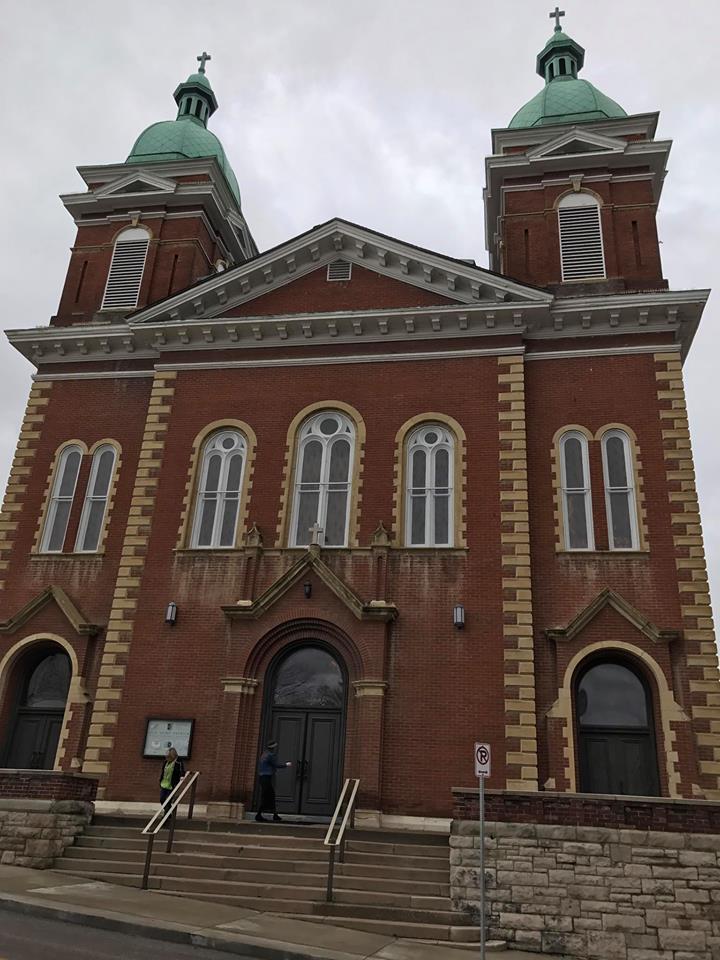
Rorate on the Road ... in Hagerstown, Maryland
Yesterday, Rorate was roaming the Pennsylvania countryside, and needed a traditional Latin Mass that didn't require a ride two hours into Washington, D.C. A friend from the area recommended we check out the new(er) TLM at St. Mary's Church in downtown Hagerstown, MD. And we're really glad we did.
500 Years of the Protestant Revolution - (1) How Luther viewed the Holy Roman Church (Strong Language)
In solemn and mournful remembrance of the events surrounding the grievous actions of Martin Luther, that split Europe and deprived hundreds of millions of souls of the benefits of sacramental life, we will post again important articles on the matter.
***
Martin Luther and the Catholic Church
a guest-post by John R. T. Lamont (2016)

"HERE I STAND":
Luther's version of the "NON SERVIAM"(Gedaechtniskirche, Speyer)

Luther's version of the "NON SERVIAM"(Gedaechtniskirche, Speyer)
A number of favourable comments about Martin Luther have been made by Catholic authorities to mark the occasion of the 500th anniversary of the Reformation in 2017. In particular, the Pontifical Council for Christian Unity, whose president is Cardinal Kurt Koch, has issued a Catholic-Lutheran ‘Common Prayer’ for 500 years of Reformation together with the Lutheran World Federation. This ‘Common Prayer’ includes the following prayers: ‘Help us to rejoice in the gifts that have come to the Church through the Reformation’, and ‘The ecumenical journey enables Lutherans and Catholics to appreciate together Martin Luther’s insight into and spiritual experience of the gospel of the righteousness of God, which is also God’s mercy’; ‘Thanks be to you O God for the many guiding theological and spiritual insights that we have all received through the Reformation.’ This is not of course an initiative of the magisterium of the Church, but it is as effective in forming the beliefs of Catholics as a magisterial statement, since it is presented in the media as a position of the Church. This initiative urgently requires comment and criticism from faithful Catholics.
Event: Conference Tomorrow - Protestant Reformation...or Revolution? (Sleepy Hollow, NY)
How the religious upheaval ignited by Luther, Calvin, and Zwingli changed Western Civilization -- with the presence, among others, of Dr. John Rao and Christopher Ferrara.
[Click on image for larger view:]
[Click on image for larger view:]
Never again get stuck without the 2017 Ordo!
Our friends at Romanitas Press have just produced a trial version of their mobile Android app of the 2017 Ordo for the traditional Roman Missal and Breviary (1962) — and it's only 99 cents. The 2018 version for both Android and Apple should be available next month.
This digital version of the Ordo for Android devices is not only handy for the traveling clergy who follow the traditional missal and breviary, but also for the laity as a mobile liturgical calendar for attending the traditional Mass.
This Ordo app is easy to use and each entry lists the class of the day, proper Mass (or options), Office’s color, and variable parts of the Mass and Breviary. Also included are helpful notes such as when a Requiem Mass is prohibited — and specifically for pastors, pulpit announcements of the liturgical year.
De Mattei: The Correctio filialis and the Laudatio of Pope Francis
The Correctio filialis and the Laudatio of Pope Francis
Roberto de Mattei
Corrispondenza Romana
October 18, 2017
After three weeks the first organized response to the Correctio filialis has appeared: a Laudatio published on the web, signed by a group of priests and intellectuals prevalently from the Austrian-German domain. (http://www.pro-pope-francis.com/).
Tears of Faith and Love: founded in 1988, FSSP enters 30th year
Come sorrowing tears, the offspring of my grief,
Scant not your parent of a needful aid;
In you I rest the hope of wish'd relief,
By you my sinful debts must be defray'd:
Your power prevails, your sacrifice is grateful,
By love obtaining life to men most hateful.
New Francis Synod Called to Approve Married Priesthood
Yesterday, immediately following the canonization of 35 saints (including 33 Martyrs, 30 of whom were murdered by a Protestant-led horde during Holy Mass), Pope Francis announced the convocation of a Special Assembly of the Synod of Bishops for the "Pan-Amazonic" region, that is, the regions of the Amazon area in various South American countries. The gathering will take place in Rome in October 2019.
The assembly was called supposedly to address indigenous natives' concerns.
But we know better.
Ultramontanism's Death Sentence
![]() |
Pope Pius XII
|
Even when it is a question of the execution of a condemned man, the State does not dispose of the individual's right to life. In this case it is reserved to the public power to deprive the condemned person of the enjoyment of life in expiation of his crime when, by his crime, he has already disposed himself of his right to live.
In 2017 Pope Francis spoke, in a not dissimilar context:
Event: Bishop Schneider to visit Kansas City
We have been metering out the public schedule of His Excellency Bishop Athanasius Schneider, who will visit the United States this month for numerous Masses and events, including in Connecticut, Washington, D.C., and Wisconsin. On 28-29 October, he will be in Missouri for a pontifical High Mass for the feast of Christ the King, with the Institute of Christ the King, and a conference on Blessed Karl.
Labels:
Christ the King,
Events,
ICRSS,
Pontifical Masses,
Schneider
De Mattei: Fatima 100 Years later. A Marian call for the whole Church
Conference of Prof. Roberto de Mattei
Buckfast Abbey, Devon, England
12-13 October 2017
The historical framework of the Message of Fatima

The message of Fatima is aimed at
the triumph of the Immaculate Heart of Mary. This is its essence, as Father
Joaquin Alonso (1938-1981) [1], Father
Serafino Lanzetta[2] and other
authors have grasped well. The prophecy contained in the message of July 13th
1917 has its culminating point in the promise: “In the end My Immaculate Heart will triumph”. It’s important to
emphasize that this promise is unconditional[3].
However, there is another dimension, no less important, which deserves
our attention and which I intend to focus on.
It‘s the prophecy, that says, if the world doesn’t convert a great
chastisement will befall it. Fatima isn’t a generic call to prayer and penance,
it is, above all, the announcement of a chastisement and the final triumph in
history of Divine Mercy.
In the vast horizon of private
revelations, the Fatima apparitions have their own characteristic: their very
close relationship with history. The great apparitions of Our Lady in the 19th
century – Rue du Bac (1830), Sant’Andrea delle Fratte (1842),
Lourdes (1858) while shedding light on their times, don’t have direct
historical references.
COLUMBUS IS OURS -- Let us rejoice!
![]() |
| Monastery of Sant Jeroni de la Murtra, near Barcelona, where the Catholic Monarchs welcomed Columbus back from the Indies in 1493 |
Now that four centuries have sped since a Ligurian first, under God's guidance, touched shores unknown beyond the Atlantic, the whole world is eager to celebrate the memory of the event, and glorify its author. Nor could a worthier reason be found where through zeal should be kindled. For the exploit is in itself the highest and grandest which any age has ever seen accomplished by man; and he who achieved it, for the greatness of his mind and heart, can be compared to but few in the history of humanity.
October 13, 2017: SSPX Rosary Crusade following the example of Polish Catholics
SSPX Italian District
Bulletin
Bulletin
The Italian
District of the Society of Pius X [hereby] adheres to the initiative by the
AIASM (Italian Association Marian Sanctuaries Companions), following the marvelous
example of the Polish Catholics, thus:
On October 13th
at 17.30 everyone is invited to recite the Holy Rosary, accompanied by fasting
and sacrifice.
Event: Bishop Schneider to offer Blessed Karl pontifical High Mass
Last year, His Excellency Bishop Athanasius Schneider visited the U.S. in October for a nine-day schedule of pontifical Masses and lectures, including offering the annual Mass in Washington, D.C., on the feast of Blessed Karl of Austria. This month the bishop will again visit the U.S. for several events and offer a pontifical High Mass on 21 October, at 1 p.m., for the feast of Blessed Karl.
Institute of Christ the King: Good news from England
![]() |
| Mass at St Walburge's, Preston |
The Institute of Christ the King have made a succession of very exciting announcements about their apostolate in the north west of England, historically the most Catholic part of the country.
In addition to the landmark church, the 'Dome of Home', the Church of SS Peter & Paul and St Philomena, in the Wirral, in the Diocese of Shrewsbury, which they have run since 2012 thanks to Bishop Mark Davis, they were given the magnificent Church of St Walburge's, Preston, in the Diocese of Lancaster, which boasts the tallest spire of any parish church in England, in 2014, by Bishop Michael Campbell.
In July, Bishop Campbell gave them another historic church, close to St Walburge's: the Church of St Thomas of Canterbury and the English Martyrs.
LEPANTO!
Lepanto
"The highest moment that the centuries ever witnessed." (Cervantes)
We cannot but recall that four great Roman Pontiffs came from the Dominican ranks. Of these, the last, St. Pius V, won undying gratitude from Christianity and civil society. He joined together, after unceasing efforts, the arms of the Catholic princes, and under the patronage of the Virgin Mother of God, whom, therefore, he ordered to be saluted in future as Help to Christians, destroyed forever at Lepanto the power of the Turks.
Francis: We must join cultural revolution to see Church's "weaknesses and shortcomings"
The Francis Revolution may be going into hyperdrive. Video below courtesy Rome Reports:
FRANCIS: “There is a real cultural revolution on the horizon of history at this time. The Church must, first and foremost, be part of it. In this perspective, it is essential to honestly recognize her weaknesses and shortcomings.”
A Catholic pope. Speaking of joining in a "cultural revolution." Let that sink in.
Office of Prime -- As suggested by the U.S. Bishops to the Laity in 1889
In 1889, a simplified office of Prime in English was recommended for morning prayer by the American bishops who also produced the Baltimore Catechism. Predating both the Vatican II changes and the Breviary revisions of St. Pius X in 1911, this office is an organic American development that is also firmly rooted in a continuous Roman tradition going back to St. Benedict.
Prime in the "Baltimore Office" consisted of two invariant Psalms for all seven days of the week (53 and 118), proper antiphons for Sundays and weekdays, and, characteristically, the Creed of St. Athanasius (Quicumque Vult) for Sundays.
Fastiggi & Goldstein vs. Shaw: responses
Robert Fastiggi and Dawn Eden Goldstein have
done me the honour of a reply, at some length, to my post, in my comments
box. I want to take this as seriously as possible, so I paste it in below, in full, in
bold, with my replies to each point.
Dear Dr. Shaw,
Correctio: a challenge for Fastiggi and Goldstein
You know you've had an influence when the Vatican Insider addresses you by name.
Correctio Filialis: a first appraisal
Roberto de Mattei
Corrispondenza Romana
October 4, 2017

On September 25th,
the day after the publication of the Correctio filialis to Pope Francis, Greg
Burke, the spokesman for the Vatican Pressroom, with condescending irony, denied
the news diffused by Ansa, which had reported that access to the site of the
Correctio had been blocked by the Holy See: “Do you really think we would do this for a letter with 60 names?”
The director of the Pressroom, who judges initiatives on the basis of the
number of “followers” , might be interested to know that www.correctiofilialis.org, eight days after being
put online, had more than 180 thousand individual visitors and 330 thousand page
visits.
Event: Oct. 19 - Conference & Pontifical Mass with Bp. Schneider in Norwalk, Connecticut
We are happy to announce that the Society of St Hugh of Cluny and St. Mary’s parish, Norwalk, Connecticut are sponsoring a conference and mass on Thursday, October 19 at St Mary’s Church. The conference and mass commemorate the tenth anniversary of Summorum Pontificum. The proceedings will be as follows:
Labels:
Cipolla,
Events,
Pontifical Masses,
Schneider
Reminder: Rorate Caeli Purgatorial Society

This is our monthly reminder to please enroll Souls of the Rorate Caeli Purgatorial Society. Over the last 30 days we've added another wonderful priest dedicated to bringing relief to loved ones enrolled by our readers. We now stand at 83 priests saying weekly or monthly traditional Latin Masses for the Souls.
** Click here to download a "fillable" PDF Mass Card to give to the loved ones of the Souls you enroll. It's free for anyone to use. **
Priests: The Souls still need more of you saying Mass for them! Please email me to offer your services. There's nothing special involved -- all you need to do is offer a weekly or monthly TLM with the intention: "For the Souls enrolled in the Rorate Caeli Purgatorial Society." And we will always keep you completely anonymous unless you request otherwise.
How to enroll souls: please email me at athanasiuscatholic@yahoo.com and submit as follows: "Name, State, Country." If you want to enroll entire families, simply write in the email: "The Jones family, Ohio, USA". Individual names are preferred. Be greedy -- send in as many as you wish and forward this posting to friends as well.
New York Times publishes op-ed on TLM in Nigeria
We continue to believe one of the greatest benefits of the otherwise dreadful Francis Effect is the unification of traditional and conservative camps within the Catholic Church, recognized by even the mainstream media. Today, a senior editor at First Things has an op-ed on the traditional Latin Mass movement in Nigeria. Published in the New York Times. Take a moment to unpack all that.
The piece, printed on page seven of the "Sunday Review" in today's New York Times, looks at the ordination of Father Charles Ike, FSSP, a charming, smart, friendly priest ordained for the Priestly Fraternity of Saint Peter in Nigeria on the feast of the Assumption seven weeks ago. The op-ed then gives a snapshot of the history of the TLM restoration and perspectives from communicants there.
Is Amoris Laetitia really Thomistic and against “decadent scholasticism”? Let’s hear what the Angelic Doctor says
Luisella Scrosati
La Nuova Bussola Quotidiano
April 11, 2016
After the publication of the Apostolic Exhortation Familiaris Consortio (1981), as likewise the Letter to the Bishops
of the Catholic Church on the Reception of Eucharistic Communion by the
Divorced-Remarried of 1994, an appeal has been made to the principle of epikeia, in order to “bypass” the prohibition
present in these documents, regarding the admission of the divorced and
remarried to the Sacraments, basing it on the fact that particular cases cannot
simply be deduced by universal laws.
According to its contesters,
the positions expressed in such documents – as those likewise clearly taught in
Veritatis Splendor – would represent
a very legalistic vision of the Christian life, which would neither take into
account the complexity of situations nor mercy. Similar observations we have
heard a number of times in the words of Cardinal Kasper, who appealed for a
broader vision, more attentive to people’s concrete life situation, more
merciful. In that context the German
Cardinal indicated the road to follow was the principle of epikeia. These are attractive considerations, as each of us would
like to share, at a deep level, a prospective which doesn’t create man for the law, but the law for man.
At the same time however, we need to leave the dynamic of slogans and actually
see how things stand.
Joseph Ratzinger: "Criticism of papal pronouncements will be possible and even necessary, to the extent that they lack support in Scripture and the Creed"
In 1969, the future Pope Benedict XVI, then Fr. Joseph Ratzinger, wrote that criticizing papal statements was not only possible, but even necessary, to the extent that the pope might deviate from the Deposit of Faith and the Apostolic Tradition. Pope Benedict XVI included these remarks in his 2009 anthology of his writings, Fede, ragione, verità e amore. These remarks, which we now publish below in English translation, are particularly relevant in light of the filial correction of Pope Francis last week:
A Classic Move: Card. Burke reappointed to Vatican High Court
![]() |
| Magnifico! |
Cardinal Burke was included among the members of the highest regular court of the Vatican, the Tribunal of the Apostolic Signatura, in a surprise move by Pope Francis made public today. Others also named today were Cardinals Vallini and Menichelli, and Archbishops Frans Daneels and Hendriks.
Why would the Pope appoint Burke as a minor member with an almost advisory role to the same Court from which he had been summarily dismissed by Francis himself from the position of Prefect (President, Chief Judge) just three years ago? The same Burke absolutely humiliated in his position as Prelate to the Sovereign Military Order of Malta?
It is a classic move. Not of Catholicity, but of Italian power politics.
Congratulations are in order both to the Cardinal and, in particular, to His Holiness. Molto bene, Santità!... Magnifico!
Correctio Filialis: A response to some critics
The Filial Correction published last Sunday has attracted more support than I, as a signatory, had dared to hope. Additional signatures from pastors and academics have been submitted by the score; a petition in support has been signed by more than 10,000 people and counting; and it has been reported widely in the secular as well as the Catholic press.
There has been very little in the way of substantive response to the Correction from those who support what it criticises. Here I — in a personal capacity — want to look succinctly at three of the more serious attempts to get to grips with it. This is made easier by the fact that they all make essentially the same, erroneous criticism
First, Stephen Walford writes, characteristically:
It is difficult to know where to start on this one: the hypocrisy or the risible accusations of heresy against the Holy Father. I’ll go with hypocrisy.
Hypocrisy is the state of those whose beliefs do not correspond with their words, particularly when they wish others to uphold standards in which they do not believe. Does Walford seriously imagine that the signatories are insincere? What on earth is their motivation, Mr Walford, if they don’t think their claims are even true? It is difficult to avoid the conclusion that Walford does not actually believe that the signatories are hypocrites; he just likes the sound of the word. The accusation, in fact, is quite literally hypocritical, as he insincerely accuses others of making insincere accusations.
RORATE Note:
Vade retro me, satana! - Modernism makes all things repugnant
The new guardian of Catholic "orthodoxy", the semper-heretical "National Catholic Reporter", calls us out for "hypocrisy" for our support for the "Filial Correction".
The charge is related to our post from 2012 in which, during the height of the intense persecution of Pope Benedict XVI -- persecution by the media, by many churchmen, by that self-entitled "Mafia" who wanted Joseph Ratzinger gone (and succeeded in it) and used dirty hands inside the Vatican to leak information to the media unceasingly -- we asked for unity and respect for the Pope using the words of Pope Saint Pius X during his life-or-death struggle against Modernism. "Love the Pope," Saint Pius X urged, as rebellious infiltrators did all they could to stifle the effects of Pascendi in the Pope's efforts to "instaurare omnia in Christo."
We know that Saint Pius X succeeded only partially in expelling the vipers and snakes of Modernism from the dens in which they were crawling. The Church had a half-century of internal peace, but Pius XII already knew that the struggle was coming to an epochal apex when he did all he could to beatify and canonize Pope Sarto in rapid succession. With Vatican II, the gates opened, and the infiltrated Modernists marched on, in order to occupy all spaces that had been denied to them in the previous decades.
De Mattei: The worldwide impact and significance of the Correctio filialis
Robert de Mattei
Corrispondenza Romana
September 27, 2017
The “filial correction” addressed to Pope Francis by more than 60
priests and scholars of the Church, has had an extraordinary impact all over
the world. There was no lack of those who tried to minimize the initiative,
declaring the number of signatories “to
be limited and marginal”. Yet if the initiative is irrelevant, why have its repercussions
been so widespread in all the media outlets of the five continents, including countries
like Russia and China? Steve Skojec on Onepeterfive
reports that research on Google News resulted in more than 5,000 news
articles, while there were 100,000 visits on the site www.correctiofilialis.org in a space of 48 hours. The adhesion
on this site is still open, even if only some signatures will be made visible.
It is essential to acknowledge that the reason for this world-wide echo is one
only: the truth can be ignored or repressed, but when it is made manifest with
clarity it has its own intrinsic power and is destined to spread by itself. The main enemy of truth is not error, but
ambiguity. The cause of the diffusion of errors and heresies in the Church is
not due to the strength of these errors, but the culpable silence of those who
should openly defend the truth of the Gospel.
Upcoming Lecture with Dr. Peter Kwasniewski at Steubenville, OH
For our readers in the vicinity of Steubenville, Ohio: I will be giving a lecture on Tuesday, October 3, at 7:00 pm, at St. Peter's Catholic Church. After the Q&A, there will be time for informal conversation and the signing of copies of Noble Beauty, Transcendent Holiness.
More information may be found at the website of Una Voce Steubenville, which is hosting the event.
You Suggest: Retreat in Rome for entrepreneurs featuring Cardinal Burke
"Startup Na Maxa/Start Up With Max" is an initiative aimed at making St. Maximilian Maria Kolbe the patron saint of start-ups and entrepreneurs. Fr. Kolbe was a man whose resourcefulness and perseverance should be a model for all contemporary business people. Even in most difficult circumstances, he showed how important determination, pro-activity, enthusiasm and vision of future handlings are. Therefore it is our desire that entrepreneurs turn to St. Maximilian to invoke his intercession.
We associate St. Maximilian Kolbe mainly with his stripped garment and his death as a martyr. But he was also an outstanding businessman who created from scratch some buoyant institutions. We can truly try to imitate him -- he was a man who in his life took all opportunities that were available to him.
The initiative "Start Up With Max", together with the Conservative Business Network, is organizing November 12-16 in Rome a retreat for entrepreneurs, startuppers and managers.
It was not a coincidence that we chose Rome as a venue for this retreat. Rome was where St. Maximilian studied and it is was where he was also ordained a priest. Moreover, it was where the idea of Miles Immaculatae started -- a magazine that has been published until this day.
In the framework of the retreat, we will be visiting the most important places related to the youth of St. Maximilian. We will be reflecting upon his teaching during the Holy Mass, the Way of the Cross and the Holy Rosary. We invite you to deepen your faith by means of participation in our event.
A part of the retreat will be delivered by His Eminence Raymond Leo Cardinal Burke.
Click "read more" for this post in Polish:
Labels:
Cardinal Burke,
Events,
Italy,
Kolbe,
Retreats,
Rome,
You suggest
Tosatti - The two responses to the ‘Correction’: Belittle, label, marginalize and the Pope’s unacceptable silence
Marco Tosatti
Stilum Curiae
September 25, 2017
Primum, denigrate. Saddle the
adversary with a label, which will in any case place him in difficulty
regarding public opinion as well as put him on the defensive. It is a rhetoric
device as old as the world itself and with which the Church is well-acquainted.
Thus, faced with an undoubtedly exceptional and exceptionally agonizing event,
such as Correctio filialis, signed –
at the present moment - by 62 personalities
in the Catholic world, both laity and priests (cardinals and bishops, we are
told, have been voluntarily excluded) we have two reactions. The first, on the part of those
directly concerned, which we will return to, is: silence.
The second, by his strongmen, of pen or computer, or the TV, if you prefer, is
to: belittle, label in a way as to marginalize, make it understood that they are a
poor lot, and (horror of horrors!) right-wing; after all, didn’t Monsignor
Fellay the Superior of the Lefebvrians sign ? Another reaction: let’s pray for
them, the poor things, who dare to say that the pope can write erroneous things!
It’s not possible: it’s the pope himself that defines who is a heretic! How
could he write erroneous things? Let’s
leave it to those who know more than we do to confute this thesis, which seems
to attribute to the pope, always and everywhere, prerogatives which he doesn’t have and which
no-one has ever claimed. We note in the
articles of criticism, more or less veiled, an element which is rigorously
missing: the evaluation whether what is
said in the formal correction makes sense or doesn’t.
Iam lucis orto sidere: Prime, The Immortal Hour
The following quasi-elegiac prose in honor of the Divine Office hour of PRIME, the hour that was killed but refused to die, is so beautiful that we had to republish it here in its entirety:
“Let the hour of Prime be suppressed”. So decreed the bishops gathered in Rome in the winter of 1963, at the dead time of the year. Of the 2,147 prelates who voted to suppress, not some local abuse or the apocryphal Acta of an obscure saint, but one of the 8 hours of the divine office, did any, I wonder, feel some slight misgivings?
And So It Begins: "FILIAL CORRECTION OF POPE FRANCIS
For the Propagation of Heresies"
Update: to add your name (the public list will be moderated, i.e. the authors are looking especially for signatories with academic qualifications etc.) please email info@correctiofilialis.org or go to Change.org to support the petition.
RORATE Note: There will many Catholics, even traditionalists, whose first defeatist reaction will be to belittle this effort. But the wise, the learned in history, will understand that this is just the first part, the first piece of the puzzle, with next steps still to come in a long and extended process.
__________________________________
RORATE Note: There will many Catholics, even traditionalists, whose first defeatist reaction will be to belittle this effort. But the wise, the learned in history, will understand that this is just the first part, the first piece of the puzzle, with next steps still to come in a long and extended process.
This first step is an initiative of a theological nature that will likely lead, God willing, to an initiative of a canonical nature from those who have the mandate to act. And so it begins:
__________________________________
Documents contained below:* (1) Filial Correction on Account of the Propagation of Heresies - Delivered to the Roman Pontiff Pope Francis at his Residence in Domus Sanctae Marthae, at the Vatican, on August 11th, 2017
* (2) Summary explaining content of the Filial Correction
* (3) Press Release and Historical Precedent (Pope John XXII, A.D. 1333)
* (4) List of first signatories
__________________________________
(1)
Correctio filialis de haeresibus propagatis
July 16th, 2017
Feast of our Lady of Mt Carmel
Most Holy Father,
With profound grief, but moved by fidelity to our Lord Jesus Christ, by love for the Church and for the papacy, and by filial devotion toward yourself, we are compelled to address a correction to Your Holiness on account of the propagation of heresies effected by the apostolic exhortation Amoris laetitia and by other words, deeds and omissions of Your Holiness.
We are permitted to issue this correction by natural law, by the law of Christ, and by the law of the Church, which three things Your Holiness has been appointed by divine providence to guard. By natural law: for as subjects have by nature a duty to obey their superiors in all lawful things, so they have a right to be governed according to law, and therefore to insist, where need be, that their superiors so govern. By the law of Christ: for His Spirit inspired the apostle Paul to rebuke Peter in public when the latter did not act according to the truth of the gospel (Gal. 2). St Thomas Aquinas notes that this public rebuke from a subject to a superior was licit on account of the imminent danger of scandal concerning the faith (Summa Theologiae 2a 2ae, 33, 4 ad 2), and ‘the gloss of St Augustine’ adds that on this occasion, “Peter gave an example to superiors, that if at any time they should happen to stray from the straight path, they should not disdain to be reproved by their subjects” (ibid.). The law of the Church also constrains us, since it states that “Christ’s faithful . . . have the right, indeed at times the duty, in keeping with their knowledge, competence, and position, to manifest to the sacred pastors their views on matters which concern the good of the Church” (Code of Canon Law 212:2-3; Code of Canons of Oriental Churches 15:3).
Scandal concerning faith and morals has been given to the Church and to the world by the publication of Amoris laetitia and by other acts through which Your Holiness has sufficiently made clear the scope and purpose of this document. Heresies and other errors have in consequence spread through the Church; for while some bishops and cardinals have continued to defend the divinely revealed truths about marriage, the moral law, and the reception of the sacraments, others have denied these truths, and have received from Your Holiness not rebuke but favour. Those cardinals, by contrast, who have submitted dubia to Your Holiness, in order that by this time-honoured method the truth of the gospel might be easily affirmed, have received no answer but silence.
Most Holy Father, the Petrine ministry has not been entrusted to you that you might impose strange doctrines on the faithful, but so that you may, as a faithful steward, guard the deposit against the day of the Lord’s return (Lk. 12; 1 Tim. 6:20). We adhere wholeheartedly to the doctrine of papal infallibility as defined by the First Vatican Council, and therefore we adhere to the explanation which that same council gave of this charism, which includes this declaration: “The Holy Spirit was not promised to the successors of Peter that they might, by His revelation, make known some new doctrine, but that, by His assistance, they might religiously guard and faithfully expound the revelation or deposit of faith transmitted by the apostles” (Pastor aeternus, cap. 4). For this reason, Your Predecessor, Blessed Pius IX, praised the collective declaration of the German bishops, who noted that “the opinion according to which the pope is ‘an absolute sovereign because of his infallibility’ is based on a completely false understanding of the dogma of papal infallibility.”
Monsignor Brunero Gherardini, Rest in Peace!
Monsignor Brunero Gherardini was a lion in defense of the Catholic Faith, even more so in the last years of his life, when he had to witness so much confusion. His death, on the evening of September 21st, in Rome, was another blow to the small army of defenders of orthodoxy and Tradition in Rome.
Monsignor's funeral will take place in his beloved Vatican Basilica on Monday morning.
Requiescat in pace!
Interview with Dr. Kwasniewski at O Clarim
From O Clarim:
A NOBLE BEAUTY – Exclusive interview with Dr Peter Kwasniewski
Aurelio Porfiri
We celebrate this year the 10th anniversary of the motu proprio Summorum Pontificum, a document released by Pope Benedict XVI that liberalized the use of the pre-Vatican II Missal.
If we want to know something more about the Extraordinary Form of the Roman Rite (the pre-Vatican II Mass), we could read Noble Beauty, Transcendent Holiness (2017, Angelico Press) by Peter Kwasniewski, a very well known scholar in the field of liturgy. Dr Peter Kwasniewski, choirmaster at the Wyoming Catholic College (USA), certainly presents very strong arguments to defend his position, as can be seen in the following interview.
Porfiri: Your book uses the phrase “noble beauty” in its title. How would you describe the noble beauty of the liturgy?
Kwasniewski: There are many different kinds of beauty. There is the simple, domestic beauty we associated with well-made furniture, carpets, blankets, plates, and books. There is an austere beauty, such as one might find in the cell of a Carthusian. There is rugged beauty, such as we see in the landscapes of Iceland or Canada or Alaska. But there is a noble beauty that we associate with sovereignty, majesty, occasions of great public solemnity. The liturgy is our courtly audience with the king of heaven and earth. It should be characterized by a tremendous sense of spaciousness, elevation, dignity, and splendor. That is what I am driving at in my title.
Porfiri: What is your ideal reader? How you imagine your audience?
One reader described me as “giving old arguments new juice.” I was born well after the Second Vatican Council ended and after Paul VI had already promulgated a new Mass. All of the traditional things I love are things that almost went extinct. My friends and I had to stumble upon them and discover them anew. I see it with fresh eyes: I have no nostalgic memories. For this reason, my writings seem to speak especially to young people who are in the same boat. This book is largely an “apologia” for the ancient liturgy and the whole world-view it embodies—which is definitely not that of modernity. My ideal reader? Someone who has an open mind to the proposal that the past generations might have had more wisdom than we do.
Labels:
Angelico Press,
Beauty,
Peter Kwasniewski,
Traditional Youth
Subscribe to:
Posts (Atom)