72 Years Ago:
"Let us first examine ourselves with sense of repentance and humility"

"Let neither men nor beasts, oxen nor sheep, taste any thing: let them not feed, nor drink water. And let men and beasts be covered with sackcloth, and cry to the Lord with all their strength, and let them turn every one from his evil way, and from the iniquity that is in their hands. Who can tell if God will turn, and forgive: and will turn away from his fierce anger, and we shall not perish?" (Jonas / Jonah, chapter 3)
The ruins of Nineveh are, of course, within the current limits of the city of Mosul.
________________________________
Now, too, everything around us points to a punishment from God. But, thanks be to God, it is not yet too late for us. We can still avert it if we recognize the time of grace, if we recognize what will bring us peace. And that is only the return to God, from whom for many years already a great portion of the world has turned away. All human means have failed; only God can still bring a solution.
Beloved faithful, let us first examine ourselves with a deep sense of repentance and humility. Are we not, after all, partly responsible for the disasters that affect us? Have we always fulfilled the duties of justice and charity toward our neighbor? Have we not sometimes entertained feelings of unholy hatred and bitterness? Have we always sought our refuge in God, our Heavenly Father?
When we turn to ourselves, we will have to confess that we have all failed. Peccavimus ante Dominum Deum nostrum: We have sinned before the Lord our God. [Baruch 1,17]
We also know, though, that God will not despise a contrite and humbled heart. [Psalm 50, 19] Cor contritum et humiliatum non despicies. We therefore turn to him and beg him with childlike confidence for his mercy. He himself tells us, "Ask, and it shall be given you: seek, and you shall find: knock, and it shall be opened to you." (Luke 11,9)
July 20, 1942
[Personal recess for several days.]

Nun: The Sign of Genocide
 |
| In solidarity with our Persecuted Brethren in Iraq and Syria |
Nun (ن), the 14th letter of the Arabic alphabet (the equivalent of letter N in our Roman alphabet), is the first letter of the word Nasara (نصارى : Nazarenes), the way Muslims have called Christians since the beginning of their invasion of the Christian world in the 7th century -- Christians under Muslim rule never called themselves thus, since the intent of Muslims was to portray Christians as a contemptible and disobedient sect.
It is the same name of the equivalent letter (נ) in the Hebrew alphabet (also a Semitic language), and it reminds us of the words of Jeremiah, also crying for an exile of his people sent to Mesopotamia:
Nun. The yoke of my iniquities hath watched: they are folded together in his hand, and put upon my neck: my strength is weakened: the Lord hath delivered me into a hand out of which I am not able to rise. (Lamentations, 1)
In their genocidal physical elimination of Christians from the Mesopotamian city of Mosul, Muslim terrorists marked each Christian-owned institution and building with this letter, for the extermination of holdouts and expropriation of their belongings:


They mean it as a mark of shame, we must then wear it as a mark of hope: Yes, we are in the army of the Resurrected Nazarene, the Master and Lord of the Universe, the Man who is God Almighty, the Second Person of the Most Holy Trinity. You may kill our brethren and expel them, but we Christians will never go away.
_______________________________
Note: Below, the full translation of the interview granted by the Syrian (Syriac) Catholic Patriarch of Antioch, Ignace Joseph III Younan, to Sergio Cenofanti of Vatican Radio (in Italian).
It's over
Genocide has been accomplished
 |
| [Cross removed this week from dome of Syriac Orthodox Cathedral, Mosul, Iraq] |
For two thousand years, our dearest brethren saw it all from Mosul: Romanized Greeks, Hellenized Persians, Hellenized Romans from all origins later called "Byzantines", Armenians, Arabs from the desert with a religion of the sword, Egyptians, Crusaders, Mongols, Turks, French and British, "Independence"... Then the clumsiest Empire in history, an Empire unwanted by most voters, unwarranted by the Republic's own Constitution, led by bellicose hawks motivated by God knows what, justifying their actions on untruths, arrived, upsetting a balance that was not the best, but was best of all possible outcomes (at that moment). Two Vicars of Christ had cried their hearts out in vain warning of the grave danger of an intervention, of the, "extremisms that could stem from it."
Things were never the same.
For years, we have been warning that support for terrorists in neighboring Syria would surely end badly. But even we could not imagine that it would end so badly so fast and over such a vast area. And yet, the insane Empire-builders are still handing billions and billions, and hundreds of millions of dollars to "moderate" terrorists! Where's the outrage? Have you contacted your congressman, senator, president, MP, prime-minister expressing your outrage, begging this madness to stop?
___________________________________
This evening, our brethren the Syrian (Syriac) Catholics and Chaldean Catholics, who worship in the language of Our Lord Jesus Christ, and all other Christians are gone from Mosul. There may be some hidden in various places, but all public signs of their presence are gone. The seat of the Syrian Catholic Archeparchy of Mosul was completely burned down by the terrorist "Islamic State" this very evening, July 18, 2014, several converging reports seem to confirm.**
After two thousand years, it is finished. It's over.*** Who will pay for the lasting damage lying Western politicians created by starting a process that would lead to what not even the first Islamic rulers, thirteen centuries ago, ever did, the obliteration of Christian life and populations? "Revenge is mine, and I will repay them in due time," says the Lord. His judgment over this generation and their rulers will be overwhelming and frightful.
In Mosul, genocide* has been accomplished. Where's the outrage? There's no more outrage, just silence - cut by sounds of blades, gunshots, bombs, and the muezzin's loud calls to prayer.
[See also: Nun: The Sign of Genocide]
___________________________________[See also: Nun: The Sign of Genocide]
Notes:
You suggest: Crowdfunding for a French Documentary
Our friend Henri Adam de Villiers, well-known worldwide for his great work at the helm of the Paris-based Schola Sainte-Cécile and also an occasional contributor to the New Liturgical Movement web log, writes us in support of this crowdfunding effort led by Mr. Loïc Lawin, a young filmmaker, to produce a documentary on the Schola, which will also be available in English. If you think it a worthwhile effort, consider contributing to it.

Links:
Guest Op-Ed: The Council Opened the Church to the Prince of this World

By Fr. Paul J. McDonald
But in his encyclical on the Holy Spirit, Dominum et Vificantem, 26, Pope S.John Paul II seems to say that the Council consciously took a risk of opening the Church to the world, that is, the world that is dominated by the "Prince of this world." It seems that he thought the risk was well worth it, for the sake of evangelization, but that it was a risk:
"One must learn how to "discern" the salvific fruits of the Spirit bestowed in the Council carefully from everything that may instead come originally from the "prince of this world." This discernment in implementing the Council's work is especially necessary in view of the fact that the Council opened itself widely to the contemporary world."
So, according to the pope who dedicated his 26 years of Petrine ministry to implementing the Council, the Council "opened itself widely to the contemporary world" which means that "what may... come from the 'Prince of this world'" is perhaps more present in the life of the Church.


Ratzinger: Hierarchy, Theologians must not scandalize "the little ones":
- Primary good of the Church is protecting Faith of Ordinary People
- Those in authority cannot abuse the Faithful's readiness to listen
_______________________________________
"Whosoever shall scandalize even one of these little ones that believe in me, it would be better for him that a millstone were hanged around his neck and he were cast into the sea." (Mk 9:42).
_______________________________________
In April 1986, during a visit to Ontario, Cardinal Joseph Ratzinger, Prefect of the Congregation for the Doctrine of the Faith, gave a keynote address to the community of Saint Michael's College, Toronto -- it was later published in the Toronto Journal of Theology under the title "The Church as an Essential Dimension of Theology." This became widely known as the Cardinal's "Toronto Lecture."
What is less known is that the address had originally been written and delivered in a language in which the future Pope Benedict XVI reasons and writes much more comfortably, Italian, in a visit to the Diocese of Brescia: it was on March 22, 1986, in a gathering organized by the Communio journal. Based on this original text of the address, our contributor Francesca Romana brings one of the most precious pearls of theological wisdom in the post-conciliar years.
It was a thought that had been clear in the Cardinal's mind, and that would be increasingly part of his concern: those in authority in the Church -- theologians, certainly, but priests and bishops as well -- must realize the immense responsibility they bear in preserving the faith of the most unprotected, the believers themselves, those who have no power, sheep in a world of wolves, hens in a world of foxes.
In other words: in a worldly setting, usually someone has to work hard to be heard. In the Church, there is certainly quite a lot of hard work, but the reason we give more relevance to, for instance, what a pope speaks than to what a cardinal says; to what a cardinal says more than to what a regular bishop says; to what a regular bishop says than to what a priest says; the reason is that the person is in that position, not that the person is particularly bright, particularly enlightened, superior in a gnostic/initiated or pagan sense (that is not the sense of the ministerial priesthood and hierarchy in Christianity), or proved himself necessarily worthy of that position. That was the Cardinal's main point.
Therefore, in order to honor the position of authority God allowed him to have, and the trust we, the "little ones", are willing to give him in faith, the man in an ecclesiastical position of teaching authority has the obligation not to abuse this trust by speaking error, scandal, or nonsense. That is, it is not a one-way street of "pay, pray, and obey, and I'll say what I want": believers must respect, but they deserve respect as well from popes, bishops, priests, and theologians, who cannot abuse their positions. If they breach the trust they did nothing to earn, they should not be astonished that the faithful suddenly notice the emperor's new clothes, and think accordingly.
_______________________________________
 |
| Cardinal Ratzinger in 1986 |
A separation of the sort between proclamation and doctrine is in profound conflict with the essence of the Biblical Word. Such a separation does nothing other than revive that division between the psychists and gnostics, with which the so-called historic Gnosis attempted to create a free area for itself, and de facto expelled itself from the Church and from the Faith. That separation [between proclamation and doctrine], in fact, presupposes the relationship there is in paganism between myth and philosophy, religious symbolism and enlightened reason; the religious criticism effected by Christianity was directed against that separation; as such, it was also critical of class-based religious thinking.
This resulted in the emancipation of ordinary [unlearned] people and also claimed for them the right to be – in the true sense of the word– philosophers; which means to say, having the knowledge of that which is characteristic and peculiar to man just as much as the academics have this knowledge; or, rather even more than the academics. The words of Jesus about the foolishness of the wise and the wisdom of the little ones (in particular Matt. 11:25 and parallels) have exactly this aim: to establish Christianity as the people’s religion, as a religion without a two-class system.
This resulted in the emancipation of ordinary [unlearned] people and also claimed for them the right to be – in the true sense of the word– philosophers; which means to say, having the knowledge of that which is characteristic and peculiar to man just as much as the academics have this knowledge; or, rather even more than the academics. The words of Jesus about the foolishness of the wise and the wisdom of the little ones (in particular Matt. 11:25 and parallels) have exactly this aim: to establish Christianity as the people’s religion, as a religion without a two-class system.
The "Gay Lobby" won (in the Vatican as well)
[Updates - Jul 18, 1200 GMT: after global outcry, the image was changed to a picture of the bishop. Full translation of article at the end of post.]
Well, it seems the takeover is complete.
This from Vatican Radio:
Stephan Ackermann, bishop of Trier, is critical of proposals to “heal” homosexuality. There is no ecclesial backing for such initiatives, Ackermann said Wednesday evening in Saabrücken.*
No, the comment is not the issue, just another symptom of what Fr. Dariusz Oko called the "Homoheresy". The problem is how this was presented in the official radio of the Holy See, Vatican Radio (Radio Vaticana): shame has been utterly and completely lost.
What is the point of having a radio, a website, a communications team, if this is what comes out of it? What is the point of it all, if the Church's most senior communications source has become a completely worldly, mundane, immorality-promoting institution? Do not read further if you are a minor or are a person of a more sensitive disposition:
What is the point of having a radio, a website, a communications team, if this is what comes out of it? What is the point of it all, if the Church's most senior communications source has become a completely worldly, mundane, immorality-promoting institution? Do not read further if you are a minor or are a person of a more sensitive disposition:
Great Orators of the Order of Friars Preachers
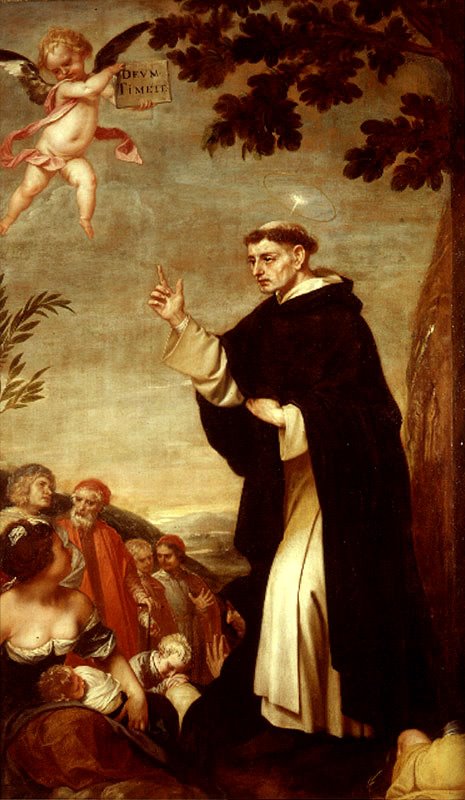
"A man who governs his passions is master of the world. We must either rule them, or be ruled by them." Saint Dominic
Martin Mosebach on the Liturgy and the Moral Life
 |
| Giuseppe Crespi, Communion |
In many dioceses in Germany it is customary for the bishop to invite artists to a meeting on Ash Wednesday, an Aschermittwoch der Künstler, an idea taken from Paul Claudel, who had organized something similar in Paris. On Ash Wednesday 2013, the novelist Martin Mosebach was invited to speak to assembled artists in Frankfurt (diocese of Limburg), on the theme of the traditional liturgy of the Roman rite. It need scarcely be said that is highly unusual for a traditionalist thinker to be invited to a regular diocesan setting to speak on that subject.
Toward the end of his speech Mosebach made the following point:
One difficulty that arose from the Church's abandonment of her traditional liturgy was surely quite unexpected. Many who observe the Church from a distance, and this includes many nominal Catholics, now see the Church as embodied principally in the moral teachings that she requires her faithful to follow. These teachings include many prescriptions and proscriptions that contradict the customs of the secular world. In the days when the Church was above all oriented toward the immediate encounter with God in the Liturgy however, these commandments were not seen merely in relation to the living of daily life, but were concrete means of preparation for complete participation in the liturgy.
The liturgy gave morality its goal. The question was: What must I do in order to attain to perfect Communion with the Eucharistic Christ? What actions will result in my only being able to look on Him from afar? Moral evil then appeared not merely as the that which is bad in the abstract, but as that which is to be avoided in order to attain to a concrete goal. And when someone broke a commandment, and thus excluded himself from Holy Communion, Confession was ready as the means to repair the damage and prepare him to receive Communion again. A surprising result of the reform is that while the Church of the past, which was really oriented toward the liturgy, appeared to many outside observers as being scandalously lax in moral matters, the current Church appears to contemporaries (and not only to those outside) as unbearably moralistic, unmerciful, and meanly puritanical. (From: "Das Paradies auf Erden: Liturgie als Fester zum Jenseits," Una Voce Korrespondenz 43 (2013), pp. 213-214; translation by Sacerdos Romanus).
Supreme Liturgical Authority, in groundbreaking text, says:
- Summorum Pontificum provides equal standing for both Forms
- Conditions for participation at Traditional Mass same as in new Mass
- and much more
 |
| Santa Cruz del Valle de los Caidos |
Fr. Soria is a monk in the abbey of the Holy Cross of the Valley of the Fallen (Santa Cruz del Valle de los Caídos), a Solesmes foundation near the Spanish capital, and his thesis was defended and approved at the Faculty of Canon Law of the University of San Dámaso, the main house for the formation of priests and theologians owned by the Archdiocese of Madrid, on May 29, 2013. The thesis was published just days ago by Spanish publisher "Ediciones Cristiandad" under the title "The Principles of Interpretation of the Motu Proprio Summorum Pontificum" ("Los principios de interpretación del motu proprio Summorum Pontificum"), which is why the Cardinal's text has only now become available.
Cardinal Cañizares' preface is a long presentation of the book, and it obviously includes many references to the work itself – but what makes it particularly special is the depth of the Cardinal’s appreciation for the motu proprio, and his defense (which had always been defended by those of us deeply appreciative of the nature of Summorum Pontificum) that what the motu proprio established in law was nothing less than the juridical equality of both forms of the Roman Rite. It is a groundbreaking text and we have translated below the most important excerpts of the Spanish original.
_____________________________________________
 |
| Card. Cañizares Llovera |
PREFACE OF CARDINAL CAÑIZARES TO THE DOCTORAL THESIS OF FR. ALBERTO SORIA JIMÉNEZ, O.S.B.
We find ourselves before a work that tackles, scientifically, a theme that in the past few years has been the object of heated controversies. Nevertheless, from its very beginning two characteristics of this work must be considered: its academic character and the belonging of the author to a community that is faithful to the great principles of the liturgy, but in which the extraordinary form of the Roman Rite is not celebrated. This has allowed him to observe the situation "from the outside," rendering possible the great objectivity reflected in his research.
...
The conception, clearly present both in the motu proprio and in the documents related to it, that the inherited liturgy is a wealth to be preserved, is to be understood in the spirit of the liturgical movement in the line of Romano Guardini, to which Benedict XVI owed so much of his personal relationship with the liturgy since his youth. The detailed and documented history of the process, from its beginnings in the 1970s up until today, that the author of this work presents to us, shows how this legislation was not the momentary result of pressure, nor a reflection of the personal and isolated opinion of the Pope, but rather that other persons had long wished for a similar solution. These criteria of the young priest Joseph Ratzinger were consolidated and purified throughout the years, and were taken up by John Paul II, who had considered the possibility of providing appropriate legislation.
We find ourselves before a work that tackles, scientifically, a theme that in the past few years has been the object of heated controversies. Nevertheless, from its very beginning two characteristics of this work must be considered: its academic character and the belonging of the author to a community that is faithful to the great principles of the liturgy, but in which the extraordinary form of the Roman Rite is not celebrated. This has allowed him to observe the situation "from the outside," rendering possible the great objectivity reflected in his research.
...
The conception, clearly present both in the motu proprio and in the documents related to it, that the inherited liturgy is a wealth to be preserved, is to be understood in the spirit of the liturgical movement in the line of Romano Guardini, to which Benedict XVI owed so much of his personal relationship with the liturgy since his youth. The detailed and documented history of the process, from its beginnings in the 1970s up until today, that the author of this work presents to us, shows how this legislation was not the momentary result of pressure, nor a reflection of the personal and isolated opinion of the Pope, but rather that other persons had long wished for a similar solution. These criteria of the young priest Joseph Ratzinger were consolidated and purified throughout the years, and were taken up by John Paul II, who had considered the possibility of providing appropriate legislation.
The mood among the cardinals designated to reflect upon this theme was favorable [Rorate note: reference to the 1986 commission - cf our 2007 post on the revelation by Cardinal Castrillón Hoyos]. The cardinalatial commission established by John Paul II, in which the influence of Cardinal Ratzinger was undeniable, had proposed to, "eliminate the impression that each missal is the temporal product of each historic epoch," and had affirmed that, "liturgical norms, not being truly and properly 'laws,' cannot be abrogated, but subrogated: the preceding ones in the subsequent ones." The demonstration that is very important, and present in this investigation, is that the attitude of Benedict XVI is not so much a novelty or a change of direction, but rather an accomplishment of what John Paul II had already undertook -- with initiatives such as the consultation of the cardinalatial commission, the motu proprio Ecclesia Dei, and the creation of the Pontifical Commission of the same name, the mass of Cardinal Castrillón Hoyos in Santa Maria Maggiore in 2003, or the declarations of the pope to the Congregation for Divine Worship that same year.
The history of the process reveals that, from the beginning, the wish to preserve the traditional form of the mass was not limited to integrists, but that people of the world of culture or writers, such as Agatha Christie and Jorge Luis Borges, signed a letter demanding its preservation, and that Saint Josemaría Escrivá made use of a personal indult granted spontaneously by Abp. Bugnini himself. It is also to be noted the concern of Benedict XVI to emphasize that the Church does not discard her past: by declaring that the Missal of 1962, "was never juridically abrogated," he made manifest the coherence that the Church wishes to maintain. In effect, she cannot allow herself to disregard, forget, or renounce the treasures and rich heritage of the tradition of the Roman Rite, because the historical heritage of the liturgy of the Church cannot be abandoned, nor can everything be established ex novo without the amputation of fundamental parts of the same Church.
Another important aspect comes from the reading of the historical narrative in this work: the advances that have taken place throughout these years regarding the pastoral sensibility for these faithful, the greater attention to their persons and to their spiritual welfare. In effect, the legislation was at first [Rorate note: "Agatha Christie" Indult, personal indults, Quattuor abhinc annos, Ecclesia Dei adflicta] very limited, it took into account only the clerical world and it practically ignored the lay faithful, considering that the first concern was disciplinarian: to control the potential disobedience to the newly promulgated legislation. With time, the situation took on a more pastoral aspect, in order to meet the needs of these faithful, which ends up being reflected in the strong change of tone of the terminology being used: it is thus that the "problem" of the priests and faithful who remained attached to the so-called tridentine rite is not mentioned anymore, but rather the "wealth" that its preservation represents.
What was thus created was a situation that was analogous to the one that had been normal for so many centuries, because we must recall that Saint Pius V had not forbidden the use of the liturgical traditions that were at least 200 years old. Many religious orders and dioceses therefore preserved their own rite; as Archbishop of Toledo, I was able to live this reality with the Mozarabic Rite. The motu proprio modified the recent situation, by making clear that the celebration of the extraordinary form should be normal, eliminating every restriction [todo condicionamiento] related to the number of interested faithful, and not setting up other conditions for the participation in said celebration than the ones normally required for any public celebration of the mass, which allowed for a wide access to this heritage that, while it is by law a spiritual patrimony of all the faithful, is, in fact, ignored by a great part of them. In effect, the current restrictions to the celebration in the extraordinary form are not different from those in place for any other celebration, in whatever rite. Those who wish to see, in the distinction made by the motu proprio of cum and sine populo, a restriction to the extraordinary form forget that, with the missal promulgated by Paul VI, the celebration cum populo without the authorization and agreement by the parish priest or rector of the church is not allowed either.
On the other hand, the possibility, expressly contemplated in the motu proprio, that in the celebration sine populo the spontaneous presence of faithful be admitted without obstacles (an expression that had provoked more than one ironic remark by the critics of the document) simply allowed for the end of the strange circumstances by which, though celebrated by a priest in a completely regular canonical situation, this mass remained closed to the participation of the faithful simply because of the ritual form being used, a form that was on the other hand fully recognized by the Church. The situation of the 1970s -- in which priests who could not adopt the new missal for reasons of health, age, etc, were condemned to never again celebrating the Eucharist with a community, as small as it could be -- was also prevented, which would be seen, according to the current sensibility, as discriminatory. On the other hand, to deliberately restrict the mass cum populo, limiting in practice the celebration of the extraordinary form sine populo, would contradict the words and intentions of the conciliar constitution: "... whenever rites ... make provision for communal celebration involving the presence and active participation of the faithful, this way of celebrating them is to be preferred, so far as possible, to a celebration that is individual and quasi-private." (Sacrosanctum Concilium, 27)
...
Et ut in musica in convivio vini
Source: Scuola Ecclesia Mater via Messa in Latino (original text in Italian)
Homily preached by Father Benedict Nivakoff, O.S.B.
On the Feast of the Holy Father Benedict
Basilica of Saint Benedict
Norcia, Italy,
July 11, 2014

“The memory of a saint is like music at a feast with wine”. This is what the book of Wisdom tells us in today’s Epistle reading from chapter 49. Like music that accompanies drinking wine, or even beer if you prefer, but in any case in the context of a great feast where one eats and drinks well, and where one as well hears beautiful music. This rings true especially for us who live here in Norcia, this poetic description of a festive banquet in which we celebrate a special occasion, a day marked by solemnity, an important person. We think, in this context, of every March 21st, the day on which we celebrate the transitus of Saint Benedict, his passing to eternity.
There are processions, special dress, dinners, the participation of the civic officials, there are fireworks, and so forth. But although this great feasting makes this event solemn and happy, it also can obscure the reality that is being celebrated. For this reason we can take advantage of July 11 for a more intimate form of festivity, we monks with the citizens of this town who venerate Saint Benedict.
Carmel
 |
| Mount Carmel in 1894 Mater et Decor Carmeli, ora pro nobis ! |
They had taken their usual round through Cana, mounting a hillock from which the long mirror of Gennesareth could be seen, and passing on, always bearing to the right, under the shadow of Thabor until once more Esdraelon spread itself beneath like a grey-green carpet, a vast circle, twenty miles across, sprinkled sparsely with groups of huts, white walls and roofs, with Nain visible on the other side, Carmel heaving its long form far off on the right, and Nazareth nestling a mile or two away on the plateau on which they had halted.
It was a sight of extraordinary peace, and seemed an extract from some old picture-book designed centuries ago. Here was no crowd of roofs, no pressure of hot humanity, no terrible evidences of civilisation and manufactory and strenuous, fruitless effort. A few tired Jews had come back to this quiet little land, as old people may return to their native place, with no hope of renewing their youth, or refinding their ideals, but with a kind of sentimentality that prevails so often over more logical motives, and a few more barrack-like houses had been added here and there to the obscure villages in sight. But it was very much as it had been a hundred years ago.
The plain was half shadowed by Carmel, and half in dusty golden light. Overhead the clear Eastern sky was flushed with rose, as it had flushed for Abraham, Jacob, and the Son of David.
Austrian Priest mentions hell and purgatory to students:
Diocese then forbids him from teaching
Updated

Thomas Ladner (in the photo) is a 36 year old Austrian priest, usually dressed in a cassock and collaborator in the parish of Stans, in Tyrol, a small town of 1500 souls, where he also teaches religion in the primary school. Before the end of the school year, he was informed of the withdrawal of his permit to teach by the diocese of Innsbruck. The priest’s fault, according to the diocesan school office, would be that he had spoken to his young students about The Four Last Things, among which he mentioned hell and purgatory; “lessons not suitable for children at their stage in life,” that he had dealt with themes on the family in “terms no longer up-to-date,” and of having used “rhetorical language,” or rather – too traditional.
The reaction this time came from the parishioners themselves, who appreciate Father Ladner’s humane manner and pastoral work, above all with the young. Parents launched a petition, while the mayor wrote a harsh letter to the curia complaining about the agitation in the town brought about by such an “unacceptable decision.”
The story was reported in the local newspaper Tiroler Tageszeitung, but, despite the clamour, the diocese and the Bishop, Manfred Scheuer, until now, have not shown any signs of changing their mind.
[Source: Il Timone. Tip and translation: Contributor Francesca Romana. Also in German, with more details of the declarations of diocesan schools superintendent Josef Stock.]
______________________
[Update: find the full translation of the German text below - translation by Elliot Bougis]
Innsbruck: Diocese bans beloved priest from giving religious instruction
Who is giving the numbers to the Pope?

Marco Tosatti
senior religious correspondent for La Stampa
senior religious correspondent for La Stampa
It is difficult to write about something that is vague and has indistinct contours as in an interview with seeming contradictions, but not contradictory in a general sense, such as the latest interview between Eugenio Scalfari and the Pope. But there is an aspect of the conversation that merits attention, because it poses questions of great weight. One of these questions concerns sexual abuse by clerics. At a certain point, in his reconstruction of the conversation, Scalfari writes that he asked how widespread this phenomenon is. The Pope responded, according to Scalfari, in this way:
“Many of my consultants who are in this struggle with me assure me on the basis of reliable data that they estimate that pedophilia in the Church is at the level of two percent. This should have reassured me, but I must say to you that it did not reassure me at all. I consider it on the contrary a most grave matter. The two percent of pedophiles are priests and even bishops and cardinals. And others, even more numerous, know but are silent, they punish but say nothing about the reason for the punishment. I find this state of things unsustainable, and it is my intention to confront it with the severity that it demands.
The sentence ends this way, without the closing quotations marks.
But it is the figure of two percent reported by Scalfari that creates a great deal of perplexity. And one must ask: a) if the Pope really said that; b) who gave him these figures? c) did Scalfari report this correctly? There are 410,000 priests in the world. Two percent of these comes to eight thousand. This is data that contrasts with that which has been accepted heretofore.
Those Very Same Words

Maurice Baring, the English poet, memoirist, and convert to the Catholic Faith, writes of going to Mass in France during World War I:
Early, at 5.30, the next morning (August 14th) I went to Mass in Amiens Cathedral; I stood between two soldiers, a Frenchman and an Englishman. This is where Edward III heard Mass on the way to Crecy. (R.F.C., H.Q., p. 17)
____________________On October 25th, St. Crispin's day, the anniversary of the battle of Agincourt, I went to Mass in the cathedral at St. Omer. One could not help thinking that Henry V had heard those very same words spoken in the very same way just before the battle of Agincourt. (Ibid. pp. 58-59)
New Catholic: We are very pleased to welcome Sacerdos Romanus, our newest contributor -- and, quite gladly for us, another member of the Ministerial Priesthood of the New and Eternal Testament to grace our humble page. Welcome, Reverend Father! (Father is, of course, in regular communion with his local Ordinary.)
Can I be more than just a "keyboard Catholic"? Realistic Optimism, expecting the days ahead
 |
| Jules Breton The blessing of the wheat fields in Artois (1857) [Prayer, faithfulness, hard work, Tradition: Catholic life!] Musée des Beaux-Arts, Arras |
____________________________________
Excerpts of an article by Marco Bongi for Italian traditional Catholic website Riscossa Cristiana:
Of late many of my friends have asked me why my articles have noticeably been less frequent. Naturally there are everyday obligations with the subsequent difficulties in finding time to write. Frankly, though, I would be lying if I denied that a sort of frustration is also lying hidden away in my pen; a sort of heightened sadness, in having to follow continuously the daily events which are now composing a picture that is now clear and unambiguous - for those at least who are not afraid to look reality in the face and who strive as much as possible to be honest with themselves....I honestly admire those who have the strength to follow with constancy and care the progress of the landslide, be it on the socio-political level or be it mainly in ecclesiastical circles. I read their lucid and documented articles regularly, and praise their courage and the patience of Job they manifest in reporting the advance of the avalanche.
However, I believe, that, sooner or later, it will be necessary in some way, to move from mere theory to practical action. Not that denouncing (especially if well-documented) is not useful. It certainly contributes to the creation of a cultural basis for coherent and well-structured action.
For the Record: The Essential Rule of Interpretation of Pope Francis
We had missed the chance to quote this when it first appeared in The Atlantic a couple of months ago, so we post it here for future reference -- since, despite its immense relevance, for the present and for future historians, it is buried deep inside a very extensive article on Benedict XVI.
 |
| Fr. Bernd Hagenkord SJ Head of the German-language Section of Vatican Radio |
__________________________________
“Francis knows exactly how power is spelled,” says Bernd Hagenkord, a Jesuit who is in charge of German programming for Vatican Radio. “He’s a communicator in the league with Mother Teresa and the Dalai Lama. They say he’s being unclear, but we know exactly what he means.”
__________________________________
Quo Primum, 444 Years

PIVS EPISCOPVS
SERVVS SERVORVM DEI
AD PERPETVAM REI MEMORIAM
Quo primum tempore ad Apostolatus apicem [From the very first, upon Our elevation to the chief Apostleship], We gladly turned our mind and energies and directed all out thoughts to those matters which concerned the preservation of a pure liturgy, and We strove with God's help, by every means in our power, to accomplish this purpose. For, besides other decrees of the sacred Council of Trent, there were stipulations for Us to revise and re-edit the sacred books: the Catechism, the Missal and the Breviary. With the Catechism published for the instruction of the faithful, by God's help, and the Breviary thoroughly revised for the worthy praise of God, in order that the Missal and Breviary may be in perfect harmony, as fitting and proper - for its most becoming that there be in the Church only one appropriate manner of reciting the Psalms and only one rite for the celebration of Mass - We deemed it necessary to give our immediate attention to what still remained to be done, viz, the re-editing of the Missal as soon as possible.
Hence, We decided to entrust this work to learned men of our selection. They very carefully collated all their work with the ancient codices in Our Vatican Library and with reliable, preserved or emended codices from elsewhere. Besides this, these men consulted the works of ancient and approved authors concerning the same sacred rites; and thus they have restored the Missal itself to the original form and rite of the holy Fathers. When this work has been gone over numerous times and further emended, after serious study and reflection, We commanded that the finished product be printed and published as soon as possible, so that all might enjoy the fruits of this labor; and thus, priests would know which prayers to use and which rites and ceremonies they were required to observe from now on in the celebration of Masses.
Pope's 3rd "conversation" with Italian liberal journalist E. Scalfari
- Vatican spokesman blames Scalfari, Repubblica criticizes the Vatican
- Don't shoot the Messenger
 |
| Dosso Dossi Jove, Mercury and Virtue Wawel Castle, Krakow |
¡Qué lío! - what a mess!
First, the account of the media commotion (there seems to be one every single day) involving declarations by the Pope through unofficial means. The summary in English is by La Repubblica, the secularist newspaper co-founded by Italian liberal and atheist journalist Eugenio Scalfari himself -- our comment at the end.
________________________________
Francis says 2% of priests are paedophiles
Once again, Pope Francis appears to be out of step with conventional wisdom in the Vatican. In his third conversation with Eugenio Scalfari, La Repubblica’s founder and former editor-in-chief, the pontiff implied that there was room for manoeuvre on the issue of celibacy, that there were paedophiles among the cardinals, and that not enough priests condemned the mafia. But the Vatican immediately issued a statement suggesting he had been misquoted.
The Pontiff recalled that celibacy for priests was not instituted until the 10th century, “900 years after Our Lord’s death”, something which the church usually prefers to overlook. He also recalled that clerics could marry in some Eastern Catholic Churches. There were solutions to the “problem” of celibacy, “and I will find them.”
This unusually open approach to the issue follows on from his comments in May, when he told reporters on the plane returning from Israel that “celibacy is not a dogma”. He added: “It is a rule that I appreciate very much… but since it is not a dogma, the door is always open.”
Martyrs : Witnesses
 |
| The 19 Holy Martyrs of Gorkum, hanged and mutilated by Protestants on July 9, 1572, in Brielle, Holland |
I'm not interested in converting Evangelicals to Catholicism. I want people to find Jesus in their own community. There are so many doctrines we will never agree on. Let’s not spend our time on those. Rather, let’s be about showing the love of Jesus.
Franciscus
June 23, 2014
We will have much more on this meeting shortly.
On July 2, 1572, Feast of the Visitation, Fr. Leonard van Veghel, the pastor of Gorkum (Gorinchem, Holland), was under great pressure. He had been temporarily released from captivity by the Protestants to tend to Catholic laity - but only under the condition that he did not preach, unless he limited himself to pure Reformed doctrine. In his sermon, instead,
Fr. Leonard, and 18 companions, paid the ultimate price one week later.
This short note is just to acknowledge publicly, coming from our humble selves, who owe them so much, the sacrifices of the thousands of Catholics martyred by Protestants, or "Evangelicals", in the past 500 years.
- Dear Martyrs, unforgettable Martyrs, you are still remembered, loved, cherished, as alive with us today as ever through the Communion of Saints.
- Dear Martyrs, your blood is a living witness, streams of blood shed for Our Lord, Our Lady, the Sacrosanct Sacrifice of the Mass, the inerrant Apostolic Doctrine, the missionary duty of the Church, and the legitimate rights of the Roman See, reflecting the Sacrifice of the Crucified and lighting our way.
- Dear Martyrs, as you did, may we also, through your powerful intercession, attain final perseverance and eternal life with you and Our Lord: "Blessed are they that wash their robes in the blood of the Lamb: that they may have a right to the tree of life, and may enter in by the gates into the city."
_________________________________
"He swore to remain faithful to the Catholic Faith, outside of which no salvation was possible. Attentive listeners said that at the end he stated that he would always proclaim, for as long as it was granted him to preach, the teachings of the Holy Roman Church, even if he had to pay for it with death." [C.J. van Blijswijk, De Martelaren van Gorcum: voorbeelden van trouw, Oegstgeest, 1993, p. 69]
Fr. Leonard, and 18 companions, paid the ultimate price one week later.
This short note is just to acknowledge publicly, coming from our humble selves, who owe them so much, the sacrifices of the thousands of Catholics martyred by Protestants, or "Evangelicals", in the past 500 years.
- Dear Martyrs, unforgettable Martyrs, you are still remembered, loved, cherished, as alive with us today as ever through the Communion of Saints.
- Dear Martyrs, your blood is a living witness, streams of blood shed for Our Lord, Our Lady, the Sacrosanct Sacrifice of the Mass, the inerrant Apostolic Doctrine, the missionary duty of the Church, and the legitimate rights of the Roman See, reflecting the Sacrifice of the Crucified and lighting our way.
- Dear Martyrs, as you did, may we also, through your powerful intercession, attain final perseverance and eternal life with you and Our Lord: "Blessed are they that wash their robes in the blood of the Lamb: that they may have a right to the tree of life, and may enter in by the gates into the city."
+
Rex gloriose Martyrum :
Ignosce quod deliquimus.
Amen.
Rex gloriose Martyrum :
Ignosce quod deliquimus.
Amen.
So... Canonizations... Infallible or not?
Bishop Giuseppe Sciacca, a remarkable prelate and Canon Lawyer and current Adjunct Secretary of the Supreme Tribunal of the Apostolic Signatura, granted days ago the following interview to La Stampa (posted here for the record of current events):
 |
| Bp. Sciacca and Pope Benedict XVI |
Is the Pope infallible when he proclaims a new saint?“According to the prevailing doctrine of the Church, when the Pope canonizes a saint his judgment is infallible. As is known, canonization is the decree with which the Pope solemnly proclaims that the heavenly glory shines upon the Blessed and extends the cult of the new saint to the universal Church in a binding and definitive manner. There is no question then that canonization is an act carried out by the Petrine primate. At the same time, however, it should not be considered infallible according to the infallibility criteria set out in the First Vatican Council’s dogmatic constitution “Pastor aeternus”.”So, according to you, this means the Pope can make a mistake when he proclaims someone a saint?“That’s not what I said. I am not denying that the decree issued for a canonization cause is definitive, so it would be rash and indeed unholy to state that the Pope can make a mistake. What I am saying, is that the proclamation of a person’s sainthood is not a truth of faith because it is not a dogmatic definition and is not directly or explicitly linked to a truth of faith or a moral truth contained in the revelation, but is only indirectly linked to this. It is no coincidence that neither the Code of Canon Law of 1917 nor the one currently in force, nor the Catechism of the Catholic Church present the Church’s doctrine regarding canonizations.”Monsignor, it has to be said though that the majority of those who support the infallibility idea have an important ally on their side: St. Thomas…“Of course, I am well aware of that. Thomas Aquinas is the most prestigious author supporting this theory. But it should be said that the use of the concept of infallibility and of language relating to it, in a context that is so far from that of the 19th century when the First Vatican Council was held, risks being anachronistic. St. Thomas placed canonization half way between things that pertain to the faith and judgments on certain factors that can be contaminated by false testimonies, concluding that the Church could not make mistakes: in fact, he claimed that: “thinking that judgment is infallible, is holy.” As I said before and I repeat again, the “Pastor aeternus” rigorously defines and restricts the concept of papal infallibility which could previously also encompass and contain or be likened to the concepts of “inerrancy” and “indefectibility” in relation to the Church. Canonization is like a doctrine which cannot be contested but which cannot be defined as a doctrine of faith as all faithful must necessarily believe in it.”
An upcoming week of Traditional Events (incl. Pilgrimage ) surrounding Our Lady of Mt. Carmel in New York City

In honor of the 130th anniversary of the founding of the Pontifical Sanctuary of Our Lady of Mount Carmel in East Harlem, Upper Manhattan, New York (Map), and the arrival in America to staff the shrine of the Society of the Catholic Apostolate, better known as the Pallottines.
- On Sunday, July 13th at 5:00 p.m. there will be a Ukrainian Greek Rite Liturgy celebrated for a pilgrimage of Eastern Rite Catholics that day.
- On Tuesday, July 15th at 7:00 p.m. there will be sung at the main altar of the shrine church, Vespers of the Little Office of the Blessed Virgin Mary (1962), followed by a candlelight procession at 9:00 p.m., and a Solemn High Traditional Latin Mass at midnight (i.e. July 16th, at 12 a.m.); Rev. Canon Jean Marie Moreau of the Institute of Christ the King will be subdeacon and homilist.
- On the morning of July 16th, the feast of Our Lady of Mount Carmel, there will be a Traditional Latin Missa Cantata at 9 a.m.
- On Saturday July 19th, at 11 a.m., there will be a Solemn High Traditional Latin Mass at the altar of the Pontifically Crowned Madonna on the occasion of the third annual pilgrimage being made that day by faithful attached to the Extraordinary Form of the Latin Rite. The Rosary, Litany of Loreto, Investiture with the Brown Scapular and Solemn Benediction will follow at 2:30 p.m.
There have been several documented miracles that have been performed by the Blessed Mother at this shrine. The image located there was proclaimed miraculous by His Holiness Pope Leo XIII, and so crowned during the pontificate of Pope St. Pius X on July 10th, 1904. There are only three images of the Blessed Virgin that have been crowned by Pontifical Authority in North America.
The Church of Our Lady of Mount Carmel at 115th Street is one of the first Italian National Parishes in the United States. At one time more than 500,000 people attended the feast of Our Lady of Mount Carmel during the month of July before and after the feast day. The crown of the Madonna and child is gold, adorned with precious stones, the emerald of which was donated by the aforementioned pope.
The Crowned Statue is taken down in procession only on special occasions, this year's anniversary being one of those special occasions, and with the authorization of ecclesiastical authority.
For more information on the Saturday, July 19th pilgrimage please contact: nyctlmpilgrimage@gmail.com
Fontgombault: A Sermon for Saint Benedict
- and the memory of Petrus a Stella, Founder.
"Are you an aqueduct of God's grace ?"
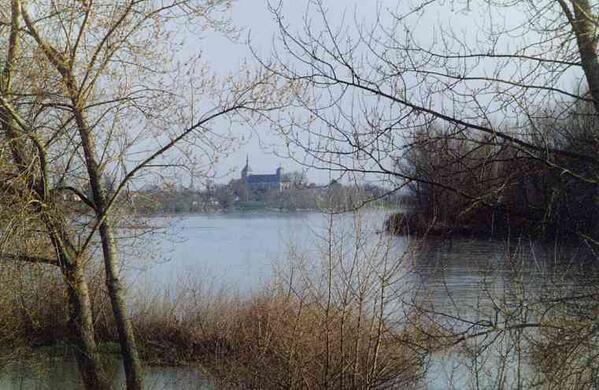 |
| The Loire river - Fleury Abbey in the background |
Sometime in the 7th century, the relics of Saint Benedict were translated from Monte Cassino to a monastery by the Loire, the Abbey of Saint Benedict upon the Loire (Saint-Benoît-sur-Loire), better known as Fleury Abbey. (There are some who say that the relics actually remained at Monte Cassino, but that is a matter for another day.)
In any event, the date of definitive placement of the relics at Fleury, July 11 (653? 655? 660?), became a second feast of Saint Benedict for all his sons and daughters - a Saint Benedict of summer, so the Patriarch could be festively celebrated, which cannot happen on the date of his death (Transitus, March 21), due to Lent or holy week. Both dates were always celebrated by Benedictines, while in the general Roman Calendar the remaining date was that of March. In the pauline calendar, the "Solemnity" of Saint Benedict was transferred from March 21 to July 11. Both dates, Transitus and Translation of Relics, are, for Benedictines, thoroughly traditional feasts.
This summer feast of Saint Benedict was celebrated today as well in Fontgombault Abbey, which also recalls this year the death, exactly 900 years ago, in 1114, of the original founder of the abbey, and first abbot, Petrus a Stella (Pierre de l'Étoile, "Peter of the Star"), and the translation of his remains, 60 years ago, to the nave of the abbatial church. The sermon of the Father Abbot for the date is available below.
 |
| Fontgombault Abbey - nave of the abbatial church View from choir: tomb of Petrus a Stella in the foreground |
________________________________
Sermon of the Right Reverend Dom Jean Pateau
Abbot of Our Lady of Fontgombault
(Fontgombault, July 11, 2014)
The Church invites us all to rejoice in the Lord, gaudeamus omnes in Domino, on this day when she celebrates St. Benedict’s feast day.
For more than 1,500 years, men have kept entering the school of the holy Patriarch, who was born in Nursia, Italy, around 480. He lived in troubled times, since the Roman Empire had collapsed four years before he was born; there were all kinds of dangers, rampaging of troops, requisitions, looting and plundering, violence, increase in foodstuffs prices, dearth and restrictions, starvation, epidemics. Benedict, “in his life repaired the house of the Lord”. His example, his Rule, his monasteries have been and remain an answer offered to men and women of all times, to those, “who desire life, and covet many days, that they may enjoy good” (Ps 33 [34]:13).
"No Confessions will be heard"
- A Confessor's Examination of Conscience
A guest-post by Fr. Bec (pen name)
 |
| Eugène Ernest Hillemacher A confessional at Saint Peter's, Rome, on Easter Sunday (1847) Musée d'Orsay |
___________________________________________
A few days before Christmas last year, a sign appeared on the door of a confessional in a certain cathedral that read, "No Confessions will be heard from Sunday 22nd to Wednesday 25th."
In this same church, priests have often been seen closing the confessional and walking past as many as twenty, thirty, and even more persons who have waited patiently but unsuccessfully to go to confession during the half hour scheduled before noon Mass. For several years, each time he has made it into that confessional, at least one of those penitents has requested more time or more confessors, to meet the obvious need.
At being made aware of this, my first reaction as a priest was to pity those souls, and to rashly judge the priests who were not hearing their confessions. But quickly I realized that neither of these was appropriate. Instead, I should offer to help, both penitents and priests, perhaps by sitting in the other confessional, perhaps hearing confessions for a longer time. Perhaps the people and the priests would accept such an offer of help from another priest.
But what if they did not? What else could a priest do in such circumstances? If pity and indignation are not appropriate, then what is?
O Lord, have mercy on those who seek Your forgiveness and healing through absolution! O Lord, have mercy on those men You chose to be priests to offer that absolution. O Lord, have mercy on me, who like them, am a sinner and a priest. Enlighten me, O Lord, as a priest and sinner. Show me what I should do. Show me how I can help.
If sinners should examine their conscience, admit their guilt and reform their lives, all with the help of Your grace, then I as a priest with the power and mission to absolve sinners, should do the same.
Confessor's Examination of Conscience :
If Pope says black is white, that's it, right?
- a very special young man knew better than that

From our 2012 series on the Life and Thoughts of Cardinal Merry del Val, on the centennial year of the death (dies natalis) of Pope Saint Pius X:
Beside the exceptional and amiable figure of St. Pius X, we have, in marvellous splendor, the figure no less exceptional and extraordinary, of his Secretary of State, Cardinal Rafael Merry del Val. Of noble birth, but still more of noble aspirations, as from the first years of his life he had one unique and most noble goal: to be a Priest of God.
ENLIGHTENING PRESENTIMENTS
Born on the 10th October 1865 in London, to the Spanish Marquis of Irish descent, Rafael Merry del Val, and to the Countess Josephine de Zulueta, English but of Spanish descent, the future Secretary of State received Baptism the following day, and was named Rafael. The prestigious Del Val family, illustrious due to the nobility of their blood no less than for their virtues, could boast that amongst their ancestors there was a martyr of the Church: Little St. Domingo del Val ... . The future Cardinal nourished a very special devotion to him.
Rafael Merry del Val was, therefore, an aristocrat , but far from being fascinated by noble society, he demonstrated even from his infancy the signs of a divine calling. At only eight years of age, when asked by an elderly Jesuit what he wanted to be when he grew up, he replied: “I want to be a priest.” And when he was saying goodnight to his parents that evening, he drew out of his sleeve a biscuit and raising it on high, said: “I will do this with the host when I become a priest.” He would also, from time to time during meals, take a glass of water and a biscuit, and raising it a little would exclaim: “This is what I will do when I celebrate the Mass.” Having learned at an early age to serve the Holy Mass, he took delight in preparing little altars and imitating the sacred ceremonies, as well as speaking of these things with various priests who, with admiration, perceived in the young Rafael the divine calling.
One day, whilst out walking with his governess, a funeral cortege was passing by. The little Rafael took off, mingling with the crowd which was following the coffin. When the governess after an anxious search finally found him and asked him why he had done such a thing, he answered candidly: “Mother told me that those who die go to Paradise: and I also want to go to paradise with that deceased person.” The Mother of the future Cardinal recounted also that on another occasion, whist she was explaining to him the meaning of papal infallibility, she decided to test him. Taking a book bound in black in her hand, she asked him: “Rafael, if the Pope said that this book is bound in white, what would you say about that?” The little boy, after a moment’s reflection replied: “Mother, the Pope would not be able to say such nonsense,” showing – by his reply – the acuteness of his most refined intelligence.
We are reposting this because some readers were curious about a recent mention of the matter in a Rorate article, in which a paraphrase of the Ignatian words was quoted: "if the Pope says that black is white then we should believe that it is white."
Subscribe to:
Posts (Atom)