Rorate Caeli

Cardinal Burke at Dignitatis Humanae Colloquium: Combat Secularization Within the Church Herself

Colloquium on Dignitatis Humanae in Norcia

On Friday Cardinal Burke opened the Dialogos Institute Colloquium on the proper interpretation of Vatican II’s Declaration on religious liberty, Dignitatis Humanae, currently being held in the Norcia, the birthplace of St. Benedict. In his opening remarks the cardinal thanked the Dialogos Institute for its work for the renewal  of philosophy and theology, and thus for the renewal of Christian society. He pointed out the importance of the question of religious liberty for such renewal. The Church can only accept teachings in organic continuity with Apostolic Tradition, and yet many theologians interpret Dignitatis Humanae as contradicting previous teaching. The Cardinal recalled one of his own teachers in canon law, a student of Fr. John Courtney Murray’s who had argued that Dignitatis Humanae represents a radical break with the magisterial teachings of 19th century popes. But, the Cardinal argued, the Church cannot accept any teaching on religious liberty that contradicts previous teachings, especially teachings on the social kingship of Christ, which belong to the deposit of faith itself. It is thus vital for the Church to reflect on the real content of her teaching with respect to Church/state relations, and religious liberty, especially given the current context of aggressive secularism and Islam. A new evangelization is needed even within the Church herself in order to re-discover the Apostolic Tradition, and to combat secular influences within the Church— including the influence of secular, indifferentist conceptions of religious liberty. Hence the importance of the current colloquium.

For the Record: Society of St. Pius X's Superior-General's "Declaration Concerning the Final Report of the Synod on the Family"

On the 50th anniversary of Vatican II's Gravissimum Educationis

Of the sixteen documents of the Second Vatican Council, the relatively short Declaration on Christian Education Gravissimum Educationis, promulgated fifty years ago on this day, October 28, 1965, is not one of the more memorable and certainly not one of the more controversial. It was quickly overshadowed by the larger Constitutions and the more innovative Declarations such as Nostra Aetate and Dignitatis Humanae. Nevertheless, if only to observe a half-century anniversary that might otherwise slip by unnoticed, it seems fitting to excerpt a few paragraphs that may be surprising when quoted in 2015.

One thing is very clearly established in the document: education, for Catholics, is necessarily bound up with Jesus Christ and with the proclamation of His Gospel. It cannot be “religiously neutral.” There is no sharp separation between the sphere of faith and the sphere of life in the world; everything in human life must be permeated with faith and aim at the ultimate end of heaven. The council fathers even obliquely refer to St. Pius X’s famous motto, Instaurare Omnia in Christo:

To fulfill the mandate she has received from her divine founder of proclaiming the mystery of salvation to all men and of restoring all things in Christ, Holy Mother the Church must be concerned with the whole of man's life, even the secular part of it insofar as it has a bearing on his heavenly calling. ... A true education aims at the formation of the human person in the pursuit of his ultimate end and of the good of the societies of which, as man, he is a member, and in whose obligations, as an adult, he will share.

The document also recognizes that the central subject in Catholic education must be theology, with a strong awareness of its liturgical expression and consummation, as well as its inherently apologetic and missionary character:

FIUV elects a new President: official communique

A note to readers: I (Joseph Shaw) attended the FIUV's General Assembly. I am delighted at the result of the elections, which passes the torch of leadership to new hands while maintaining continuity. Notably, our new President, Felipe Alanís Suárez from Mexico, is our first from outside Europe. I have been asked to continue the series of Position Papers which I have been publishing on this blog, and will do so. There follows the official communique from the President.

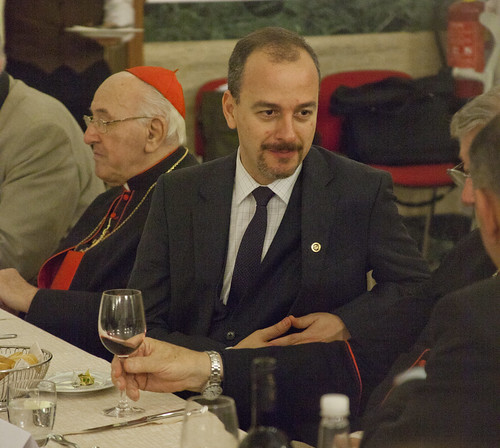
IMG_9330
Felipe Alanís Suárez, at dinner between Cardinals Brandmuller (left) and Pell (right).
Foederatio Internationalis Una Voce

Non cessant clamare quotidie UNA VOCE dicentes: Sanctus, Sanctus, Sanctus

Quae patronum invocat sanctum Gregorium Magnum Papam
2015 - 50th Anniversary Year of the Federation founded in 1965

IN FESTO DOMINI NOSTRI IESV CHRISTI REGIS

Dear Members of the Foederatio Internationalis Una Voce,

It is with great expectations that I write this letter to all of you, in my new capacity of President of our beloved International Federation.

The new Synod Council: split between "liberals" and "conservatives".
Chaput has the biggest vote, Forte joins through a technicality


Lost amidst all the news from the just-concluded Synod was the election by the Synod fathers of the new "Synod Council" that will assist the Synod Secretariat until the next ordinary Synod (which is yet to be scheduled or announced, although it should take place in the next 3-4 years). 

The names of the 12 elected members of the Synod Council have not yet been officially revealed pending the appointment by Pope Francis of 3 more members, but Sandro Magister published the names yesterday:

De Mattei: "The failed Synod: everyone defeated; and Catholic morality in particular"

Roberto de Mattei
Corrispondenza Romana
October 27, 2015

["SYNODALITY" IN ACTION]

The day after the XIV Synod on the Family, everyone seems to have won. Pope Francis has won, since he was able to find a compromising text among the opposing positions; the progressives have won since the approved text admits the divorced and remarried to the Eucharist; the conservatives have won, since the document doesn’t contain an explicit reference to Communion for the divorced [and remarried] and rejects “homosexual marriage” and the gender theory.

New Archbishop of Bologna a friend of the Traditional Mass [UPDATED: An unworthy man]

Pope Francis named today as new Archbishop of Bologna Matteo Zuppi, up to now Auxiliary Bishop of Rome. He has been mentioned here in Rorate for his visits to Santissima Trinita dei Pellegrini, the Personal Parish of the Traditional Mass in Rome (run by the Fraternity of St. Peter) - for instance, in 2014 - and his discreet attempts to help the Franciscans of the Immaculate.

May God keep him faithful, and may he be a worthy successor of the faithful Cardinal Caffarra in the defense of Christian morality.

[2018 & 2019 Update: HE HAS NOT proved himself worthy of Cardinal Caffarra. On the contrary, he has become one of the greatest promoters of the homosexual lobby in the Church today. This became absolutely clear with his promotion of known heretic James Martin, a deviant Jesuit who promotes the most horrendous lifestyles as acceptable to Catholics. For this, Zuppi was created as a Cardinal by Francis in September 2019.]

Repost: "Yes, I know Bergoglio. He’s a person who’s caused a lot of problems in the Society."

“Yes I know Bergoglio [, says a Jesuit superior from another Latin American country]. He’s a person who’s caused a lot of problems in the Society and is highly controversial in his own country.

Just in time for the Post-Synod Confusion: A new English translation of the Book of Gomorrah (discount for Rorate readers)


Just in time for the Post-Synod mess: A new English translation of the Book of Gomorrah, St. Peter Damian’s manifesto against the infestation of homosexuals in the Catholic priesthood, with a foreword by Cardinal Juan Sandoval Íñiguez

“Why, I ask, O damnable sodomites, do you seek after the height of ecclesiastical dignity with such burning ambition? Why do you seek with such longing to snare the people of God in the web of your perdition? Does it not suffice for you that you cast your very selves off the high precipice of villainy, unless you also involve others in the danger of your fall?”

--The Book of Gomorrah, chapter 20

While some prelates at the Synod of Bishops advocated “accepting and valuing” homosexuality, a new English translation of the Book of Gomorrah has just been published that promises to bring St. Peter Damian’s powerful condemnation of the vice of sodomy to a wide audience of Catholic readers.

Event: All Souls' Day TLM at Philly Cathedral

Monday, November 2, 2015 at 7:00p.m.
Solemn High Requiem Traditional Latin Mass 
& Absolution of the Dead at the Catafalque

The Cathedral Basilica of Ss Peter & Paul,
17th & Race Streets, Philadelphia

Synod: In interview, Kasper says he won - in video, Pell is not so sure. We report, Francis decides.

Cardinal Kasper clearly considers the Final Relatio of the Synod favors his position in an exclusive interview to Il Giornale, translated only by Rorate. Cardinal Pell (see video below) does not. Whose view will Francis favor if the language is unclear?...

“Communion for the divorced if they repent; homosexual [unions] are not family”

The Synod explained via new media
An epic Catholic rant and a look back to see the present

The Synod of Sin has concluded. For some perspective to understand the traditional position -- from a non-traditional medium -- we bring you two helpful tools.

(UPDATED) The Triumph of Ambiguity - The Synod Final Relatio's most controversial passages: 69-71, 75, 84-86 (English translation)

The six most controversial passages in the Final Relatio (so far) are nos. 70-71, 75, and 84-86, which also got the fewest "yes" votes and the most "no" votes in the entire document. Paragraphs 84-86 (on the divorced and remarried) got 187, 178 and 190 "yes" votes and 72, 80 and 64 "no" votes respectively. The minimum number of votes for a passage to be included in the Final Relatio was 177, which means that no. 85 squeaked by by just one vote past the minimum. 

Passage 85 (made up of two paragraphs) is special; it quotes John Paul II's Familiaris Consortio # 84 but omits the part where communion for the "divorced-and-remarried" is forbidden. It also opens a path to doctrinal devolution by speaking of the "orientations of the bishop" with regards to the "divorced and remarried". 

We have updated this post to include translations of all these six, plus no. 69 which provides necessary context for 70-71. Our thanks to blogger Vox Cantoris for his valuable help on par. 69-75. We have highlighted the potential flashpoints in the passages below.

Our initial commentary can be found at the end of this post. Extended commentary on these passages and on the Pope's slashing speech against conservatives -- an obvious sign of frustration and a terrifying glimpse into his theology (since when was it possible to oppose the "letter" and "spirit" of CATHOLIC doctrine, and to defend one but not the other?) will follow on Monday.

 Complex situations
69. The sacrament of marriage as a faithful and indissoluble union between a man and a woman called to accept one another and to welcome life, is a great grace for the human family. The Church has the joy and the duty to announce this grace to every person and in every context. She feels that today, in an even more urgent way, She has the responsibility of making the baptized rediscover how the grace of God works in their lives - even in the most difficult situations - in order to lead them to the fullness of the sacrament. The Synod, while appreciating and encouraging families who honor the beauty of Christian marriage, intends to promote the pastoral discernment of situations in which the reception of this gift has difficulty in being appreciated, or in which it is compromised in various ways. Keeping dialogue open with these faithful [people] in order to enable the maturing of a coherent openness to the Gospel of marriage and the family in its fullness, is a grave responsibility. Pastors should identify the elements that may favor evangelization and the human and spiritual growth of those entrusted to their care by the Lord.

UPDATE: Final Report of Synod published.
(Original post) Will the final Synod document have hidden time-bombs on the issue of the "divorced-and-remarried"?
If Familiaris Consortio can't be overturned, then it will be distorted

The Final Report of the Synod is now available in Italian only:


[Our translation of paragraphs 84-86 of the "Relazione Finale" and our commentary on these, and on the Pope's speech, are located in a separate post: The Triumph of Ambiguity - The Synod's Final Relatio, numbers 84-86)]

***

[Original posting time: 10/24/15 3:30 PM]

The final document of the Synod is expected to be published this evening, Rome time. No word yet on whether it will be only in Italian, or if translations are to be made available at the same time. Once the document is out we will try to post relevant passages as soon as possible. 

However we already have an idea about its contents from the official Vatican press briefing today, where Cardinals Schönborn and Damasceno Assis spoke. 

It might be protested that these two Cardinals are more or less on the "progressive" side, and therefore have an interest in twisting or distorting the presentation of the final document. Our response is that if the document can be interpreted in a heterodox-friendly manner, then that is a major issue even if a first reading of it is friendly to orthodoxy. We already saw this happen with the Synod Instrumentum Laboris (henceforth referred to as IL), which at its release was largely hailed as a "conservative" document, only for its progressivist time-bombs to become more evident upon a closer reading of the text

DANGER AHEAD. Synod document drafting committee member: Familiaris Consortio? "Circumstances have changed!" Divorced-and-remarried, "decentralization" still on the agenda

Cardinal Oswald Gracias of Mumbai, one of ten mostly-liberal prelates assigned by Pope Francis to the drafting committee for the final Synod relation, has unexpectedly emerged in recent days as a champion for greater "openness" to homosexuals. His comments in today's Vatican press conference are true to form, and given his role in drafting the Synod document hints at something that can be manipulated in favor of Kasperite and liberal concerns. 

It is telling that in speaking of decentralization he, and other champions of this idea, repeatedly refer to the problem of polygamy in Africa as an example of issues that need to be dealt with by local bishops' conferences. One has to ask if this is an agreed-on liberal talking-point to humiliate the African bishops into endorsing the "decentralization" option. 

Op-Ed: "The Failed Francis Pontificate - Finding another Path for the Church: may Pope Pacelli help us!"

We are very honored to post this new article by a very wise, knowledgeable, and highly influential cleric, writing under the pen name of don Pio Pace.

***


Father Pio Pace

I visited in these past few days the tomb of Pius XII, in the crypt of the Vatican Basilica. My thoughts often go back to Pius XII, this great moralist pope, in this month of October 2015, in which takes place this strange Synod of the Family, during which we have spoken only of adulterous couples and homosexual couples. During which the doctrine de fide et moribus has been brought up for debate, as if the Church had not defined it already.

The Most Dangerous Part - Language Group Reports on Third Part of Instrumentum Laboris

English First (4  ANGLICUS groups), then French (3 GALLICUS groups), Italian (3 ITALICUS groups), Spanish (2 HIBERICUS groups), German (GERMANICUS).


Emphases ours. 


[Update (3 PM GMT): Only a small minority of the circoli minori are either favorable to the Kasper position or use language that can be interpreted in its favor. Most of the circoli are clearly unfavorable (Anglicus A, C, Gallicus B, etc) or simply ignore it. For some reason some commentators are saying the opposite, but this confirms the huge defeat of the Kasper thesis. Of course there are many, many shadows; the defeat of the Kasperites on the level of the circoli minori should not cause any complacency or relaxation in our vigilance.]

Relatio – Circulus Anglicus “A”

Moderator: Card. PELL George

Relator: S.E. Mons. KURTZ Joseph Edward

Bishop Athanasius Schneider: Attack on marriage and family from "atheist, neo-Communist world"

We are pleased to bring our readers two sermons from His Excellency Bishop Athanasius Schneider, auxiliary bishop of Astana, Kazakhstan, and titular bishop of Celerina. Bishop Schneider was in the United States this past weekend for events and priestly ordinations for the Canons of New Jerusalem. Please see below for the texts of these two powerful and timely sermons.


                                                  The Family - Domestic Church, Front Royal, Virginia

Huge Kasperite defeats and liberal Trojan horses on contraception:
Why orthodox Catholics should remain vigilant over the Synod


Yesterday we reported that an overwhelming majority of Synod Fathers have signified their opposition to the "Kasper proposal" to give communion to the "divorced and remarried". La Croix's report on yesterday's Synod proceedings (Les évêques restent timides dans leurs propositions) gives a more precise number: only one out of four bishops were in favor. This statistic emerged in the course of the voting in the circuli minori over the proposed amendments or modi (at least 600, according to La Croix) to the third and most controversial part of the "Instrumentum Laboris", the part that (among other things) deals with divorced couples.

One out of four, or 25%, is smaller than even the "35%" support for Kasper's proposal that was estimated by Abp. Mark Coleridge of Brisbane earlier during the Synod, and the "three out of ten working groups" who supported the proposal in the Synod of 2014 according to Cardinal Pell. If anything, this Synod seems to have resulted in a decrease of support for Kasper. This is a crushing blow, we repeat, a crushing blow to the position of Cardinal Kasper and Co, stealthily supported by the highest echelons in the Church since February 2014, and even earlier, and by Synod manipulations since before the organization of the 2014 Synod. Well done, Synod fathers!

THE SYNOD: The decentralization of the Church offends the Faith and common sense

Roberto de Mattei
IL FOGLIO
October 20, 2015

Urgent - Synod Week 3, counting heads - from inside the Synod - Overwhelming majority against communion for "remarried" divorcees

Urgent news from inside the Synod hall today:


The news source is from the correspondent of the highly liberal official newspaper of the French Bishops' Conference, La Croix, Sebastien Maillard - the head count comes directly from inside the hall (tweeted 16 minutes ago at the time of this post):


"Overwhelming majority against communion for remarried divorces, according to observer in the Synod hall"

Catholic Teaching on Marriage and Divorce - the Bible, Our Lord, and the Constant Teaching, simple and to the point


Catholic teaching on marriage – theological background

a guest-post by John Lamont

The subject of Catholic marriage is now being hotly debated at the current session of the Synod on the Family. It is thus helpful to have available an account of the essentials of Scriptural teaching on this subject, which this article will attempt to provide.

The starting point for this account is the text of Deuteronomy 24;1-4:

Polish bishops: liberal Synod fathers want to change doctrine.

One of the most pernicious slogans used both by the Synod liberals and the Synod's apologists is that "doctrine will not be changed, only the discipline". It is a slogan calculated to lull Catholics into complacency -- after all, whatever happens, the doctrine is not gonna change, right? It is a slogan, a talking point, that reveals how well the liberals understand the modern Catholic mentality, with its unwarrantedly sharp distinction if not de facto divorce between "doctrine" and "discipline", between "Tradition" (big T) and "tradition" (small t), between the "letter" and the "spirit" of laws and doctrines, and between the "essence" of Church teachings and the "language" in which these are expressed. 

Thankfully, Archbishop Stanisław Gądecki, President of the Polish Bishops' Conference and acknowledged mouthpiece of the Polish hierarchy, has published a short note (October 17)  on the website of the Polish Bishops' Conference, succinctly exposing this slogan, this mantra, for what it is: a deception, a lie. (Our thanks to Toronto Catholic Witness for the translation). 

 Archbishop Gądecki: they are trying to push through changes in doctrine

Doctrinal "devolution" to the bishops' conferences? Francis already endorsed it in 2013. UPDATE: Francis' most important speech so far on "decentralization" -- and his intentions for the Synod


[UPDATE 10/19/2015 2:30 AM GMT]: For the record: Edward Pentin has posted a complete "working translation" of Francis' watershed speech on his desire to see a more decentralized and "Synodal" Church that "begin(s) with the people and their everyday problems" and for which the "conversion of the papacy" is central.

We will not dedicate more time to commenting on the theme of decentralization. It is enough to say that so long as the good bishops and cardinals who have been attacking the proposals for "decentralization" shy away from naming the true patron of the proposal -- the Pope himself -- they are only avoiding the problem, instead of addressing it. 

Equally important as the "decentralization" aspect is Francis' assertion that it is the "flock" that is "discern(ing) the new ways that the Lord is revealing to the Church", which he uses to justify the controversial "consultation" that took place in the run-up to the Synod. Remember that it was this process of consultation that the German and Swiss bishops (and powerful lay groups such as the German Zentralkomitee der deutschen Katholiken) used to collect support for far-reaching reforms in the teachings of the Church on family life and sexual morality.

On the One-Year Anniversary of the Beatification: "The Papacy of Paul VI"
Devastating Excerpt from New Book on a Disastrous Pontificate

Today, on the one-year anniversary of the beatification of Pope Paul VI, who presided over the autodemolition of the Church and of her age-old liturgy, Rorate brings to readers an excerpt from H. J. A. Sire’s superb new book Phoenix from the Ashes: The Making, Unmaking, and Restoration of Catholic Tradition. If you don’t have this book yet, do yourself a favor: buy it and read it cover to cover. There is no better single volume on the conciliar deviation and the postconciliar crisis, as well as their historical roots. Meanwhile, this section on Paul VI (pp. 363–373) is brilliant, utterly truthful, and therefore utterly devastating. His beatification will eventually be recognized for the political maneuver it was—a crucial part of the progressive “canonization of Vatican II.”


The Papacy of Paul VI

by H. J. A. Sire

Over this scene of devastation presides the remote figure of Pope Paul VI. In two ways, the evaluation of this pope’s character has been coloured by attitudes to the revolution in the Church with which we still live. Firstly, admirers of that change are precluded from the criticisms that a ruler would naturally incur in such circumstances; and secondly, the assumption that the changes were right and inevitable ones has obscured the extent to which Paul VI was personally responsible for them. Such points of view have prevented a realistic assessment of what, by any objective test, would be judged the most disastrous pontificate in history. In substantiating that estimate, we should first examine the personality of Paul VI.

Trial of St. Joan of Arc: History brings clarity with what's happening at the Synod

The following is a sermon delivered today, on the 21st Sunday after Pentecost, by a traditional mission priest. We provide you with the text of the sermon below, and you may click here to listen to the audio.

"... this second synod broke nearly every law known at the time, both canonical and civil, on how trials are conducted. Methods used against Joan included among other things, packing the court, confusion tactics and false contradicting statements, as well as a sort of shadow synod."


“There was a man in the land of Hus, whose name was Job, simple and upright and fearing God; whom Satan besought that he might tempt: and power was given him from the Lord over his possessions and his flesh; and he destroyed all his substance and his children, and wounded his flesh also with a grievous ulcer”— Offertory Antiphon
There was a man named Job. St. Zeno of Verona (d. 380) and other fathers say Job is a type of Christ. St. Gregory the Great goes one step further in stating: “Holy Job is a type of the Church.” In other words, Job acts as a prefigurement of the future Passion of the Christ as well as His Mystical Body, the Church. We are now in one of the Job-moments of our Holy Mother, the Church.

Recall that a TYPE is a historical person, thing or event that really happened, but, at the same time, mysteriously prefigures a future reality that is bigger than itself. Our God is the Lord and Master of all History. Only He can work things out at one moment in time… such that it foreshadows another later moment. This is especially seen in the link between the Old and New Testaments. Listen to the Church Father St. Melito of Sardis: “It is [Christ] who endured every kind of suffering in all those who foreshadowed Him. In Abel He was slain, in Isaac bound, in Jacob exiled, in Joseph sold, in Moses exposed to die. He was sacrificed in the Passover Lamb, persecuted in David, dishonored in the prophets.” And so on with the entire Old Testament. (By the way, there are no such types to be found in any other writings. They are not in the Koran… nor in the book of Mormon. What does this mean? We are in the right place!)

The Cardinals' Manifesto
- Amidst the Chaos of the Past Week, its Immense Historic Significance Cannot Get Lost


The exact wording of the historic "Cardinals' Manifesto", or "The Pell-Müller Intervention" (after the names of its main authors), which became known as simply the "Letter of the Thirteen Cardinals", the most profound challenge faced by a Pontiff in recent history, may be in dispute. But the general terms of the missive are not. And, in particular, the huge historic significance of a document that promises to be foundational in the 21st-Century papacy cannot be lost. 

The Ridiculous Synod: The Sacrilege that made the Synod Hall Weep


Update (Oct. 16): the story told (or made up) by a Synod Father sounded like a Mexican telenovela because it really was one! It was told by Bp. Alonso Gerardo Garza Trevino, of Piedras Negras.
_____
We do not know if any of this is true. We do not know if the original story is true - the unidentified Synod participant who may have told it may well have made it up. We do not know if it truly caused "commotion" in the assembly (other than perhaps the horror for the sacrilege of how Our Lord in the Blessed Sacrament is treated in the narrator's diocese). If it is true that the "commotion" was "general", or if only the Spanish-language spokesman of the Holy See Press Office (Chicago priest Fr. Manuel Dorantes, the Spanish-language counterpart of Fr. Rosica) was "moved", and decided to share his own "emotion". What is true is that Fr. Dorantes told this story in the official press conference today.

Socci: "At the End of the Synod, Francis may impose his will, Diktak-style -- but Bergoglism is foundering everywhere"

[The Argentinian War Machine with the German Engine is Stuck in the Mud]

Antonio Socci
Libero
October 11, 2015

"Is there still a sense of sin among the Synod Fathers?"


 Roberto de Mattei
Corrispondenza Romana
 October 14, 2015

"Is the Pope asking forgiveness for the scandal of the 'Gay Synod'?" - or was it an apology at all?

Synod closes this Wednesday: Pope in a side chat with
unofficial spokesman and Civiltà Cattolica director Fr Antonio Spadaro SJ
(Photo by Matteo Matzuzzi)

Radicati EDITORIAL: "The New Mass, The Mass of the Assembly: the Cradle of Agnosticism"

Editorial: Radicati nella fede, September 2015
Newsletter of the Catholic community of
Vocogno, Diocese of Novara, Italy

That which is no longer present in the Mass, inevitably disappears from Catholic life. It is only a matter of time - and not much at that.

This is what has happened with the last liturgical reform: the “empty spaces” of the rite have become the “empty spaces” of a new Christianity.

We’d like to focus on one among the many: the disappearance of the submissa voce for the priest, which corresponds to lack of silence in the assembly. It appears to us that this is one of the points that most evidently indicates a radical change in the Catholic Rite. Then again, it is typically this which appears to be scandalous to the faithful who chance upon the Traditional Mass: the long parts where the priest, especially in the Canon, pronounces the words softly, and the faithful - not being able to hear anything - are obliged to be silent.

We have noticed many times that this is more of a problem than the use of Latin.

Sermon - The Rosary: In Lepanto as Today, God is Concerned with the presence of Truth in the World He Created

Fr. Richard G. Cipolla
Sunday, October 11, 2015
XX Sunday After Pentecost

Last Wednesday was the feast of Our Lady of the Rosary.  It is a feast beloved by so many Catholics, for the Rosary is one of the most popular, in the best sense of that word, prayers among Catholics.  

And rightly so.  For the power of the Rosary lies in its essence as prayer, in the affirmation of our faith that begins this prayer, where we affirm our faith in the oldest of all the Creeds, where we pray that prayer taught to us by the Lord Jesus himself in which we address God as our Father, where we use the angelic salutation to Mary as the means, the springboard, to a contemplation of those events in the life of our Lord that are the historical bases of our faith.  For Christianity, like Judaism, is an historical faith, its basis is in our time and place; it is not merely other worldly but is linked deeply and finally in our time and place in this world. The lynch pin of the Rosary lies in the prologue of the Gospel of St. John: and the Word was made flesh and dwelt among us full of grace and truth. It is the Incarnation of God in the flesh, the making of the infinite Word of God flesh in the womb of the Virgin Mary, that lies at the heart not only of the Rosary but the whole Christian faith itself. 

 But the Rosary has a history. It did not drop down from heaven like the dew in Rorate Caeli nor was it discovered on tablets in upstate Connecticut.  There is an association of the Rosary with St. Dominic and that link is protected by pious recollection.  Whatever the origin of this prayer, there is no doubt that by the fifteenth century it is one of the widespread forms of prayer in the Church.  

Explosive Revelation: Miniature Shadow Synod being held with Pope and outside guests every day at Santa Marta

Buried within the article published today in the Catholic German newspaper Die Tagespost is the incredible news that helps to explain both the amazing way in which rules are changed by the hour at the 2015 Synod, and the constant leaks of threats and papal opinions. Every day a kind of miniature Shadow Synod meets at the Domus Sanctae Marthae with the Pope (including some Synod Fathers and some outside guests) to decide what steps should be taken at the Synod.

Maybe not even the author realized how explosive the revelation he included nonchalantly in his piece below is: there is no method, rules, or roadmap in the Synod of Bishops, just a will to reach a specific end, no matter what means are used.

No Complete Clarity
Die Tagespost
October 13, 2015, p. 5
by Guido Horst
Rome: Not very much leaks out of the Synod – and it is still an open question, just how its end and concluding word of the pope will look like

[Excerpts:]

[…] Who says what, how much the two fronts clash against each other – and nobody so far denied that these fronts exist – what happens substantially in the Synod Hall – all these things are not getting into the public. […] Only in the coming days, will it come out how many Synod Fathers wish which changes to the Church's practice. As Cardinal Luis Antonio Tagle of Manila, one of the four delegate presidents of the Synod, said a few days ago in front of journalists: the three hundred bishops did not come together in order not to decide upon anything. The uncertainty about how the outcome will be of these three-week long negotiations is being heightened by the fact that in the guest house of the Vatican, Santa Marta, there takes place a kind of 'Shadow Synod': Pope Francis meets with participants of the Synod and with outside guests in order to speak with them individually. In the end, it is up to the pope to make a decision about the still open questions and to communicate his decision to the whole Church in a concluding text. That, however, is up to now the greatest riddle which underlies the whole Synod. […]

Synod, Week 2, Day 2: The Catholic Faith - and the Diabolical Communion

The Catholic Faith:

In the Catholic Church itself, all possible care must be taken, that we hold that faith which has been believed everywhere, always, by all. For that is truly and in the strictest sense Catholic, which, as the name itself and the reason of the thing declare, comprehends all universally. This rule we shall observe if we follow universality, antiquity, consent. We shall follow universality if we confess that one faith to be true, which the whole Church throughout the world confesses; antiquity, if we in no wise depart from those interpretations which it is manifest were notoriously held by our holy ancestors and fathers; consent, in like manner, if in antiquity itself we adhere to the consentient definitions and determinations of all, or at the least of almost all priests and doctors.
Saint Vincent of Lérins
Commonitorium
 A.D. 434

***

The Diabolical Communion:

Synod - Simple and to the point: Polish Bishops explain why "remarried" divorcees will never be able to licitly receive Holy Communion

Since the very first year of Rorate, we have covered the persistent wave of those prelates who have tried to use the cover of "mercy" to push for sacrilege (in the name of reception of Holy Communion by civilly "remarried" divorcees). Naturally, at that time we did not expect we would ever reach an age where support for the idea would come from the very highest level of the hierarchy.

Thankfully, Catholic Poland does not disappoint. In his intervention on the matter, made Saturday in the Synod Hall, and made public this Monday, the President of the Polish Bishops' Conference , Archbishop Stanisław Gądecki, explained it clearly and in unforgettable words why Catholic doctrine on the matter can never be changed from what it always was.

The Polish Conference also published a theological commentary explaining the matter at the light of the Councils of the Church, in particular of the Sacrosanct Council of Trent, which dealt particularly with the concepts of sanctifying grace, sacramental grace, and mortal sin which must be muddled by the manipulators in order for the sacrilege to be forced down the Church.

First his intervention:

UPDATED - Synod, week 2 begins: 13-Cardinal Letter Rejected by Pope - Plus, Pell Appeal Ignored

The letter sent by thirteen Cardinals, all of whom are present at the Synod (this is important, since so many Cardinals were deliberately excluded or as kept away as possible from the Synod body because they disagree with the German view that is clearly favored by the Pope), contained specific complaints about the suffocating procedure put in place in order to ensure a specific result.

The letter was signed by Cardinals Caffarra (Bologna), Collins (Toronto), Dolan (New York), Eijk (Utrecht), Erdö (Esztergom-Budapest, president of the Council of the Bishops' Conferences of Europe and Synod Relator-General), Müller (Prefect of Doctrine for the Faith), Napier (Durban, President-Delegate), Pell (Secretary for the Economy), Piacenza (Penitentiary Major)*, Sarah (Prefect of Divine Worship), Scola (Milan*), Urosa (Caracas), Vingt-Trois (Paris, President-Delegate *). [Update: there was a mix-up in the early report by Sandro Magister, later clarified: the four additional signatories were Cardinals DiNardo (Galveston-Houston), Njue (Nairobi, Kenya), Rivera (Mexico City) and Sgreccia (emeritus of the Pontifical Academy for Life)**]. 

The text was the following:

Synod Manipulators Reach New Low: Silencing the victims -- then taunting and bullying them

Isn't this "the age of the laity"?... Yet, if the laity, the faithful laity -- the laity who believe in what Christ and His Church have always taught about the Sacrament of Holy Matrimony, Family, Penance, the Blessed Sacrament -- want a little tiny bit of more information from what these hyperclericalist Modernists are trying to manipulate behind closed doors at the Synod, and they find the occasional ally at the occasional good and faithful bishop, then they are humiliated.