Rorate Caeli

The crisis of the Church is a crisis of Bishops
2 - Swiss episcopal fraternity
Bp. X: "Sex ed in school is bad"; Bp. Y: "No, sex ed is swell!"

A bishop rightly condemns one of the most outrageous "sex education" curricula in the world. One would think that a fellow bishop would support him - or, at the very least, remain quiet. Not so: in the post-Conciliar world episcopate, episcopal solidarity means criticizing a fellow bishop not when he is wrong, but when he is right.

The Local reports (tip: reader):

Two Swiss Catholic bishops have traded verbal blows after the bishop of Chur, Vitus Huonder, argued that parents should have the right to exempt their children from sex education classes at school.

In a letter written to mark Human Rights Day on December 10th, the bishop from the Alpine town launched a stinging attack on the country's educational establishment.

According to Huonder, “state institutions promote a kind of education that destroys the natural protection of a person's sexuality, namely the sense of shame.”

Ongoing series: The crisis of the Church is a crisis of Bishops
1- Overturning faithful school decisions in Australia

From The Australian (tip: Canberra reader):

A SENIOR Catholic bishop has described as "absolutely appalling" the decision by a Catholic primary school in far western NSW to exclude a girl based on her parents' sexuality, and ordered the school to reverse its decision.

The girl's parents, one of whom was reportedly christened Catholic, enrolled her into kindergarten at Sacred Heart Primary School in Broken Hill for 2012, but their application was rejected because they are in a same-sex relationship.


Bishop [Emeritus] of Parramatta, Kevin Manning, who has responsibility for the Wilcannia-Forbes district covering Broken Hill, told The Australian this morning there was "no way in the world that we can persecute a child because of what their parents did".

"I've instructed (the school) to offer her the position," Bishop Manning said.

Tu es spes mea, portio mea in terra viventium


J.S.Bach
Wachet auf, ruft uns die Stimme [Kantate - BWV 140]
Arie: Wann kommst du, mein Heil?

Msgr. Gherardini: Vatican II is not a super-dogma
The importance and the limits of the authentic Magisterium

Monsignor Brunero Gherardini, Prof. Emeritus (Pont. Univ. Lat.), canon of the Vatican Basilica and director of Divinitas. [Source: Disputationes Theologicae, December 7, 2011 (Translation provided by the United States District of the Society of Saint Pius X - FSSPX/SSPX)]

The great 50th anniversary celebration has begun. There is no media drumbeat yet, but you notice it in the air. The 50th anniversary of Vatican II will uncork the most effervescent superlatives that can be devised in its eulogistic judgments. Not a shadow of the sober attitude that had been requested, as a moment of reflection and analysis for a more critically in-depth evaluation of the conciliar event. They have already started the free-wheeling statements and repetitions of what has been said and repeated for 50 years: Vatican II is the culminating point of Tradition and the very synthesis thereof. International conferences on the largest and most significant of all Ecumenical Councils are already scheduled; others, of greater or lesser importance, will be organized along the way. And the commentary on the subject is becoming more plentiful from day to day.L’Osservatore Romano, obviously, is doing its part and is harping especially on the adherence owed to the Magisterium (Italian edition, December 2, 2011, p. 6):

Vatican II is an act of the Magisterium, therefore…. The argument advanced is that every act of the Magisterium is to be accepted as coming from the Pastors who, by reason of apostolic succession, speak with the charism of truth (DV [Dignitatis Humanae] 8), with the authority of Christ (LG [Lumen Gentium] 25), in the light of the Holy Ghost (ibid.).

Aside from the fact that this just proves the magisterial authority of Vatican II with the documents of Vatican II, which at one time was called petitio principii [begging the question], it seems evident that this way of proceeding starts from the premise that the Magisterium is absolute, a subject independent of everything and everyone, except apostolic succession and the help of the Holy Ghost. Now although apostolic succession guarantees the legitimacy of Holy Orders, it appears difficult to establish a criterion that guarantees the intervention of the Holy Ghost, within the parameters being discussed here.

For the record: nothing new, actually...

From La Stampa's Andrea Tornielli (in Italian):

The response of the Fraternity of Saint Pius X to the proposal of the Holy See, delivered to its superior general, Bishop Bernard Fellay, is expected in the next few days. And the signs that arrive from Econe, where the headquarters of the Lefebvrists are located [Rorate note: the headquarters are located in Menzingen, in the Swiss Canton of Zug], do not at all seem to announce a positive answer of acceptance of the "doctrinal preamble" prepared by the Vatican.

Tornielli then proceeds by quoting words of the sermon pronounced by Bp. Fellay on the Feast of the Immaculate Conception (audio available here, in French), including the folllowing: «You have heard that there is a Roman proposal that says, "we are ready to recognize you," but the problem is that there is still a condition. This condition, however it may be defined, is always the same in the end: the Second Vatican Council must be accepted. In other words, the current situation is the following: they have told us, "yes, you may criticize the Council, but with one condition: that you accept it all the same.' But we say: "how will we be able to criticize afterwards?" I believe this to be a fair assessment of the current situation.»

As it can be seen, there is nothing essentially new from the time of the interview granted by Fellay to DICI on November 28, that is, a modulated counter-proposal (not a rejection) will be given by the head of the FSSPX/SSPX, and that Society will have to wait for the eventual Vatican response to it. At that time, it must be recalled, the Superior General said that his response would be given shortly afterwards.

A sign of things to come? The new Archbishop of Manila on the Church's mission

The Archbishop-elect of Manila, Luis Antonio Tagle, was installed today in his new position. The full text of his inaugural homily has not yet been posted on the official website of the Archdiocese of Manila, but it has already appeared on at least one blog from the Philippines. (The full text can be found here.)

Much of the attention on this youngish prelate has been focused on his ecclesiological views in the light of his affiliation with the "Bologna school". It is an affiliation that continues to color his theological vision if the following passage from his inaugural homily as Archbishop of Manila -- especially the second paragraph -- is any indication (emphases are Rorate's):

Americae Regina

Elegi, et sanctificavi locum istum, 
ut sit ibi nomen meum, 
et permaneant oculi mei,
et cor meum ibi cunctis diebus.


Mestiza? Maybe. A representative of genuine Catholic and Latin culture, a culture that transcends peoples and places as long as it retains whatever is True and Beautiful? That is for sure: no wonder the Virgin chose as her name in Tepeyac the Arabic- and Latin-derived name of her ancient title in Spanish Extremadura. Catholicity, by definition, knows no boundaries: ¡Ave María purísima!

Extraordinary!

This is not exactly a review, just a short note. After some time, it was at last possible for us to view the "Extraordinary Form of the Roman Rite: An Instructional Video for Priests and Seminarians" DVD, produced by the Priestly Fraternity of Saint Peter (FSSP), in all its details, angles, and in the different language settings, and it can be honestly said that there is nothing like it in instructional videos. The four different angles are extremely (extraordinarily?) useful for servers as well.

Note: the video was acquired by us, it was not sent as a gift. The DVD is available in the FSSP North America bookstore website, and it includes English, Spanish, Italian, French, and German audio options.

Campos: Cornerstone blessing and First Mass in new Seminary Chapel


Bishop Fernando Rifan, Apostolic Administrator of the A.A. Saint John Mary Vianney, in Campos, Rio de Janeiro, Brazil, blessed the cornerstone of the new Seminary Chapel on the Feast of the Immaculate Conception. Following the ceremony, the Chapel housed the first of the countless Sacrifices that will be celebrated in that sacred space.

The Roman Rite: Old and New - IX
The motivation behind the New Mass? A liturgy for the World

In the ninth installment of Don Pietro Leone's "The Roman Rite: Old and New", the author concludes the second part of his study, going to the core of the motivation behind the New Mass, the revolutionary change that was not ordered by the Council: a liturgy made for the world, for a Church that wants to be "accepted" by the World, "loved" by Protestants, understood and engaged with Modernity. Behold the thinking of The Architect, Archbishop Annibale Bugnini. Behold the Liturgy of Man.

____________________________________________


Motivation [behind the New Mass]: Rapprochement with the World

In the first part of this essay, we considered the ecumenical motivation of the changes made to the Old Rite, in other words the motivation of rapprochement with Protestantism; in this second part, we consider the motivation of rapprochement with the world.      
Evidence of such motivation may be found in the works of Mgr. Bugnini (“La Riforma Liturgica”), and of four of his collaborators, Fathers Augé (on the Collects), Raffa (on the Secrets), Fervetti (on the Postcommunions), and Braga (on the New Roman Missal and the Propers of the Saints): see the respective articles in “Ephemerides Liturgicae” 84 (1970).
Mgr. Bugnini speaks of “adaptations” (La Riforma Liturgica III 25.1 p.391[1]); Fr. Augé speaks of abridging texts that were “too negative, moralizing, or polemical” (p. 298); Fr. Braga speaks of “not putting in difficulty the psychology of the man of to-day who has other problems, a different way of thinking, and also lives in a different material and disciplinary situation: non porre in difficoltà la psicologia dell’uomo di oggi, che sente altri problemi, ha un diverso modo di pensare, vive anche in una situazione materiale e disciplinare diversa” (p. 272).

The Commentary of Msgr. Ignacio Barreiro on Universae Ecclesiae

(For the background to this post, see this article: Luc Perrin on Catholic Traditionalism in France.)


The first part of the address touches upon an issue that is rarely addressed in a formal manner:
There has been some concern on the name used to call the older liturgy. In these documents it is called Extraordinary Form and also “Antiquior Usus” (the “more ancient use”). Some commentators have pointed out that the name “extraordinary” is pejorative. If we read objectively both the Summorum Pontificum and the Instruction there is no way that this concern can be proven. But nevertheless it can be stated that the term “extraordinary” places the traditional rite in a certain condition of inferiority with regards to the ordinary form, because this denomination seems to underlines that the “normal” form is the missal of Paul VI, so it might be prudent to use a different name. This perceived inferiority can injure the legal equivalency as proclaimed in art. 6th of the Instruction. The documents refer also to the traditional rite as the “Antiquior Usus” (the “more ancient use”) so we could use that name more frequently. But even “Antiquior Usus” as a denomination has the limitations that it could be construed as somewhat like an object taken from a museum, so we should explore options to find an appropriate denomination. One possibility is to call it the Latin-Gregorian Liturgy as it has been denominated in the inform (sic) of the Ecclesia Dei Commission published in the report “The Activities of the Holy See 2010”. 

Photo: Msgr. Ignacio Barreiro in cope. Source: Orbis Catholicus

Luc Perrin on Catholic Traditionalism in France

This past November, the Society of St. Hugh of Cluny began publishing on its blog the full texts of the addresses at its Conference For the Whole Church: Looking Forward with Summorum Pontificum, which was held on September 23, 2011. (Rorate briefly noted this conference here.) A report by the same Society on the actual conference and the liturgies that accompanied it can be found in For the Whole Church: Report on the Conference of the Society

The speakers were: Fr. Richard Cipolla, D.Phil., parochial vicar of St. Mary Church; Dr. Luc Perrin, Professor at the Univ. of Strasbourg, France; Dr. Lorenz Jaeger, editor of the FAZ, Germany, and Visiting Lecturer at Stanford University; and Msgr. Ignacio Barreiro Carámbula, S.T.D., at that time the Acting President of Human Life International.

Luc Perrin's paper on the actual state of the Catholic Traditionalist movement in France (as opposed to online fantasies about it) is of utmost importance as a long-time insider's view of the subject. His praise of the United States as the "Promised Land for Traditional Catholicism" is well worth noting, as is his elucidation of the roots behind French "Tradiland's" gradual but continued growth.

At any rate, here is the address: "Catholic Traditionalism from a French Perspective"

A year-long cycle for Lectio Divina according to the Classical Roman liturgy

Don Paco of Ite ad Thomam has compiled and posted his own plan for reading all of Scripture in one year, broadly following the annual cycle of the ancient Divine Office of the Roman Rite. As he explains:

Now, since what I want to do is read all of Scripture (yes, I am rather obsessive about continuity and completeness), I have decided to follow the order prescribed in the Breviary only in broad outline. So rather than reading exactly that which is prescribed in the Divine Office, I am going to read every book of the Bible at the time in which the Divine Office prescribes selections from that book. Also, in order to cover all of the books that the Divine Office does not prescribe, I will follow our friend Paul's advice, to read "Genesis, Exodus, Leviticus, Numbers, Deuteronomy, Josue, and Judges from Septuagesima through the IV Week of Lent, one per week. Add Ruth to September, and Paralipomenon and Esdras to the weeks of Pentecost, after Kings. Canticles can go with the other Wisdom books, in August, and Baruch with Ezechiel and Daniel, in November. You could read the Psalms each day, repeating them twice in the year, or read half during the Easter Octave and half during the Octave of Pentecost. Or read two Gospels each week, or read a portion throughout the year."
Advent is about half-way through but it shouldn't be too late for anyone who would like to (at least partly) follow this plan for lectio to start now.

I invite our readers to comment as well on Bible-reading and lectio divina from a Traditional Catholic perspective.

Photo: St. Catherine of Alexandria by Onorio Marinari. Source.

The words of Monsignor Ocáriz and Conciliar innovations

A guest-post by Côme de Prévigny

In France, some observers have absolutely decided to see in the intervention of Monsignor Ocáriz a scathing response to Bp. Fellay. The text of the Spanish monsignor is of such impact that they have reason to panic and to sidestep the troubling reality.

Mgr. Ocáriz is not just any priest. The Vicar General of Opus Dei, the only community with a statute of personal prelature, he knows the differences between Rome and the Fraternity well because he was one of the two experts (along with future Cardinal Bertone) named to discuss with the theologians of the Fraternity of Saint Pius X (including future Bp. Tissier de Mallerais) in early 1988. He was the only one involved in those conversations to directly participate in the doctrinal discussions opened by Benedict XVI between 2009 and 2011 with the work founded by Abp. Marcel Lefebvre. The Spanish monsignor is known throughout the world as one of the experts in the matter of religious liberty.

Mgr. Ocáriz published his recent text in L'Osservatore Romano, a paper increasingly separated from the thinking of the Pope, in which he deals with the problem of the reception of Vatican II. A French journalist saw in this a firm response regarding the recent interventions of Bp. Fellay, Superior General of the Fraternity of Saint Pius X. I believe he is seriously mistaken.

Rupture, Reform, and Renewal

Bernard Dumont, editor of Catholica

(Catholica n. 113, Autumn, 2011, www.catholica.fr - translated for Rorate by  Dr.John Rao; online publication of complete article authorized by the author.)

In his encyclical Fides et Ratio (September 14, 1998), John Paul II confronted a series of philosophical problems. These were both general in character---concerning an entire society that has fallen into confusion---as well as specifically related to the contemporary situation of the Church. One passage (n. 87) was devoted to a methodological point that has gained a particular significance today, given the recent, extensive, and open discussion regarding interpretation of the outcome of the Council and ascertaining how it may have constituted either a rupture or a maintenance of continuity with the past. This passage merits being cited in its entirety. It is to be found in a section of the seventh chapter of the encyclical that seeks to delineate certain “current tasks”, and treats rapidly of two tendencies judged dangerous for the philosophical activity that theology requires: eclecticism and historicism. The first tendency that is cited is examined from the standpoint of useless linguistic inventions that become sources of misunderstanding; the second, treated in a bit more detail, is presented as a particular instance of that first abuse.


“Eclecticism is an error of method, but lying hidden within it can also be the claims of historicism. To understand a doctrine from the past correctly, it is necessary to set it within its proper historical and cultural context. The fundamental claim of historicism, however, is that the truth of a philosophy is determined on the basis of its appropriateness to a certain period and a certain historical purpose. At least implicitly, therefore, the enduring validity of truth is denied. What was true in one period, historicists claim, may not be true in another. Thus for them the history of thought becomes little more than an archeological resource useful for illustrating positions once held, but for the most part outmoded and meaningless now. On the contrary, it should not be forgotten that, even if a formulation is bound in some way by time and culture, the truth or the error which it expresses can invariably be identified and evaluated as such despite the distance of space and time.

More resplendent than light

Every holy and spiritual soul who examines the mysterious secrets of Heaven
and who looks intently at the hierarchy of the heavenly Spirits
discovers, before all the others and immediately after the Redeemer,
the Blessed among women, the full of grace,
She Who generated God without losing the honour of Her virginity.

Thus, this most Blessed Virgin,
more resplendent than light,
more pleasing than any sweetness,
more illustrious than any sovereign,
illuminates the whole world, and,
renewing all things with the excellent perfume that She emanates,
surpasses the multitude of the Cherubim and Seraphim,
both in power and in might.

Amadeus of Lausanne

[Contributor: Francesca Romana]

Joy...

A short and rare opinion note by J.P.Sonnen, of the Orbis Catholicus blog:

Note to "Traditionalist" Catholics

We must get beyond our most dangerous enemy: a melee (which ensues when groups become locked together in combat with no regard to group tactics or fighting as an organized unit).

We must be nice. We must be positive. We must be welcoming to visitors and outsiders at our Masses. We must be happy. Joy. Filled with the Holy Ghost.

And we must not have a dystopian view of the twenty-one ecumenical councils of the Church, as the Orthodox pick and choose.

The census is calling... - 2

Raffaello Sanzio
Visitation (detail)
____________________________

Ottorino Respighi
Antiche arie e danze per liuto (prima suite), 2. Gagliarda, di Vincenzo Galilei (Piano arrangement)
____________________________


The world is charged with the grandeur of God.
  It will flame out, like shining from shook foil;
  It gathers to a greatness, like the ooze of oil
Crushed. Why do men then now not reck his rod?
Generations have trod, have trod, have trod;       
  And all is seared with trade; bleared, smeared with toil;
  And wears man’s smudge and shares man’s smell: the soil
Is bare now, nor can foot feel, being shod.


And for all this, nature is never spent;
  There lives the dearest freshness deep down things;        
And though the last lights off the black West went
  Oh, morning, at the brown brink eastward, springs—
Because the Holy Ghost over the bent
  World broods with warm breast and with ah! bright wings.

Fr. Gerard Manley Hopkins
____________________________

"Springtime" update:
Before the Council, science; after the Council, death.

Mother of Science, of the University, and of Beauty, the Catholic Church has always been at the forefront of the search for Truth. No wonder that, in 1904, priests and brothers of the Society of Jesus founded the Ebro Observatory (Observatori de l'Ebre, in Catalan, Observatorio del Ebro, in Spanish), a groundbreaking project for the study of the Sun, in Roquetes (Tarragona, Catalonia, Spain). As the Observatory's website itself recalls:

The Ebro Observatory is a research Institute founded by the Society of Jesus in 1904 to study the Sun-Earth relationships. It is a nonprofit Foundation associated with the Spanish Research Council (CSIC) since its inception. It has continuously maintained collaboration with the National Meteorological Institute (INM) since 1920. Recently, it has started collaboration with other institutions, like the National Technical Aerospace Institute and the Cartographic Institute of Catalonia.

The Observatory was, by itself, one of those structures that defy anti-Catholic prejudices, both in the beautiful presence of Catholic priests dedicated to scientific research and in its very foundation, in a time and place condemned by outsiders as examples of "darkness": not only a Jesuit foundation, but a Jesuit foundation in early 20th Century Spain, the humiliated post-imperial Spain of 1898.

Following fifty years of Conciliar "Springtime", however, there are not many Jesuits now left in the Observatory. The Observatory announced the following in the end of November:

After more than [one] hundred years of active presence at the Ebro Observatory, the staff of the Society of Jesus will leave our Center. Due to a restructuring of the Society of Jesus, the last Jesuits who are working at the Observatory - father Luis Felipe Alberca, father Ernest Sanclement and brother Isidre Moncal - will move to Barcelona later this year. The Observatory, along with the City of Roquetes, is preparing an event of recognition and farewell as thanks for their work at the Center, and in general in this region, for many years. This event will be held on December 14 in the Landerer’s Building of the Observatory. Also, an exhibition has been prepared at the Library of the Observatory for this event and it can be visited until December 30.

It is probably all the fault of the pre-Conciliar world itself: as George Weigel said in July, in pre-Conciliar Spain, "Catholic intellectual life withered"...

[Image: the Ebro Observatory was, in the 1920s, one of the foremost Jesuit research centers in Spain.]

Reminder: Fasting and Abstinence on the Eve of the Feast of the Immaculate Conception

In the years leading up to the conclusion of Vatican II, the day before the Feast of the Immaculate Conception was commonly observed by Catholics in many countries as one of the few remaining days of both fasting and complete abstinence from meat. It was thus observed (as of 1962) in the United States, Canada, the United Kingdom, Ireland, the Philippines and some other countries. 

Despite the reduction in the days of required fasting and abstinence with the promulgation of Paenitemini in 1966 followed by further reductions at the behest of national hierarchies, there exists no reason why Catholics -- especially those of a Traditionalist bent -- should not observe the older practices regarding fasting and abstinence. While some devout souls might want to go to greater lengths and keep all of Advent (except Sundays and some feast days) as a time of fasting and abstinence, others could start by keeping the fasts that existed in the years immediately before and during Vatican II. In December this would include not only December 7, but also the one-day fast just before Christmas Day (observed either on December 23 or 24 depending on the country).

There are also the Ember Days of Advent, which are of their very nature days of increased prayer and penance despite having been removed in many countries from the list of days for fasting and abstinence years before Vatican II, with the sole exception of Ember Friday as a day of complete abstinence (because it is a Friday). 

K is for...nothing
Just what Europe needs: in Louvain, Catholic not even in name only

The largest and historically most prestigious University in the Low Countries, the University of Louvain (the Dutch-speaking university, Katholieke Universiteit Leuven, in Flanders, from which most French-speaking aspects were transferred to a smaller sister-university in Wallonia in 1970) is about to change its name - and more. From Flemish student newspaper Veto (excerpts):

"KU Leuven - University of Leuven" [in English]. This is probably the new name of the university. A consensus has been reached in the university to keep the K, but to remove all references to the name Catholic. The proposed [new] mission statement of the university also includes independence from the Church and proactive openness.

Lacordaire in Advent: "A star shall rise out of Jacob"

Montes Israel, ramos vestros expandite, et florete, et fructus facite: Prope est ut veniat dies Domini. (Response to First Lesson in Matins, Tuesday in the Second Week of Advent, Roman Breviary - cf. Ez. xxxvi)
_____________________________________

Isaac, the son of Abraham, hears the same promise and the same prophecy; they are repeated to Jacob, the son of Isaac. The three first Hebrew generations, thus confirmed in the hope of the Messiah, spread out in twelve patriarchs, fathers of twelve tribes; and Jacob, about to die, assembles them around his bed to close the first Messianic age by a solemn prophecy, which sums up the preceding ones, giving, at the same time, additional precision to them. Surrounded, then, by his twelve children, he announces to each of them, by some characteristic traits, what will be his lot in the future. 

Having arrived at Judah, he says these memorable words to him: "Judah, thee shall thy brethren praise: thy hands shall be on the necks of thy enemies; the sons of thy father shall bow down to thee. Judah is a lion's whelp: to the prey, my son, thou art gone up: resting thou hast couched as a lion, and as a lioness: who shall rouse him? The sceptre shall not be taken away from Judah, nor a ruler from his thigh, till he come that is to be sent, and he shall be the expectation of nations."

Thus, at the moment when the patriarchal inheritance becomes subdivided into twelve branches, the branch from which the Messiah is to be born is designated; it is to be that of Judah; and the day predestined for the appearance of the Messiah is marked by a sign which posterity will easily recognise.

Teaching Catholic girls to become good Muslims


Sometime in October of this year, students of the Saint-Pierre School (a Catholic school in the Diocese of Luçon, located in the commune of Les Essarts in the Vendée) visited the mosque of La Roche-sur-Yon, accompanied by their teachers. The purpose: to "soak in" the spirit of Islam. It seems that they succeeded, judging from these pictures:


Source: Website of the Italian District of the SSPX

H/t: Messa in Latino

Rorate Caeli Purgatorial Society (fiftieth posting of souls)


Below, please find the fiftieth posting of enrolled souls of the Rorate Caeli Purgatorial Society, which has 16 holy priests saying regular Traditional Latin Masses for the souls. Another long list this week, with nearly 1,300 individual souls enrolled.

Let us not forget that Advent is a sort of "mini Lent" where it is meritorious to sacrifice in anticipation of the coming of our Lord. One wonderful way would be to remember the souls in Purgatory.

A reader from Brazil suggested to Rorate, after sending us over 150 souls, that genealogy is a great way to not only learn your family's history but to help them by enrolling them in this Society. What a wonderful sacrifice it would be, this Advent, to invest that time and bring relief to your family members who may be among the Church Suffering.

How to enroll souls: please email me at athanasiuscatholic@yahoo.com and submit as follows: "Name, State, Country." If you want to enroll entire families, simply write in the email: "The Jones family, Ohio, USA". Individual names are preferred. Be greedy -- send in as many as you wish and forward this posting to friends as well.

Please consider forwarding this Society to your family and friends, announcing from the pulpit during Holy Mass or listing in your church bulletin. We need to spread the word and relieve more suffering souls.

Please pray for the enrolled souls and the 16 holy priests saying Traditional Masses for the Society:

Developments in the City of Rome

Messa in Latino reports the following news:

1) The Opus Dei-run Minor Basilica of Sant' Eugenio inaugurated its weekly Mass according to the 1962 Missal on the first Sunday of Advent, November 27, 2011. This Mass will be celebrated at 4:00 P.M. until the fourth Sunday of Advent (December 18). The final schedule will be announced by January. The Basilica's Traditional Latin Masses used to be held every third Saturday of the month. (Read the original article on MiL.)

To our knowledge this is the first-ever publicly-accessible every-Sunday TLM to be inaugurated in any church or oratory under the care of Opus Dei.

2) Beginning on December 6 (the feast of St. Nicholas of Bari) the Pontifical Athanaeum Regina Apostolorum (run by the Legionaries of Christ) will have Mass according to the 1962 Missal every Tuesday at 1:00 P.M. This will make Regina Apostolorum the sole Pontifical University in Rome currently with a regularly-scheduled and publicly-announced TLM. (Source.)

Divinum Officium Advent Update


Dear Friends of the Divine Office:

We at the Divinum Officium Project would like to thank everyone for their continued support and prayer for the success of this project.

As we prepare for the coming of the Word Incarnate during the Advent Season, what better way to prepare than to familiarize oneself with the Church's liturgical texts, and harmonize our own prayer with the Church's worship? Throughout the Advent season, the Church proposes for our consideration in the Mass and in the Divine Office the prophecies of Isaias, who beautifully foreshadowed the coming of Emmanuel, God-With-Us, He who will be born of the Virgin and bring about the gift of salvation.

Roman Church:
a name of humility

In Advent, on the Feast of Saint Francis Xavier, the words of Cardinal Journet:

The true Church is the Church of the true pope, of the true successor of Peter, and the true pope is, in divine law we mean, the legitimate bishop of Rome. Who thus sees with which specific title the true pope is Roman also sees with which specific title the true Church is Roman. Roman Church: this is not nevertheless her interior, comprehensive, and profound name, but her concrete, apparent, immediately comprehensible name; when the Christian communities of the Far East, removed from paganism by Francis Xavier and that had remained without priests for two hundred years, saw disembarking missionaries once again, they recognized them by asking them if they obeyed to the "white robe".

"Jesus of Nazareth, a man approved of God..." (Acts ii, 22). Jesus was undoubtedly more than that; yet, he was truly that, and if Peter bitterly cried for having denied this name of humility, it was for remembering that his Master had made himself a Nazarene only in order to live among us, that it was, deep down, one of the very sweet names of his love. Roman Church: it is, one can truthfully say, the name of service of the Divine Church, her name of humility, lent to a piece of land, because, in order to save the world, it was necessary for her to know all humiliations of time and space.

It is, at the same time, a miraculous name. It makes immediately known - not due to a simple metonymy, but due to a true elevation of the Roman episcopate to universal episcopate - where is located the spiritual power that Simon, son of John, received from Jesus near lake Tiberias, and that he himself laid down in the heart of the Christian community founded in pagan Rome, in Babylon (I Peter v, 13), so that from there it would unify all Christians in the universe.
Charles Journet
L'Église du Verbe Incarné

The census is calling... - 1

Pieter Bruegel the Elder
The Census in Bethlehem (De volkstelling te Bethlehem - 1566) (detail)

Ottorino Respighi
Antiche arie e danze per liuto (terza suite), 1. Italiana (Piano arrangement)

Benedict XVI: "Trinitarian monotheism ... is the source of personal and universal peace"

From the blog of the Vatican Information Service:


TRINITARIAN MONOTHEISM IS THE SOURCE OF PEACE


VATICAN CITY, 2 DEC 2011 (VIS) - Today in the Vatican, the Holy Father received participants in the annual plenary session of the International Theological Commission, which has just completed its work under the direction of its president, Cardinal William Joseph Levada, prefect of the Congregation for the Doctrine of the Faith.

For the record: viewing the current situation

We thank a priestly source who first sent this analysis of the current situation in the Holy See-SSPX dialogue, written by Jean-Paul Guénois, of French daily Le Figaro, now translated by La Stampa's Vatican Insider. We post this for the historical record of events.
Will Benedict XVI accept the petitions of the Integrists? [Benoît XVI va-t-il accepter les requêtes des intégristes? - original title]

The nature of the intellectual assent that is owed
to the teachings of the Council

The following article, written by Monsignor Fernando Ocáriz Braña, Vicar General of Holy Cross and Opus Dei (also one of the Vatican representatives in the doctrinal talks with the Priestly Fraternity of Saint Pius X), was published in this afternoon's (dated tomorrow) edition of the official daily of the Holy See, L'Osservatore Romano.

__________________________________

On the 50th anniversary of the indiction

On adhesion to the Second Vatican Council


 The forthcoming 50th anniversary of the convocation of the Second Vatican Council (25 December 1961) is a cause for celebration, but also for renewed reflection on the reception and application of the Conciliar Documents. Over and above the more directly practical aspects of this reception and application, both positive and negative, it seems appropriate also to recall the nature of the intellectual assent that is owed to the teachings of the Council. Although we are dealing here with a well-known doctrine, about which there is an extensive bibliography, it is nevertheless useful to review it in its essential points, given the persistence - also in public opinion - of misunderstandings regarding the continuity of some Conciliar teachings with previous teachings of the Church's Magisterium.

First of all, it is not pointless to recall that the pastoral motivation of the Council does not mean that it was not doctrinal – since all pastoral activity is necessarily based on doctrine. But, above all, it is important to emphasise that precisely because doctrine is aimed at salvation, the teaching of doctrine is an integral part of all pastoral work. Furthermore, within the Documents of the Council it is obvious that there are many strictly doctrinal teachings: on Divine Revelation, on the Church, etc. As Blessed John Paul II wrote: “With the help of God, the Council Fathers in four years of work were able to produce a considerable collection of doctrinal statements and pastoral norms which were presented to the whole Church” (Apostolic Constitution Fidei Depositum, 11 October 1992, Introduction).

The Roman Rite: Old and New - VIII
The New Mass destroyed centuries of propers

In the eighth installment of Don Pietro Leone's "The Roman Rite: Old and New", the author continues the second part of his study, showing in detail how the destructive spirit of the artificial pseudo-historical committees responsible for the New Rite wiped out most of the collects of the Roman Rite - and dislocated Gospel and Epistle readings proper to each day in the West since the earliest centuries. And a brief view of a minor but consistent problem in several languages: mistranslations, here viewed mostly in the Italian version (minor, because, as this work has consistently shown, the rite itself is problematic, in Latin and in any translation).

____________________________________________


Comparison of the Propers

We shall now compare the Propers of the Old and New Rites, namely the orations known in the Old Rite as the Collect, the Secret, and the Postcommunion; as well as the Gospel and Epistle Readings.
Fr. Anthony Cekada in his work “The Problems with the Prayers of the Modern Mass” (1991) writes that the orations date back in part as far as the fifth century, and that Tradition dates the nucleus of the Collects back to Pope St. Damasus (366-384). He shows the extent of the changes made to the orations: the Missal of the Old Rite contains 1,183 orations; 760 of these were completely abolished, and half of those remaining were altered so that now no more than 17 % of the original orations survive.
In the rest of this section we shall concentrate on the changes made to the Collects on the basis of the work Liturgia - Memoria o Istruzioni per l’Uso? by Lorenzo Bianchi (Piemme, 2002), although similar changes were made to the other orations as Fr. Cekada shows.

Cardinal Burke on "mutual enrichment"

The Catholic News Agency's November 28, 2011 article / interview on Raymond Burke's first year as a member of the College of Cardinals has garnered attention primarily for its prediction of coming persecution against the Catholic Church in the U.S.A. Our readers might find the following passage to be of equal if not greater interest:


Cardinal Burke is also responsible for overseeing the Church's liturgy as a member of the Vatican's Congregation for Divine Worship.

He is grateful to Blessed John Paul II and Pope Benedict XVI for giving the Church "a font of solid direction" regarding worship, based on the Second Vatican Council's vision of a "God-centered liturgy and not a man-centered liturgy."

That intention was not always realized, he said, since the council's call for liturgical reform coincided with a "cultural revolution."

Many congregations lost their "fundamental sense that the liturgy is Jesus Christ himself acting, God himself acting in our midst to sanctify us."

Cardinal Burke said greater access to the traditional Latin Mass, now know (sic) as the "extraordinary form" of the Roman rite, has helped correct the problem.

"The celebration of the Mass in the extraordinary form is now less and less contested," he noted, "and people are seeing the great beauty of the rite as it was celebrated practically since the time if Pope Gregory the Great" in the sixth century.

Many Catholics now see that the Church's "ordinary form" of Mass, celebrated in modern languages, "could be enriched by elements of that long tradition."

In time, Cardinal Burke expects the Western Church's ancient and modern forms of Mass to be combined in one normative rite, a move he suggests the Pope also favors.

"It seems to me that is what he has in mind is that this mutual enrichment would seem to naturally produce a new form of the Roman rite – the 'reform of the reform,' if we may – all of which I would welcome and look forward to its advent."

Wait, what?!?
Msgr. absolved in court

In order to avoid saying anything ourselves, we pass the word to Catholic Culture's Phil Lawler:

The troubling rise of 'Msgr. CB'
By Phil Lawler | November 30, 2011 3:02 PM

Lawler links to this announcement published on Nov. 21, to which we had paid no attention:

The Holy Father: ...
- Appointed Msgr. [C.B.], official of the Section for General Affairs of the Secretariat of State, as bureau chief of the same section.

This could seem very worrisome - yet, thanks to a commentator, we post here the following as a matter of justice:

Brazilian Bishops to faithful: avoid communicatio in sacris

A highly surprising and encouraging note of the Brazilian Episcopal Conference, the largest Conference in the world, in a nation where the Church has been under the siege of wealthy Evangelical sects and strange pseudo-Catholic groups for decades (source and tip: Fratres in Unum).

Pastoral Note of the Presidency of the CNBB [Brazilian National Bishops' Conference] on certain questions related to the improper use of the words "Catholic", "Catholic Church", "Clergy", and others

Marmion - Charity for neighbor: avoid judging others

Lessons from the letters of spiritual direction of Blessed Columba Marmion

The love of God bears within it the love of neighbor. The first commandment is to love God with our whole soul, with our whole mind,  with our whole heart and with our whole strength. The second commandment is similar to the first: “You are to love your neighbor as yourself.” Therefore, the life of union with God implies , as a necessary consequence, love toward our neighbor.

In Dom Marmion’s correspondence, few pages are to be found relating to fraternal charity, but these deserve to be borne in mind; we come across more than one characterized by that  by that fine psychology full of truth and of that luminous clearness which are part of the charms of his teaching: 

Translations make all the difference

Indeed, they do. For the past forty years, though there have certainly been some disputes in the French translation of the New Mass (regarding some words in the Creed and in the Pater, for instance), the main points of contention of the English translations have never been an issue in Francophone countries; for instance, there have never been any problems with:

-Et avec votre esprit (And with Your spirit - the plural your); or
-Pour la multitude...  (pro multis..., not for all).

And we should be glad for this: as it is well known, the liturgical crisis never occurred in France, French Belgium, Quebec, or other French-speaking communities.

Abp. Nichols praises "Civil partnerships" for "people of the same sex"

A Vatican II moment in England.

True, all men are not alike from the point of view of varying physical power and the diversity of intellectual and moral resources. Nevertheless, with respect to the fundamental rights of the person, every type of discrimination, whether social or cultural, whether based on sex, race, color, social condition, language or religion, is to be overcome and eradicated as contrary to God's intent.
Gaudium et Spes, 29


The Archbishop of Westminster, leading cleric in England and Wales, said the following words at a recent press conference following the Bishops' meeting:

'We would want to emphasise that civil partnerships actually provide a structure in which people of the same sex who want a lifelong relationship [and] a lifelong partnership can find their place and protection and legal provision,
............
'As a Church we are very committed to the notion of equality so that people are treated the same across all the activities of life. The Church holds great store by the value of commitment in relationships and undertakings that people give. Stability in society depends upon the reliability of commitments that people give. That might be in offering to do a job but especially in their relationships with one another. Equality and commitment are both very important and we fully support them.' 

OK, then. As long as the politicians don't call it marriage!
(Source and tip: Father Blake; image: recently-unveiled coat of arms of the Speaker of the House of Commons of the United Kingdom.)

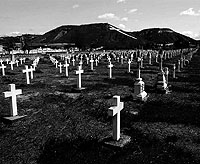
Paracuellos - 75th anniversary


[On the 70th anniversary of the Passion of Spain, in 2006, our special series included as one of its most relevants texts the list of the Martyrs of Paracuellos de Jarama. Since then, several others have been beatified - and 22 will be beatified on December 17. Blogger Francisco Cigüeña, who was present there on Sunday- with only a few hundred others - rightly calls Paracuellos the largest reliquary in the world. These are our martyrs, this is our glorious Church: dear Martyrs of Paracuellos, you who are so dear to Almighty God, pray for Holy Mother Church, pray for Spain! Queen of Martyrs, intercede for us!]

Exactly 75 years ago, on November 7 and November 8 (and from November 28 to November 30), 1936, the largest isolated massacre of Catholics in modern times happened in the outskirts of Madrid, near the foot of a hill called Cerro San Miguel (Saint Michael Hill), in Paracuellos de Jarama.

Many thousands of Catholics were martyred by the forces which defended the Spanish Republic (including Communists, Socialists, and Anarchists), in the most brutal and despicable ways, before and especially during the nearly three years of the Spanish Civil War -- yet no place was as soaked with the blood of martyrs in so short a time as the fields of Paracuellos.