Allowing Doctrinal and Moral Questions:
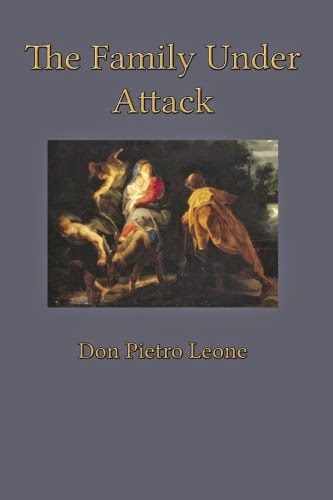
Don Pietro Leone's Searching Book on the Family and the Evasion or Inversion of the Finalities
Drs. Robert & Maike Hickson
“It is difficult to gauge the number of abortions [the destruction of unborn babies] performed per year worldwide, although the World Health Organization estimates a figure of 40-55 million for clinical abortions, and an equally high figure might be estimated for abortions resulting from the use of the interuterine device [the “IUD”] and for the destruction of the unborn resulting from in vitro fertilization. As for those [destructions of life] caused by pills and chemicals in the earliest period...one might reasonably guess that their numbers amount to hundreds, thousands, or millions of millions [of deaths] per year. Such numbers of human lives destroyed each year [by abortion overall] make the genocides of Hitler...and Stalin [and Mao]...seem almost insignificant and, without any doubt whatsoever, [it] exceeds the numbers of human lives destroyed by any other method in the history of mankind. What is perhaps most remarkable about these numbers [of destroyed pre-born children] is not their sheer magnitude, but the mercy of God in allowing the world to continue to exist in light of them.” (Don Pietro Leone, The Family Under Attack (2014), pp. 175-176—my emphasis added)
***
“What divides the two doctrines [the Traditional and the Novel] is their respective visions of the family: its primary finality [the “matrimoniae finis primarius”] and, consequently, its size and the possibility of limiting its size....To show that the novel doctrine is not unambiguously modernist [“the only justification for giving such confused and confusing texts a Catholic interpretation” (152)], one would have to explain [about this 1968 encyclical, Humanae Vitae's “unhappy synthesis of two opposing tendencies” (152)] that it can give the finality of love priority over the finality of procreation only chronologically; that the responsibility that it [“the novel doctrine” with its novel “natural birth control”] advocates cannot... exclude generosity, but [such mature responsibility] must entail the attitude whereby parents accept the number of children that God in His Providence wishes to send, and at the time He wishes to send them. This is then how we [faithfully try to] interpret the modern [contemporary] magisterial doctrine on these issues, observing in passing that it [i.e., our strained “hermeneutic”] is a symptom of a grave crisis in the Church that the Magisterium, the function of which is to deepen and clarify Catholic doctrine, has in the last forty to fifty years been producing texts obscure or misleading, which cannot be understood without expert theological exegesis.” (Don Pietro Leone, The Family Under Attack, pp. 152-153)
***
“We begin with the Declaration of the Holy See in March 1944 (AAS XXVI p. 103) concerning the modern authors who deny the absolute priority of the procreative finality of marriage. It observes inter alia that certain [modern] authors take as the primary finality: 'the reciprocal love of the spouses and their union to be developed and perfected by the physical and spiritual gift of their own person' [We—says Don Pietro Leone himself in this longer bracket and footnote—are not far from Familiaris Consortio here [22 November 1981]. We can trace the inversion of the finalities of marriage in the present [2014] Magisterium to the 'modern authors', through the personalism of Pope Paul VI...and the new theories bruited about on the floor of the [Vatican] Council [1962-1965], even by cardinals such as Léger and Suenens, which reduced the importance of the procreative purpose of marriage and opened the way to its frustration by elevating its unitive end and the gift of self to an equal or higher level (cf. Romano Amerio, Iota Unum, s.46).]” (Don Pietro Leone, The Family Under Attack, p. 133—my emphasis added, in both the main text and in the extended footnote referred to and then quoted)
***
“We have been careful clearly to distinguish the natural and the supernatural orders throughout, especially in view of the tendency to confuse them prevalent in contemporary thought....In the recent teaching of the Magisterium on the themes treated in this book, the distancing from the Faith occurs principally by means of confusion of the natural and supernatural orders. This tendency was already manifest in the Second Vatican Council [because of Eclectic Ecumenism, too!]. In the first chapter of 'Die Neue Theologie' (Amis de St. Francois de Sales 1996), the comment of the Jesuit Fr. Henri Bouillard S.J. is quoted that: 'The Second Vatican Council avoided the expression “supernatural” in its principal documents.' In this connection Romano Amerio in Iota Unum points out (at paragraph 253 in chapter 35 on Ecumenism) that in the two documents Ad Gentes and Nostra Aetate (on Ecumenism and the non-Christian religions) the word 'supernatural' did not even appear....Ambiguity and equivocation in matters of the Faith not only confuse the mind but also make it more difficult to lead a good life. They [ambiguity and equivocation] are a danger to souls, acting insidiously in the manner of a slow poison.” (Don Pietro Leone, The Family Under Attack, pp. 1, 55, and 91—my emphasis added)
***
A recent and learned book by Don Pietro Leone, The Family Under Attack (2014), just arrived in the mail as a gift to our family, but it was sent also with a polite invitation and request. This request— made explicitly and especially to my wife—was for her to read and review this deeply thoughtful book, and even in a timely way if it were feasible.
As it turns out, it has not been feasible for my wife to do so in a timely way, in view of some challenging imponderables that surprised us, and given our larger family obligations. But, one evening, when she was looking the other way, her husband deftly snatched the book and began to read it—and then for several hours. He completed the book of 360 pages on the next day, after being especially attentive to the concluding and discerningly critical, two appendices, which were also a sort of recapitulation of the book: Appendix A—“Theology of the Body”; and Appendix B—“Limbo Called Into Question.”