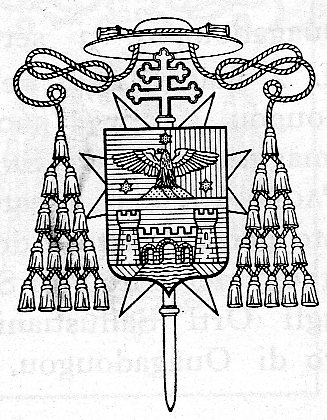
HENRICVS S.R.E. CARD DANTE
PRESB. S. AGATHAE IN VRBE
ROMANVS
5.7.1884 - 24.4.1967
PRESB. S. AGATHAE IN VRBE
ROMANVS
5.7.1884 - 24.4.1967


July 28 is the day of St. Vladimir according to the calendar followed by Russian Greek-Catholics, and July 29 is the day of St. Olaf in the Latin calendar. The Saint Olaf Pilgrimage, organized by Una Voce Russia together with two Catholic parishes, the Latin-rite of St. Nicholas in Luga, and the Byzantine-rite parish of Sts. Cyril and Methodius in St. Petersburg, brought together men and women coming from several places in Russia as well as from Poland and Italy, both Greek-Catholics and Latins, to walk about 100 km in four days, spending nights in improvised tent camps, and assisting at celebrations which both St. Olaf, a Viking turned Christian, and St. Vladimir, the 10th century prince and baptizer of Russia, would have easily recognized as something familiar: the Traditional Latin Mass and its Eastern counterpart, the Divine Liturgy in the Church Slavonic language.
The goal of the pilgrimage was the city of Novgorod, where St. Olaf has spent some time as an exile before returning to Norway to die as a martyr in the battle of Stiklestad. Nowadays Novgorod is the center of Russian Catholics’ veneration of this holy king, promoted by the Catholic parish priest there, Fr. Vladimir Timoshenko. Father Vladimir presented to the pilgrims an icon of Saint Olaf and also pronounced a very moving sermon at the Mass celebrated by Fr. Paolo Giacinti IVE, the parish priest of Luga who also travels regularly to St. Petersburg to say the “old” Mass there. Also of particular interest were three lectures delivered by Greek-Catholic priest Fr. Kirill Mironov.

Next August 31 is the first anniversary of the death of Cardinal Carlo Maria Martini, which we could call "the Baptist", the precursor, the cardinal who, during the long years of the ecclesial "winter-involution" kept alight and upright the Conciliar torch. And it was not easy for him. Rowing against the current is only within the reach of the wise and strong. Dissenting within and from the Church [is something] only the saints and prophets can do.I do not believe I exaggerate if I say that, in a certain sense, Bergoglio is Martini's son.
CONGREGATIO DE CULTU DIVINO ET DISCIPLINA SACRAMENTORUM
There was once an empty Chair. It was left vacant up until the very last minute on the 22nd of June, with no plausible explanation from Pope Francis, as he deserted the concert offered in his honour in the packed Aula Nervi of Paul VI.Now the Chair is occupied. Not by the Pope, however, but by an Argentinian football [soccer] star, Ezequiel “El Pocho” Lavezzi, and surrounded by his jubilant team-mates.

It happened on the 13th of August, in the Sala Clementina of the Apostolic Palace, at the end of the meeting between Pope Jorge Mario Bergoglio and the Italian and Argentinean national football teams.While the Italian footballers politely waited in line to greet the Pope, the Argentinians, in disorder, crowded around him, to such an extent that it made him exclaim: “Here in the Vatican they criticize me, and call me undisciplined: now they have seen my race!”In giving news of the meeting , L’Osservatore Romano spoke of the “uncontainable exuberance” of the Argentine players, “with the Chair guards having their hands full keeping an eye on everything.”But the Vatican paper was careful not to publish the photo of the occupied Chair, which instead, was diffused on Twitter by the protagonist of the bravado.As for the Chair guards, seeing that the Master of the House let it happen, they were not able to intervene in defense of the sacred Chair, and so were not even able to give honour to their name. Has the reform of the Curia already begun?

The fact that the Sorrowful Virgin is elected and invoked as the Patron of a good death wonderfully corresponds to Catholic doctrine and to the pious Tradition of the Church. (...)
Because the Doctors of the Church by common consent profess that, if the Most Blessed Virgin did not apparently have any participation in the public life of Jesus Christ, and then suddenly reappeared on the path to Calvary and under the Cross, she could not have been present without Divine design. For, as she suffered and almost died together with her suffering and dying Son, she gave up her rights as mother over this Son for the salvation of men and, to appease Divine justice, she, as much as it pertained to her [quantum ad se pertinebat], immolated Him, so that it can be said appropriately that she has, together with Christ, redeemed the human race [Ipsam cum Christo humanum genus redemisse].
But if for this reason, every kind of grace we receive from the treasury of the redemption is ministered as it were through the hands of the same Sorrowful Virgin, everyone can see that a holy death should be expected from her, since it is precisely by this gift that the work of the Redemption is effectively and permanently completed in each one. (...)
... further, there is a most constant belief among the faithful, proved by long experience, that as many as employ the same Virgin as Patron will not at all perish forever.

On the feast of the Assumption of Our Lady the Priestly Fraternity of Saint Peter (F.S.S.P.) had their church of the Maternal Heart of Mary, in Sydney Australia, constituted a personal parish by George Cardinal Pell, archbishop of Sydney. Fr Duncan Wong, F.S.S.P. was appointed as the parish priest. Being a personal parish of the F.S.S.P. it is dedicated exclusively to the celebration of the Traditional Mass.The first Solemn High Mass to be celebrated in the newly erected parish was celebrated by the parish priest, Fr Wong. Fr Damonn Sypher F.S.S.P. was Deacon, and Mr Daniel Mould F.S.S.P. was Subdeacon.


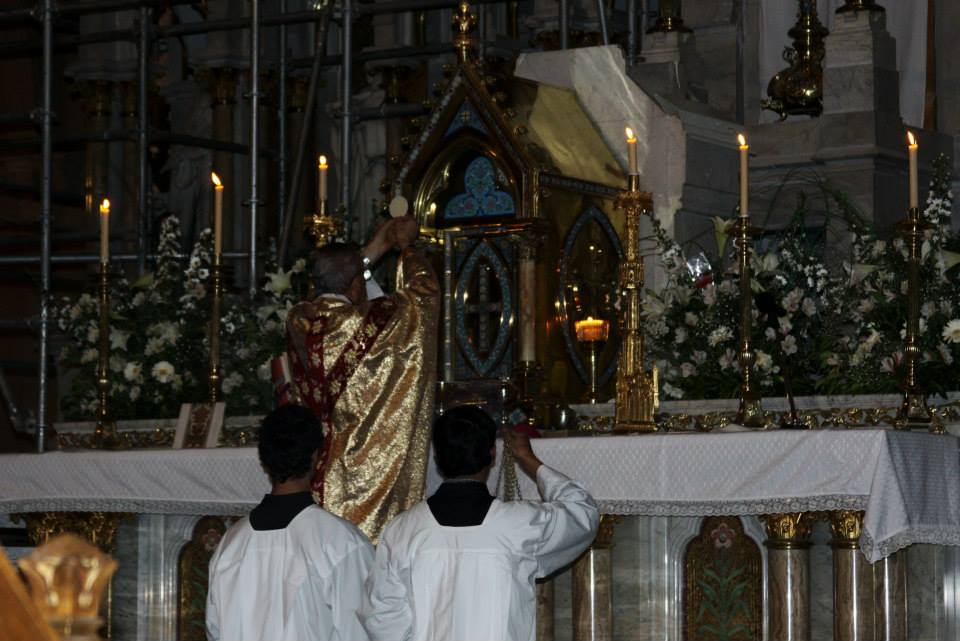
During the past weekend (Saturday, Sunday and Monday), the 4th National Pilgrimage of Our Lady of Christendom in Argentina took place, from Rawson, Province of Buenos Aires, to the Basilica of the National Shrine of Our Lady of Luján, the National Patroness of Argentina, in the same Province.The pilgrimage lasted for three days with the celebration of public Masses in the Extraordinary Forum on each one of them - the last one, inside the Basilica, celebrated by Archbishop A. Baseotto, emeritus of the Military Ordinariate (image below).
 |
| The Cardinal-Patriarch in a pastoral journey in the Bassano del Grappa area, Aug. 1901 |
 |
| The Relics of St.Pius X in Venice, 1959 |
The 100th year since the holy death of the brilliant and great Pope Saint Pius X, begins in the Americas tonight at 8:15 Eastern Time. The great-hearted Pontiff "fell asleep in the Lord" 99 years ago on August 20 at 1:15 a.m., local Roman time. This is his "Dies natalis", his birthday into paradise.
So, the holy Centennial Year begins.

I brought you into the land of Carmel,
to eat the fruit thereof, and the best things thereof:
and when ye entered in, you defiled my land,
and made my inheritance an abomination.
The priests did not say: Where is the Lord?
and they that held the law knew me not,
and the pastors transgressed against me:
and the prophets prophesied in Baal, and followed idols. ...
If a nation hath changed their gods,
and indeed they are not gods:
but my people have changed their glory into an idol.
Be astonished, O ye heavens, at this,
and ye gates thereof, be very desolate, saith the Lord. ...
Thy own wickedness shall reprove thee,
and thy apostasy shall rebuke thee.
Know thou, and see that it is an evil
and a bitter thing for thee to have left the Lord thy God,
and that my fear is not with thee, saith the Lord the God of hosts. ...
Why dost thou endeavour
to shew thy way good to seek my love,
thou who has also taught thy malices to be thy ways,
And in thy skirts is found the blood
of the souls of the poor and innocent? ...
And thou hast said: "I am without sin and am innocent:
and therefore let thy anger be turned away from me."
Behold, I will contend with thee in judgement,
because thou hast said: "I have not sinned." ...
From thence thou shalt go,
and thy hand shall be upon thy head:
for the Lord hath destroyed thy trust,
and thou shalt have nothing prosperous therein. ...
For from the least of them even to the greatest,
all are given to covetousness:
and from the prophet even to the priest,
all are guilty of deceit.
And they healed the breach of the daughter of my people disgracefully,
saying: "Peace, peace": and there was no peace.
They were confounded, because they committed abomination:
yea, rather they were not confounded with confusion,
and they knew not how to blush:
wherefore they shall fall among them that fall:
in the time of their visitation
they shall fall down, saith the Lord.

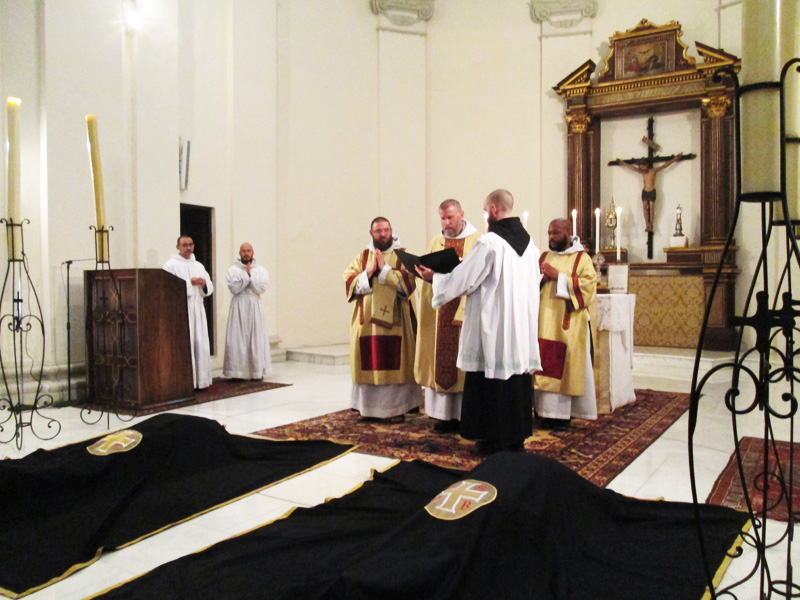
On Saturday August 3, 2013, Br. Michael Reyes, O.S.B. and Br. Francis Davoren, O.S.B. of the Monastery of San Benedetto in Norcia, Italy made their solemn profession in the Basilica built over St. Benedict and St. Scholastica’s birthplace. This marks the first time that two of our monks made their vows at the same time.The community in Norcia now numbers 17 monks, with 11 in solemn vows. The attached photos show the traditional mystical burial of the monks, as well as a close up of the two newly-professed at the reception after the Mass.
I was born in Ireland in 1962 and served the Latin Mass a few times just before the NO was introduced and we were 're-trained'. I abandoned my faith in my mid teens but life without God left me unhappy and thanks be to God, I had returned to my faith through a sometimes painful journey by the time I was 24.
The life of faith is a journey and some of our own journey follows. I do not tell families how to live their lives as each family is different but there are some Catholic practices which will help any family that adopts them.
Married life began when I was 26 and my wife was 23. We were open to life and we were just an ordinary everyday very average Novus Ordo Catholic couple.


The Coptic Orthodox Church of Egypt is following closely the unfortunate incidents occurring in our nation and confirms its strong support of the Egyptian law enforcement, the armed forces, and all civil Egyptian institutions in confronting violent armed organizations and dark malicious forces, both internal and external. The attacks on our government entities and peaceful churches are terrorizing our citizens both Coptic and Muslim. These actions stand against all religions, morality, and humanity.
We value the stance of the friendly and loyal countries who understand the nature of these events. We strongly denounce the fallacies broadcasted by the western media and invite them to review the facts objectively regarding these bloody radical organizations and their affiliates instead of legitimizing them with global support and political protection while they attempt to spread devastation and destruction in our dear land. We request that the international and western media adhere to providing a comprehensive account of all events with truth, accuracy, and honesty.
Our sincere condolences are extended to all the victims and martyrs of duty that gave their lives, and we pray for the recovery of all those injured and afflicted. We persevere in our strong national unity and repulse any attempts to polarize our great nation into a secular conflict. We absolutely reject even partial foreign interference in our internal affairs. As the hand of evil extends to burn, kill and destroy; the Hands of God are nearer to protect, strengthen, and build. We have full faith and confidence in the Divine intervention that will navigate the Egyptian people in this delicate time of our history to a better tomorrow and a brighter future filled with justice, peace, and democracy that the people of the Nile Valley so rightly deserve.
Two years ago, I met him in the shrine of [the Madonna of] Zuccarello di Nembro, near Bergamo, for the Mass in memory of his mother. He was seating in the sacristy, folded on the chair, finding it hard even to answer back those who greeted him. "How is Father Stefano?" He opened his arms as much as he could and whispered, "He is like this, on the cross". I had just written a book on Padre Pio with Mario Palmaro, but only when faced with that spiritual son of his I finally experienced a small bit of true compassion for the suffering I had unworthily described with words.Three months ago, I saw him again, shortly before the bomb of the intervention exploded. He was restless, but more for the future of the Church than for that of his foundation. "Now, only the triumph of the Immaculate Heart of Mary can save us. We are at that time that Padre Pio called of the 'four Ts': tutte tenebre [all darkness, total darkness]". "And what can we do, Father?" "We must prepare, pray, and continue the struggle. And then," he added with that smile of his, a little as that an old man, and a little as that of a child, "there are the 'four Ts' of light: all Franciscans of the Immaculate".We were at Sassoferrato, in the seminary of the order. A huge building emptied of vocations by the Conventual Friars Minor and replenished by the Franciscans of the Immaculate. A building in which these friars who greet everyone with the splendid 'Ave Maria' live side by side with Lady Poverty. In their houses, poverty is the true one, not that shown to the photographers' cameras nor that preached to others. It is lived truly and one can literally breathe it as soon as one crosses the threshold of any of their convents. Not in the churches, because there, as father Francis wanted, all things must be as splendid as possible for the Lord. But in their houses only those who decide and accept to be truly poor can live.
The mystery play of Elche is a sacred musical drama of the death, the passage into heaven (known as the Assumption) and the crowning of the Virgin Mary. Since the mid-fifteenth century it has been performed in the Basilica of Santa Maria and in the streets of the old city of Elche, situated in the region of Valencia. It is a living testimony of European religious theatre of the Middle Ages and of the cult of the Virgin.
This theatrical performance, which is entirely sung, comprises two acts, performed on 14 and 15 August. These depict the death and crowning of the Virgin in a series of scenes and related paintings: the death of Mary, the night procession that is followed by hundreds of participants carrying candles, the morning procession, the afternoon funeral procession in the streets of Elche, and the enactment of the burial, Assumption and coronation in the Basilica.
 |
| Copts pray inside the Church of St. Moses (Moussa), destroyed by Muslim rioters in Minya, Egypt, Aug. 14-15, 2013 |
In matters political Islam is a system of despotism at home and of aggression abroad. The Prophet commanded absolute submission to the imam. In no case was the sword to be raised against him. The rights of non-Moslem subjects are of the vaguest and most limited kind, and a religious war is a sacred duty whenever there is a chance of success against the "Infidel". Medieval and modern Mohammedan, especially Turkish, persecutions of both Jews and Christians are perhaps the best illustration of this fanatical religious and political spirit.
The university [of Bonn] was also very proud of its two theological faculties. It was clear that, by inquiring about the reasonableness of faith, they too carried out a work which is necessarily part of the "whole" of the universitas scientiarum, even if not everyone could share the faith which theologians seek to correlate with reason as a whole. This profound sense of coherence within the universe of reason was not troubled, even when it was once reported that a colleague had said there was something odd about our university: it had two faculties devoted to something that did not exist: God. That even in the face of such radical scepticism it is still necessary and reasonable to raise the question of God through the use of reason, and to do so in the context of the tradition of the Christian faith: this, within the university as a whole, was accepted without question.I was reminded of all this recently, when I read the edition by Professor Theodore Khoury (Münster) of part of the dialogue carried on - perhaps in 1391 in the winter barracks near Ankara - by the erudite Byzantine emperor Manuel II Paleologus and an educated Persian on the subject of Christianity and Islam, and the truth of both. It was presumably the emperor himself who set down this dialogue, during the siege of Constantinople between 1394 and 1402; and this would explain why his arguments are given in greater detail than those of his Persian interlocutor. The dialogue ranges widely over the structures of faith contained in the Bible and in the Qur'an, and deals especially with the image of God and of man, while necessarily returning repeatedly to the relationship between - as they were called - three "Laws" or "rules of life": the Old Testament, the New Testament and the Qur'an. It is not my intention to discuss this question in the present lecture; here I would like to discuss only one point - itself rather marginal to the dialogue as a whole - which, in the context of the issue of "faith and reason", I found interesting and which can serve as the starting-point for my reflections on this issue.In the seventh conversation (διάλεξις - controversy) edited by Professor Khoury, the emperor touches on the theme of the holy war. The emperor must have known that surah 2, 256 reads: "There is no compulsion in religion". According to some of the experts, this is probably one of the suras of the early period, when Mohammed was still powerless and under threat. But naturally the emperor also knew the instructions, developed later and recorded in the Qur'an, concerning holy war. Without descending to details, such as the difference in treatment accorded to those who have the "Book" and the "infidels", he addresses his interlocutor with a startling brusqueness, a brusqueness that we find unacceptable, on the central question about the relationship between religion and violence in general, saying: "Show me just what Mohammed brought that was new, and there you will find things only evil and inhuman, such as his command to spread by the sword the faith he preached.” The emperor, after having expressed himself so forcefully, goes on to explain in detail the reasons why spreading the faith through violence is something unreasonable. Violence is incompatible with the nature of God and the nature of the soul. "God", he says, "is not pleased by blood - and not acting reasonably (σὺν λόγω) is contrary to God's nature. Faith is born of the soul, not the body. Whoever would lead someone to faith needs the ability to speak well and to reason properly, without violence and threats... To convince a reasonable soul, one does not need a strong arm, or weapons of any kind, or any other means of threatening a person with death...".The decisive statement in this argument against violent conversion is this: not to act in accordance with reason is contrary to God's nature. The editor, Theodore Khoury, observes: For the emperor, as a Byzantine shaped by Greek philosophy, this statement is self-evident. But for Muslim teaching, God is absolutely transcendent. His will is not bound up with any of our categories, even that of rationality.


"Factum est autem dum irent et ipse intravit in quoddam castellum, et mulier quaedam Martha nomine excepit illum in domum suam. Et huic erat soror nomine Maria, quae etiam sedens secus pedes Domini audiebat verbum illius. Martha autem satagebat circa frequens ministerium, quae stetit et ait, Domine non est tibi curae quod soror mea reliquit me solam ministrare? Dic ergo illi ut me adiuvet. Et respondens dixit illi Dominus, Martha, Martha, sollicita es et turbaris erga plurima, porro unum est necessarium. Maria optimam partem elegit quae non auferetur ab ea."
"Now it came to pass, as they went, that he entered into a certain town: and a certain woman named Martha received him into her house. And she had a sister called Mary. who, sitting also at the Lord's feet, heard his word. But Martha was busy about much serving. Who stood and said: Lord, hast thou no care that my sister hath left me alone to serve? Speak to her therefore, that she help me. And the Lord answering, said to her: Martha, Martha, thou art careful and art troubled about many things: But one thing is necessary. Mary hath chosen the best part, which shall not be taken away from her."
Luke 10:38-42, Gospel pericope for the Feast of the Assumption in the pre-1950 Roman Missal

"Quapropter, postquam supplices etiam atque etiam ad Deum admovimus preces, ac Veritatis Spiritus lumen invocavimus, ad Omnipotentis Dei gloriam, qui peculiarem benevolentiam suam Mariae Virgini dilargitus est, ad sui Filii honorem, immortalis saeculorum Regis ac peccati mortisque victoris, ad eiusdem augustae Matris augendam gloriam et ad totius Ecclesiae gaudium exsultationemque, auctoritate Domini Nostri Iesu Christi, Beatorum Apostolorum Petri et Pauli ac Nostra pronuntiamus, declaramus et definimus divinitus revelatum dogma esse : Immaculatam Deiparam semper Virginem Mariam, expleto terrestris vitae cursu, fuisse corpore et anima ad caelestem gloriam assumptam".
Pius P. P. XII, Constitutio apostolica Munificentissimus Deus, A. D. 1950

 |
| There the King comes, and his avant-garde with flowers in their hands Corpus Christi of the St.-Eugène/Ste.-Cécile community, Paris (by G.Bridault) |


